 Home
HomeSettling of an unresolved particle
This case id the unresolved variant of Settling of a resolved particle. In terms of the geometry and setup this case is identical to the resolved variant of this case the main difference is in the used models and the significantly lower resolution.
Note
This case is located in CFDEMcoupling/validationCases/settlingTest_unresolved_Pianet2007.
Models used
Particle forces:
The drag force is computed by the DiFelice drag model.
Alteration of effective gravity forces due to the difference of fluid and particle densities is modelled by the Archimedes force model.
Particles are mapped to CFD by the engine locateModel.
The voidfraction is computed by the divided voidfraction model. The voidfraction is limited to unity and, hence, effectively ignored.
Momentum exchange between particles and fluid is computed in an implicit manner, see Zhou et al. (2010), JFM.
The case runs using cfdemSolverPiso. However, this case skips the solution of the
Navier-Stokes equations using the setting couplingProperties/solveFlow false. This
setting results in discarding particle impact on the fluid altogether and is a reasonable
assumption for this unresolved setup as it computes drag with the undisturbed fluid
velocity and, thus, the particles travels through a fluid at rest.
The case, moreover, uses and added mass which is set in the enable_cfd_coupling command
on the DEM side.
Results
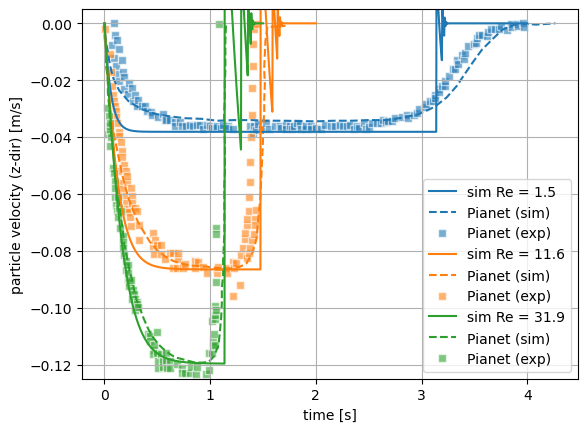
Figure 2: Experimental and numerical velocity of the falling particle
for different Reynolds numbers. In the current setup the particle collides with the
bottom wall at the end of the simulation. In contrast to the resolved simulation,
the particle does not slow down prior to collision as the Navier-Stokes equations
are not solved, compare the velocity curve for  .
Consequently, the rebound after collision is substantially more notable in the
unresolved case.
Moreover, please note that the experimental results from
Pianet et al. comprise two experimental campaigns.
.
Consequently, the rebound after collision is substantially more notable in the
unresolved case.
Moreover, please note that the experimental results from
Pianet et al. comprise two experimental campaigns.
Literature
[1] G. Pianet, et al. Assessment of the 1-fluid method for DNS of particulate flows: Sedimentation of a single sphere at moderate to high Reynolds numbers. Computers & fluids 36.2 (2007): 359-375.