 Home
HomePurpose
Force model to account for the drag force according to the correlation by DiFelice.
Note
This model or solver is supported by CFDEMcoupling on GPU devices.DiFeliceDrag
Syntax
Defined in couplingProperties dictionary.
forceModels
(
    DiFeliceDrag
);
DiFeliceDragProps
{
    velFieldName         word;
    voidfractionFieldName word;
    granVelFieldName     word;
    voidfractionInterpolationType word;
    UInterpolationType   word;
    suppressProbe        switch;

    // (optional) forceSubModel switches
    scaleDrag            scalar;
    scaleDH              scalar;
    treatForceExplicit   switch;
    implForceDEM         switch;
    verbose              switch;
    interpolation        switch;
    scalarViscosity      switch;
    voidageFunctionDiFelice switch;
    voidageFunctionRong  switch;
    voidageFunctionTang  switch;
    nu                   scalar;
};
velFieldName = name of the finite volume fluid velocity field (default: “U”)
voidfractionFieldName = name of the finite volume voidfraction field (default: “voidfraction”)
granVelFieldName = name of the finite volume granular velocity field (default: “Us”)
interpolation = flag to use interpolated voidfraction and velocity values (default: false)
voidfractionInterpolationType = interpolation type for voidfraction field (default: “cellPoint”)
UInterpolationType = interpolation type for velocity field (default: “cellPointFace”)
suppressProbe = can be used to suppress the output of the probe model (default: false)
This forceModel reads the following forceSubModel switches and overwrites the defaults as indicated in parentheses:
scaleDrag
scaleDH
treatForceExplicit
implForceDEM (default: true)
verbose
interpolation
scalarViscosity
voidageFunctionDiFelice (default: true)
voidageFunctionRong
voidageFunctionTang
particleSpecificCG
Examples
forceModels
(
    DiFeliceDrag
);
DiFeliceDragProps
{
    velFieldName "U";
    interpolation true;
}
Description
Calculates the particle based drag force following the correlation of Di Felice (see [1] and [2]):
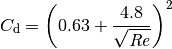
with 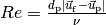 being the particle Reynolds number based on the particle diameter
  and the fluid kinematic viscosity
  .
.
By default, the drag is corrected by the Di Felice voidage correction
 with
with

Refer to forceSubModel for more details and options.
If particleShapeType multisphere is selected, caluclations are performed
for multisphere particles. For superquadric and convex particles, this model uses the
diameter of particle bounding sphere.
Literature
[1] R. Di Felice. “The voidage function for fluid-particle interaction systems”. International Journal of Multiphase Flow 20 (1994): 153-159.
[2] Z. Y. Zhou, S.B. Kuang, K.W. Chu and A. B. Yu. “Discrete particle simulation of particle-fluid flow: model formulations and their applicability”. Journal of Fluid Mechanics 661 (2010): 482-510
Restrictions
None.