 Home
HomeHoelzerSommerfeldDrag
Syntax
Defined in couplingProperties dictionary.
forceModels
(
    HoelzerSommerfeldDrag
);
HoelzerSommerfeldDragProps
{
    velFieldName        "U";
    voidfractionFieldName "voidfraction";
    granVelFieldName    "Us";
    interpolation       switch;
    voidfractionInterpolationType word;
    UInterpolationType  word;
    suppressProbe       switch;
    ignoreTorque        switch;
    particleShape       word;
    crossArea
    {
        t1 table;
        t2 table;
        ...
    }
    sqAngleDiscretization label;

    // (optional) forceSubModel switches
    scaleDrag           scalar;
    scaleDH             scalar;
    scaleTorque         scalar;
    treatForceExplicit  switch;
    implForceDEM        switch;
    verbose             switch;
    scalarViscosity     switch;
    voidageFunctionDiFelice switch;
    voidageFunctionRong switch;
    voidageFunctionTang switch;
    nu                  scalar;
};
velFieldName = name of the finite volume fluid velocity field (default: “U”)
voidfractionFieldName = name of the finite volume voidfraction field (default: “voidfraction”)
granVelFieldName = name of the finite volume granular velocity field (default: “Us”)
interpolation = flag to use interpolated voidfraction and velocity values (default: false)
voidfractionInterpolationType = interpolation type for voidfraction field (default: “cellPoint”)
UInterpolationType = interpolation type for velocity field (default: “cellPointFace”)
suppressProbe = can be used to suppress the output of the probe model (default: false)
ignoreTorque = calculate and apply torque based on hydraulic sphere, cf. Hilton & Cleary, 2011. (default: false)
particleShape = particle shape (default:
clump) , further recognized values:fiber,fiber2. Decides if cross section area are computed for a fiber or a clump (default) where the hydraulic diamter is used instead. Both fiber modes are only valid for multisphere particles where the spheres form a straight and single line. The two fiber modes differ in how the fiber cross section is computed:fiberThe fiber length is computed from difference of the volume of all spheres and the clump volume determined in Aspherix. The cross section then depends on the particle orientation and is computed as if the fiber was a cylindric particle. This approach is only valid for multispheres where neighboring particles touch or overlap.fiber2The fiber length is computed from the clump volume scaled by thescaleVolparameter as defined in the voidfraction model. For fibers where the constituating spheres touch this will result in shorter fiber lengths than modefiber1. The cross section then depends on the particle orientation and is computed as if the fiber was a cylindric particle. This approach is only valid for multispheres where neighboring particles touch or there is a gap between them.
Note
The
particleShapesetting is only valid for multisphere particles.crossArea = dictionaries specifying the projected particle cross section for different angles. One dictionary per clump type.
Note
The
crossAreamust be defined for convex particles.sqAngleDiscretization = number of discrete steps for calculation of the particle’s cross sectional area. The cross section is dicretized with the indicated number of equidistant angular steps (per half-section due to symmetry). This means, the default setting will split the cross section into 16 triangular sections with a center angle of 22.5 degree around the particle origin. For a circle this discretization results in a reasonably accurate result at low cost. (default: 8)
Note
This setting is only used for superquadric particles.
Note
Increasing the number of points may severely affect simulation performance. Using a very low number of points may have adverse effects on simulation accuracy.
This forceModel reads the following forceSubModel switches and overwrites the defaults as indicated in parentheses:
scaleDrag
scaleDH
scaleTorque
treatForceExplicit
implForceDEM (default: true)
verbose
interpolation
scalarViscosity
voidageFunctionDiFelice
voidageFunctionRong (default: true)
voidageFunctionTang
For particleShapeType = "multipshere" and particleShapeType = "superquadric"
the followings switches are read in addition:
implTorqueDEM
Examples
forceModels
(
    HoelzerSommerfeldDrag
);
HoelzerSommerfeldDragProps
{
    velFieldName "U";
    interpolation true;
}
Description
The force model performs the calculation of forces (e.g. fluid-particle interaction forces) acting on each DEM particle. The HoelzerSommerfeldDrag model is a model that calculates the particle based drag force following the correlation of Hoelzer and Sommerfeld (2008) accompanied by the voidfraction correlation of Di Felice (see Zhou et al. (2010), JFM).
Code of this forceModel contributed by Alexander Podlozhnyuk, DCS Computing GmbH.
Note
The HoelzerSommerfeld drag law uses, as a characteristic area, the cross-sectional area of the particle perpendicular to the relative fluid velocity.
Note
For particleShapeType convex the surface area for all particle templates
must be specified by the user in the particleShapeProps sub-dictionary.
The sqAngleDiscretization sets the number of discrete steps for calculation
of the particle’s cross sectional area, see Fig. 1 . Due to symmetry only half
the cross section is descretized. This half is diveded with the indicated number
of equidistant angular steps. This means, the default setting will split the cross
section into 16 triangular sections with a center angle of 22.5 degrees around the
particle origin.
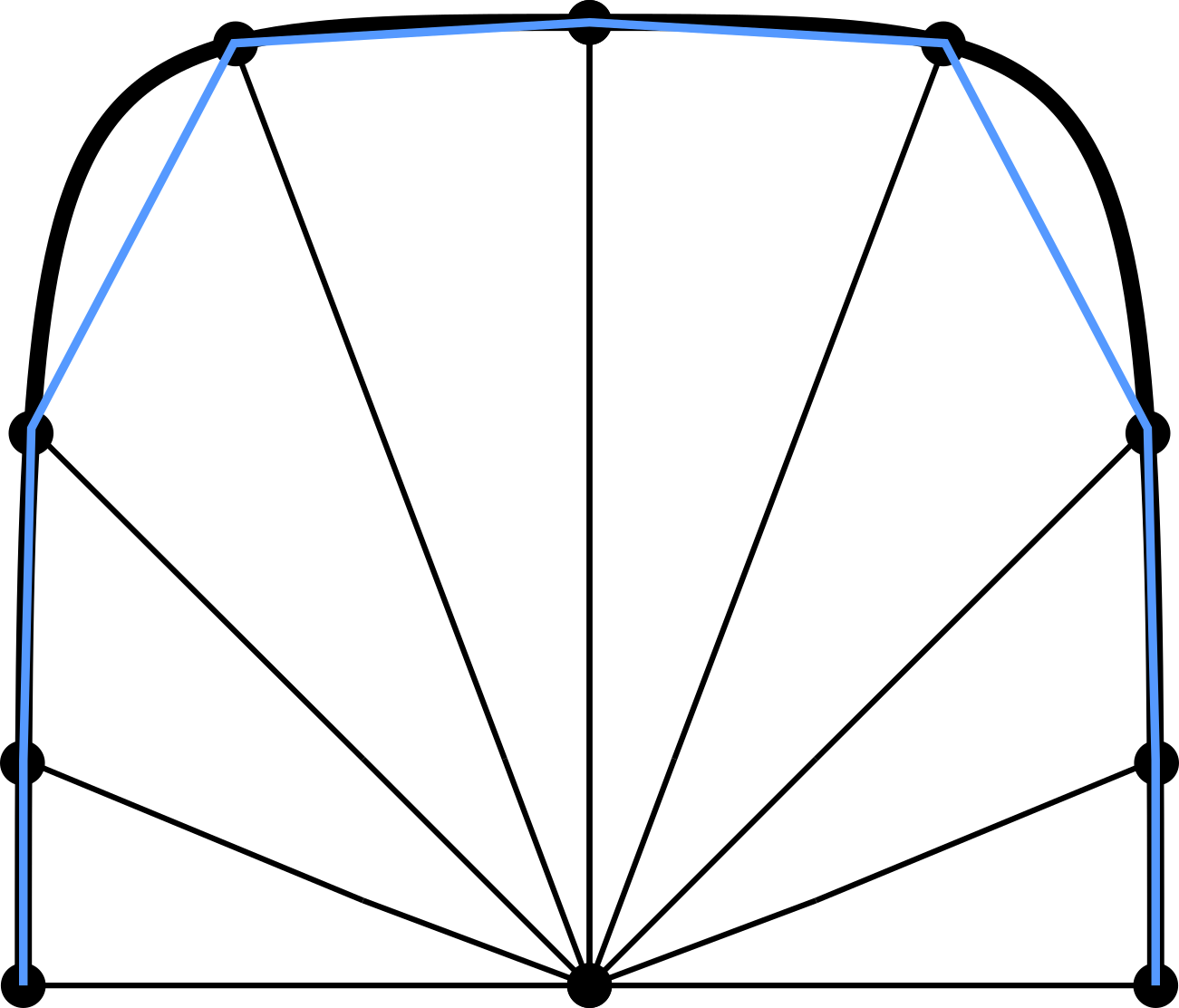
Figure 1: Division of a superquadric cross setion into the default eight sections and resulting approximation of shape and cross section in blue.
Restrictions
None.