 Home
HomeSchillerNaumannDrag
Syntax
Defined in couplingProperties dictionary.
forceModels
(
    SchillerNaumannDrag
);
SchillerNaumannDragProps
{
    velFieldName     "U";
    voidfractionFieldName "voidfraction";
    interpolation    "bool1";
    voidfractionInterpolationType "type1"
    UInterpolationType   "type2"

    // (optional) forceSubModel switches
    implForceDEM     switch;
};
velFieldName = name of the finite volume fluid velocity field (default: “U”)
voidfractionFieldName = name of the finite volume voidfraction field (default: “voidfraction”)
interpolation = flag to use interpolated voidfraction and fluid velocity values (default: false)
voidfractionInterpolationType = interpolation type for voidfraction field (default: “cellPoint”)
UInterpolationType = interpolation type for velocity field (default: “cellPointFace”)
This forceModel reads the following forceSubModel switches and overwrites the defaults as indicated in parentheses:
scaleDrag
scaleDH
treatForceExplicit
implForceDEM (default: true)
verbose
interpolation
scalarViscosity
Examples
forceModels
(
    SchillerNaumannDrag
);
SchillerNaumannDragProps
{
    velFieldName "U";
}
Description
Calculates the particle based drag force following the correlation of Schiller and Naumann for the particle drag coefficient:

with 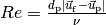 being the particle Reynolds number based on the particle diameter
  and the fluid kinematic viscosity
  .
.
The drag coefficient is limited to 
This drag model is only defined for spherical particles.
Restrictions
None.