 Home
HomeKochHillDrag
Syntax
Defined in couplingProperties dictionary.
forceModels
(
    KochHillDrag
);
KochHillDragProps
{
    velFieldName        word;
    voidfractionFieldName word;
    granVelFieldName    word;
    voidfractionInterpolationType word;
    UInterpolationType  word;
    suppressProbe       switch;

    // (optional) forceSubModel switches
    interpolation       switch;
    implForceDEM        switch;
    scaleDrag           scalar;
    scaleDH             scalar;
    treatForceExplicit  switch;
    verbose             switch;
    implForceDEMaccumulated switch;
    scalarViscosity     switch;
    nu                  scalar;
};
velFieldName = name of the finite volume fluid velocity field (default: “U”)
voidfractionFieldName = name of the finite volume voidfraction field (default: “voidfraction”)
granVelFieldName = name of the finite volume granular velocity field (default: “Us”)
suppressProbe = can be used to suppress the output of the probe model (default: false)
This forceModel reads the following forceSubModel switches and overwrites the defaults as indicated in parentheses:
scaleDrag
scaleDH
treatForceExplicit
implForceDEM (default: true)
verbose
interpolation
implForceDEMaccumulated
scalarViscosity
Examples
forceModels
(
    KochHillDrag
);
KochHillDragProps
{
    velFieldName "U";
    voidfractionFieldName "voidfraction";
}
Description
Calculates the particle-based drag force following the correlation of Koch & Hill (see [1] and [2]):
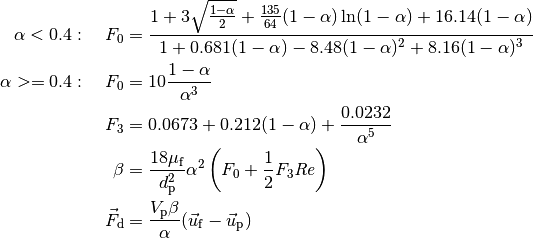
with  the voidfraction and
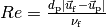 being the particle Reynolds number based on the particle diameter
  and the fluid kinematic viscosity
  .
.
This drag model is only defined for spherical particles. For superquadric and convex particles, this model uses the diameter of particle bounding sphere.
Note
If the hybrid voidfracion model is used the voidfractionFieldName here should match the one set for the selected unresolved voidfraction model.
Literature
[1] D. L. Koch and R. J. Hill. “Inertial effects in suspension and porous-media flows”. Annual Review of Fluid Mechanics 33 (2001): 619–647.
[2] C. Goniva, C. Kloss, N. G. Deen, J. A. M. Kuipers and S. Pirker. “Influence of rolling friction on single spout fluidized bed simulation” Particuology 10 (2012): 582–591.
Restrictions
None.