 Home
HomeperiodicPressure
Syntax
Defined in couplingProperties dictionary.
forceModels
(
    periodicPressure
);
periodicPressureProps
{
    gravityFieldName "g";
    voidfractionFieldName "voidfraction";
    mode             "word";
    targetVelocity   vector;
    p                scalar;
    i                scalar;
    avMixtureDensity scalar;
};
gravityFieldName = name of gravity field
voidfractionFieldName = name of voidfraction field (default: “voidfraction”)
mode = keyword for operation mode, choose
controlledormixtureDensitytargetVelocity = target ensemble average particle velocity (for monodisperse systems) - only for mode
controlledp = proportional constant for controller - only for mode
controlledi = integral constant for controller - only for mode
controlledavMixtureDensity = average density of the mixture in the domain - only for mode
mixtureDensity
This forceModel reads the following forceSubModel switches and overwrites the defaults as indicated in parentheses:
scaleDrag
scaleDH
verbose
Examples
forceModels
(
    periodicPressure
);
periodicPressureProps
{
    gravityFieldName "g";
    voidfractionFieldName "voidfraction";
    mode "controlled";
    targetVelocity (0. 0. 0.);
    p 2500;
    i 1;
}
Description
The force model calculates a force field following two different modi:
controlledandmixtureDensity, which can be used to transform fluid pressure gradient to dynamic pressure gradient which is necessary for periodic boundaries.
With mode controlled the force field is set in a way, that the ensemble
average particle velocity reaches a target velocity.
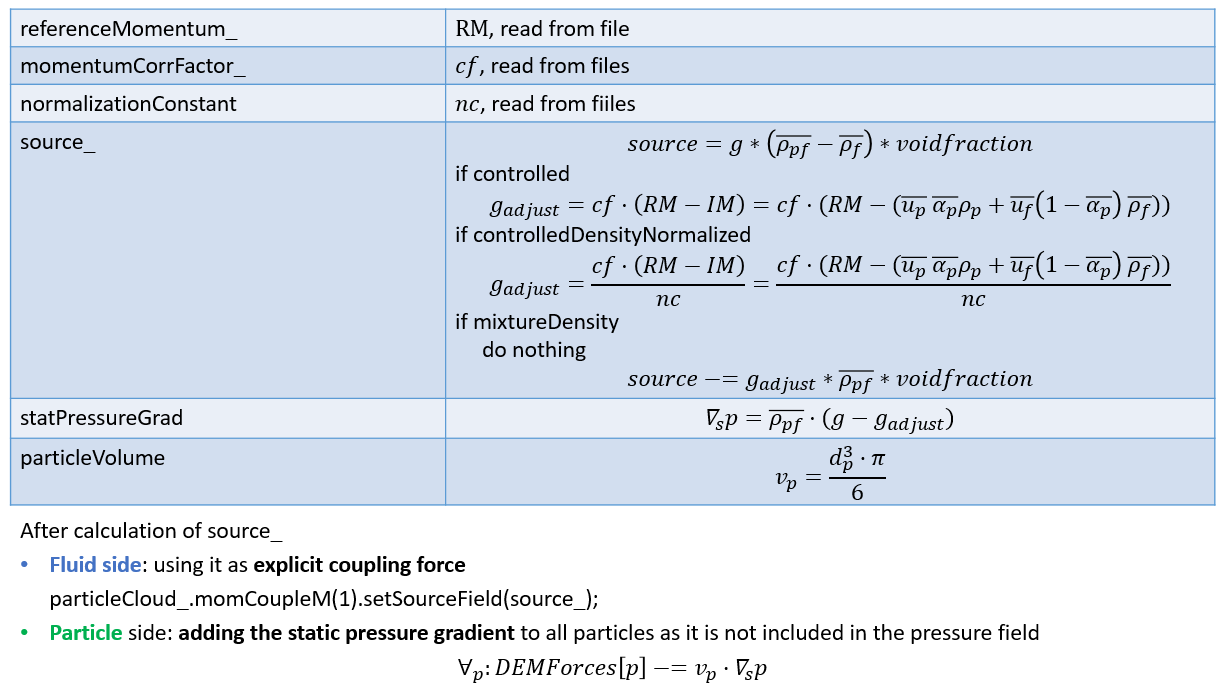
With modus mixtureDensity, a force field rhoMix*g*voidfraction is calculated.
The force is passed to the explicitCoupleSource model via the setSourceField()
function. For theoretical background see
Radl, Girardi and Sundaresan (2012): “Effective drag law for parcel-based approaches
– what can we learn from CFD-DEM?”, ECCOMAS 2012, Vienna.)
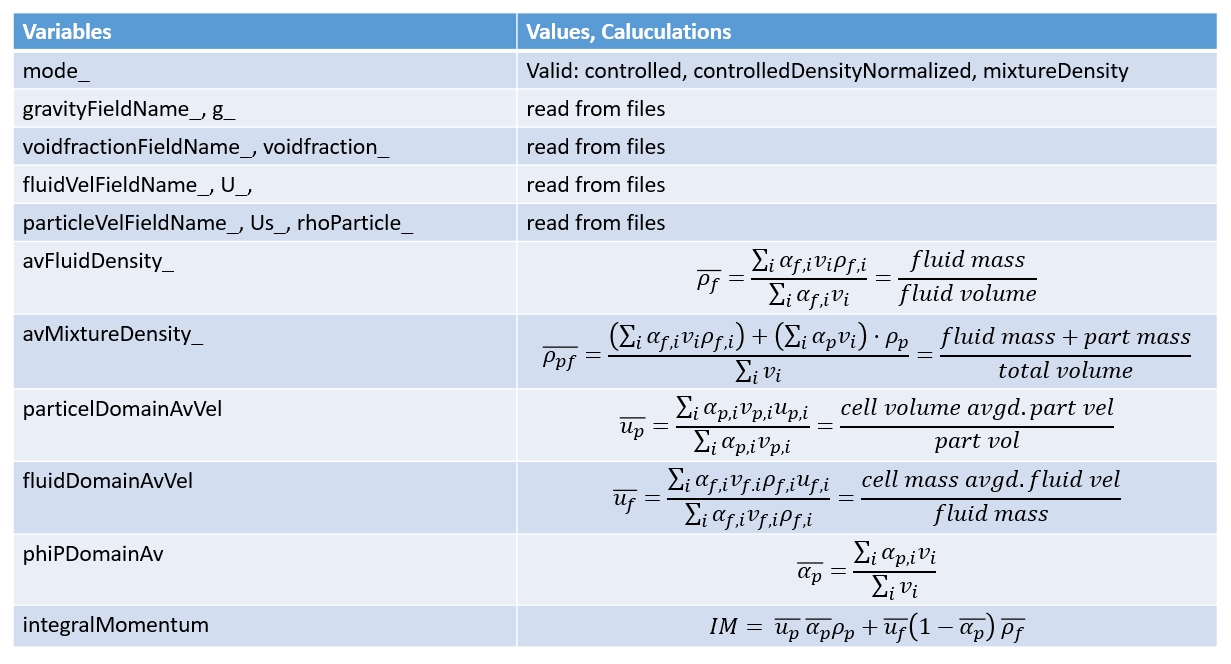
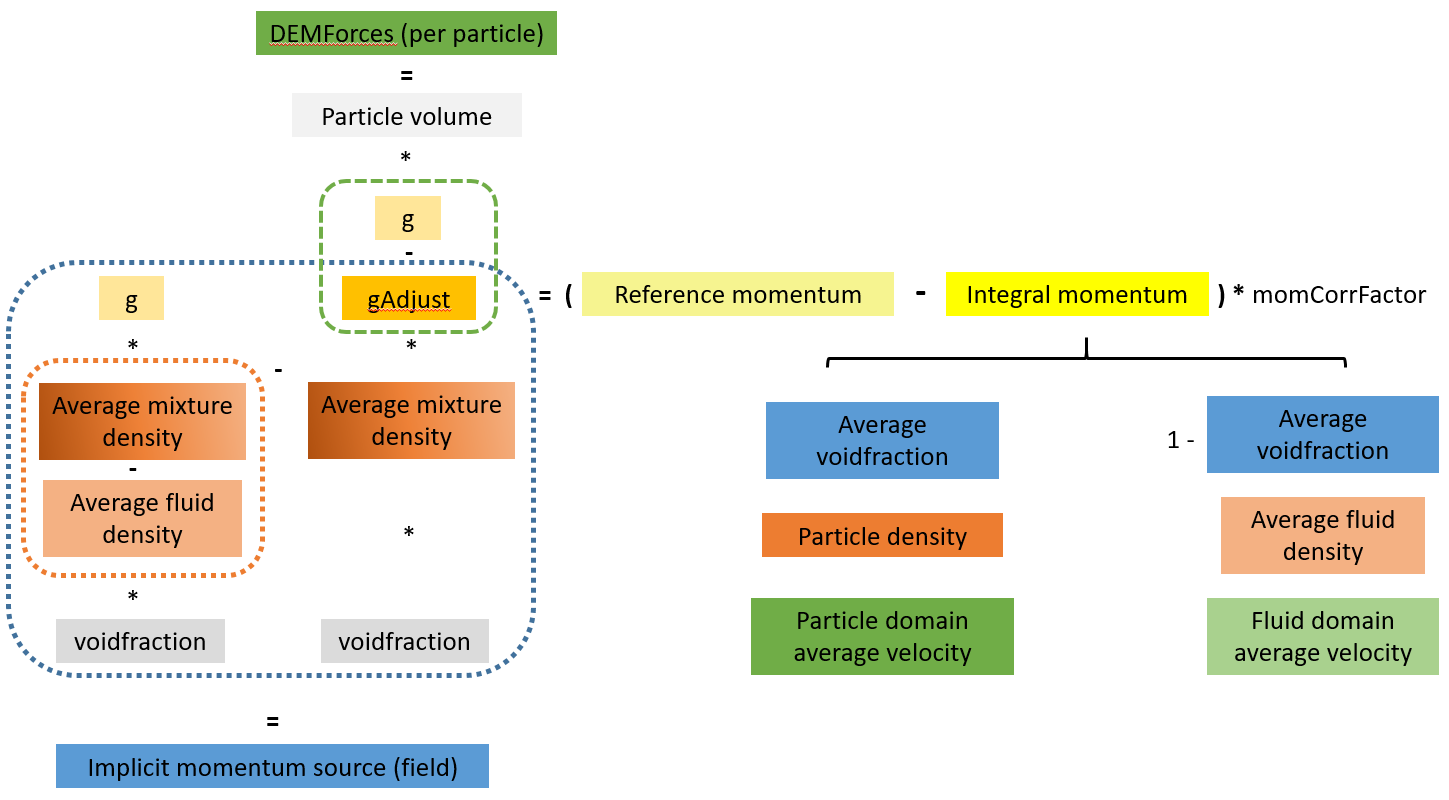
The following images show a brief summary of the equations and an overview of how the force on the CFD and DEM side is calculated:
Restrictions
None.