 Home
HomeSettling of two spheres
The original Glowinski case Glowinski considers two spheres falling in liquid. Both spheres are arranged behind each other such that the trailing one travels in the wake of the leading sphere. Since it experiences less drag, the trailing sphere gains on the leading one, until the spheres finally touch and start to tumble.
Note
This case is located in CFDEMcoupling/validationCases/twoSpheres_Glowinski1999.
Models used
This is a resolved CFD-DEM case using the immersed boundary method (IBM). Consequently models are used that take advantage of the resolved velocity and pressure field around the particle.
Particle forces:
The drag force is computed by the Shirgaonkar model.
Alteration of effective gravity forces due the difference of fluid and particle densities is modelled by the IB variant of the Archimedes force model.
Particles are mapped to CFD cells by a variant of the engine locateModel specifically tailored towards resolved CFD-DEM simulations.
The voidfraction is computed by the IB voidfraction model accounting for large particles.
There are two variants for this case, one using cfdemSolverPimple and another using cfdemSolverIB. The former uses the implementation of the IBM from IBParticle while the latter uses a different IBM implementation directly from the solver and does not require usage of an additional model. Both setups require the usage of appropriate IB modes as discussed above.
Note
The default setup of this case runs with a lower resolution and a larger CFD time
step. To recreate the results shown in this article comment the settings changes
in prerun_TH.sh.
Results
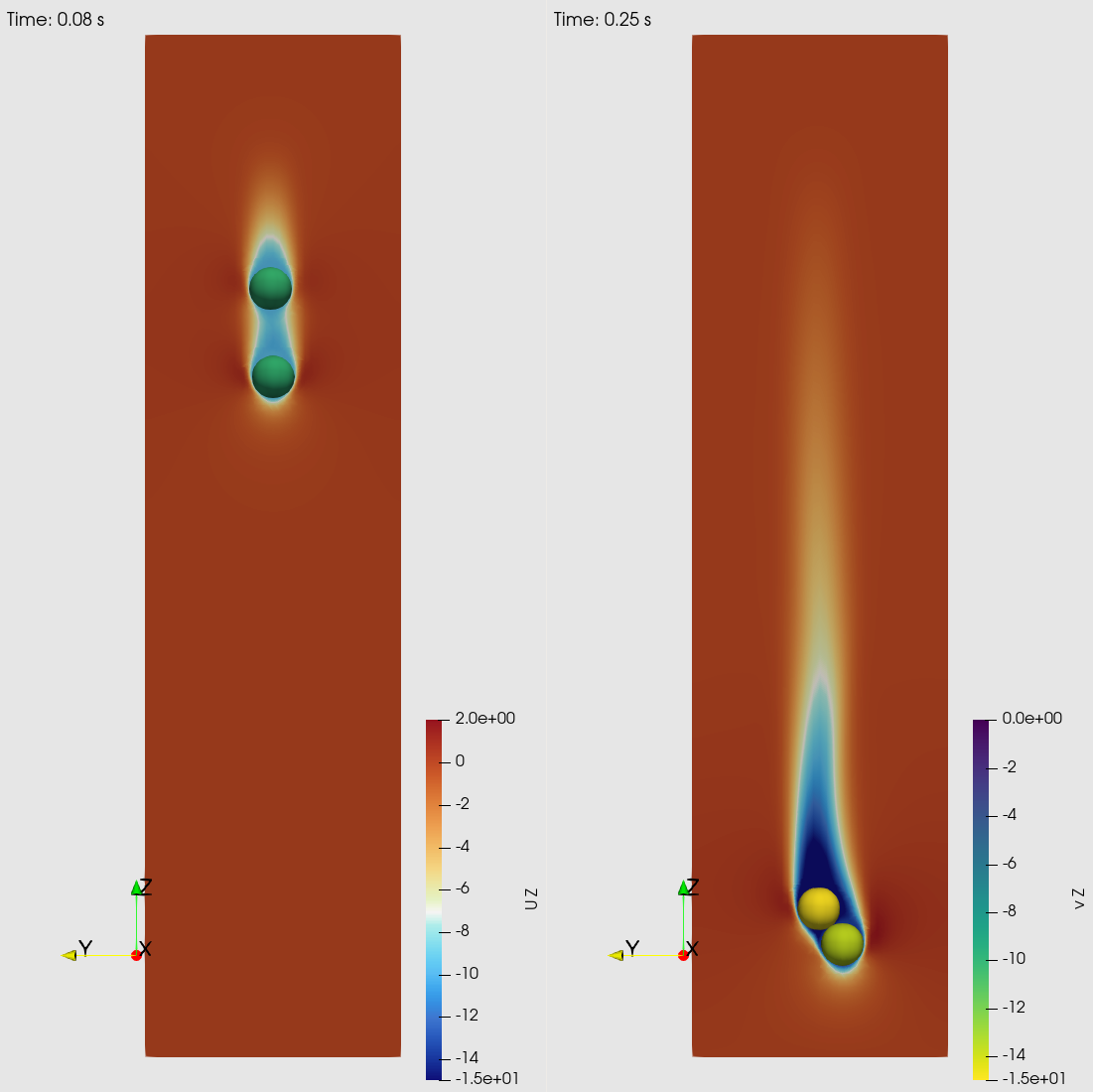
Figure 1: Particles colored by their velocity and fluid velocity field at two point in time of the simulation.
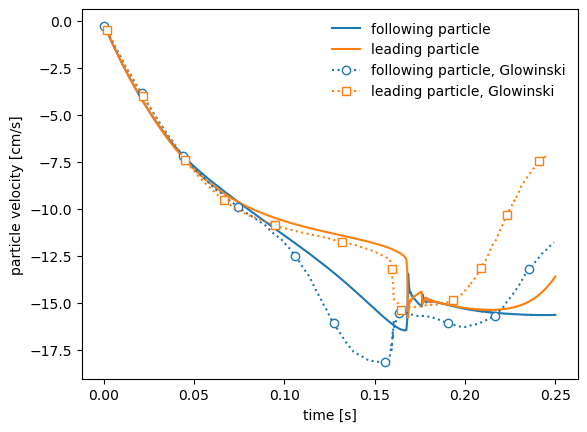
Figure 2: Particle velocity over time compared the results from Glowinski.
Literature
[1] R. Glowinski, T.-W. Pan, T.I. Hesla, and D.D. Joseph. * A distributed Lagrange multiplier/fictitious domain method for particulate flows*. International Journal of Multiphase Flow 25 (1999): 755-794