 Home
HomepackedBedTemp
In this test case the flow through a particle packing is heated by the particles. The change of fluid temperature through the particle packing is tracked and benchmarked against the analytical solution for heat transfer.
The particular simulation discussed in this article is run with cfdemSolverPisoScalar, spherical particles and the Koch-Hill drag law. There is a set of variations for employing different Nusselt number correlations and adding a liquid on the particle surface which evaporates over time and affects the thermal energy balance. The case calculates a comprehensive and detailed budget of thermal energy.
The current setup features a bulk inlet flow at the bottom with a constant temperature. In contrast to the Ergun case, the walls are treated as slip conditions with zero temperature gradient. The particle packing is created in a separate init-simulation.
Models used
- Particle forces:
The drag force is computed by the KochHill drag model.
Alteration of effective gravity forces due the difference of fluid and particle densities is modelled by the Archimedes force model.
The heat exchange between particles and fluid is modelled using LaEuScalarTemp. This model does not compute a force but, instead, the heat flux between fluid and particles using a Nusselt number correlation. In all other regards it behaves as a regular forceModel.
Particles are mapped to CFD by the engine locateModel.
The voidfraction is computed by the divided voidfraction model.
Momentum exchange between particles and fluid is computed in an implicit manner, see Zhou et al. (2010), JFM. The particles are frozen in space on the DEM side to not loosen the particle packing. Consequently, the particles act on the flow and a pressure drop across the particle packing is created but no forces act on the particles. This modelling step is achieved by disabling the particle integrator on DEM side.
On DEM side, the particles are given a virtually infinite heat capacity and, thus, do not cool down over time. While this system behavior is not realistic, it allows for validation of the results with analytical results.
Results
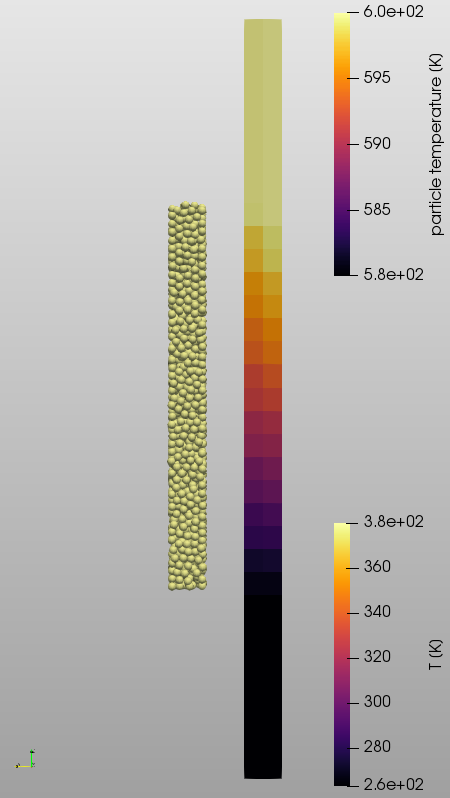
Left: Overview of the case at the end of the simulation. Left the particle packing with still homogeneous particle temperature due to the large thermal capacity of the particles. On the right the fluid temperature which increases due to heat transfer from the particles.
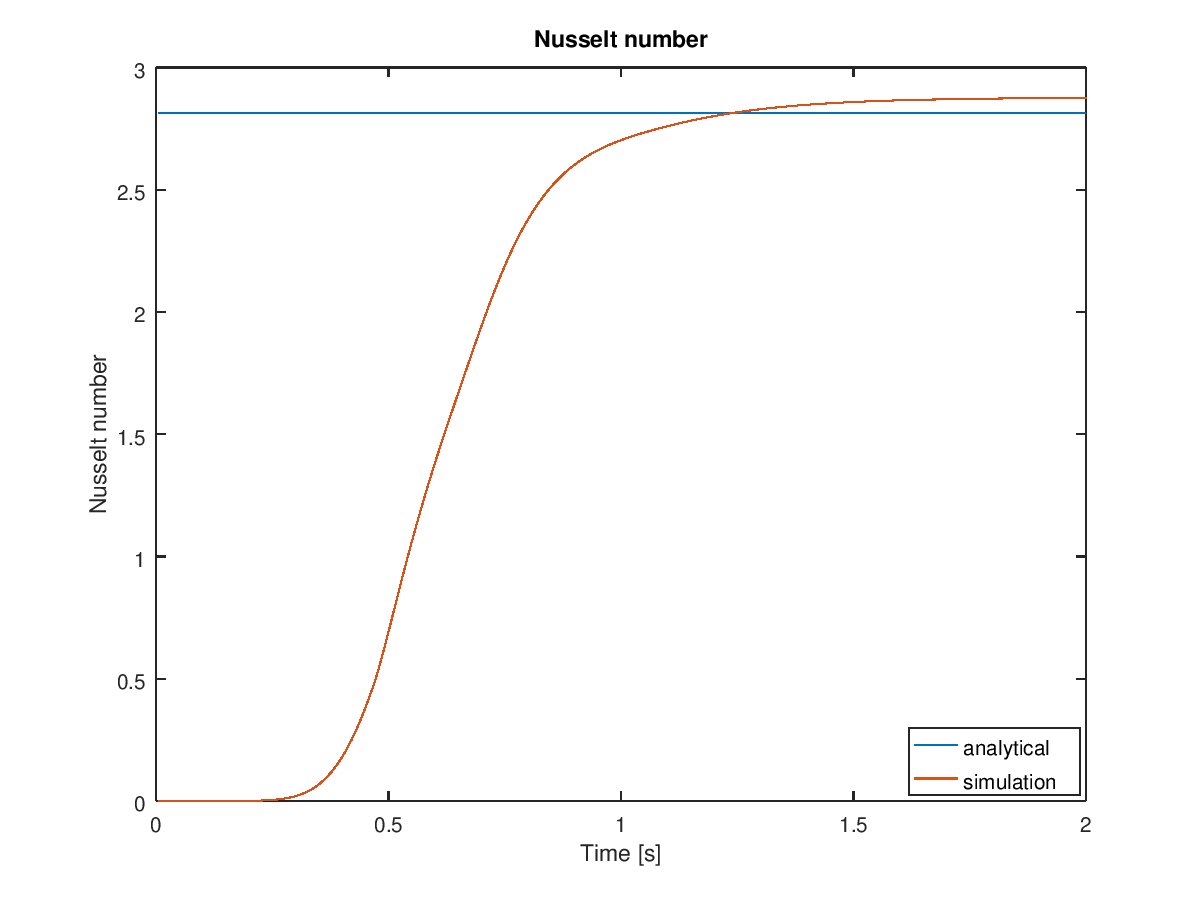
Right: Change of Nusselt number over time. The Nusselt number converges towards the value expected from analytical considerations.