 Home
HomeGlowinski case with fibers
The original Glowinski case considers two spheres falling in liquid. Both spheres are arranged behind each other such that the trailing one travels in the wake of the leading sphere. Since it experiences less drag, the trailing sphere gains on the leading one, until the spheres finally touch and start to tumble.
The present setup is similar in terms of initial particle arrangement. However, fibers are falling instead of spheres leading to a different system behavior.
The fibers are represented as spheres bonded to elongated structures on the DEM side and are, therefore, flexible. On the CFD side the bonds are neglected and the drag of each individual sphere is computed. The bonds on the DEM side then enforce a collective behavior.
Models used
This is a resolved CFD-DEM case using the immersed boundary method (IBM). Consequently models are used that take advantage of the resolved velocity and pressure field around the particle.
Particle forces:
The drag force is computed by the Shirgaonkar model.
Alteration of effective gravity forces due to the difference of fluid and particle densities is modelled by the IB variant of the Archimedes force model.
Particles are mapped to CFD cells by a variant of the engine locateModel specifically tailored towards resolved CFD-DEM simulations.
The voidfraction is computed by the IB voidfraction model accounting for large particles.
Results
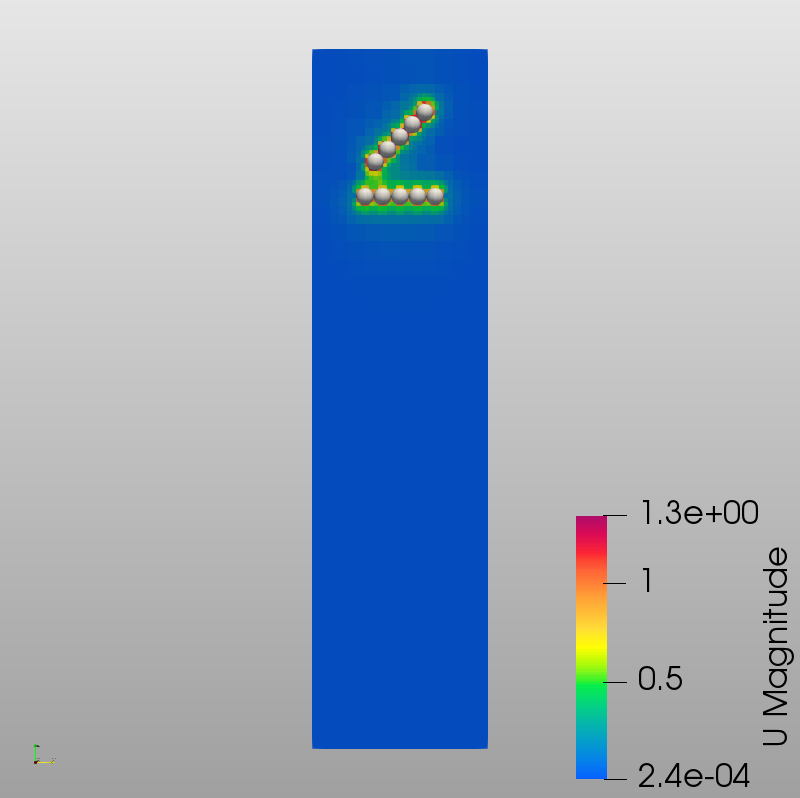
Figure 1: Particle position and fluid velocity field at the start of the simulation.