 Home
HomeFilling of a cylinder using an external DEM code
On the DEM side particles are poured into a cylindric container resulting in particles accumulating at the bottom and creating a particle bed. The simulation is run without interaction of fluid and particles, i.e. particles are not affected by a drag force. The DEM simulation results are stored in a set of VTK files.
cfdemPostproc – coupling to external DEM data
cfdemPostproc reads VTK data for each time step and computes the voidfraction and the average particle velocity within a CFD cell.
The VTK files can be created with any DEM code and need to contain the particle position (as a vector, named ‘x’), their velocity (also as a vector named ‘v’) and the radius (called ‘radius’).
Results
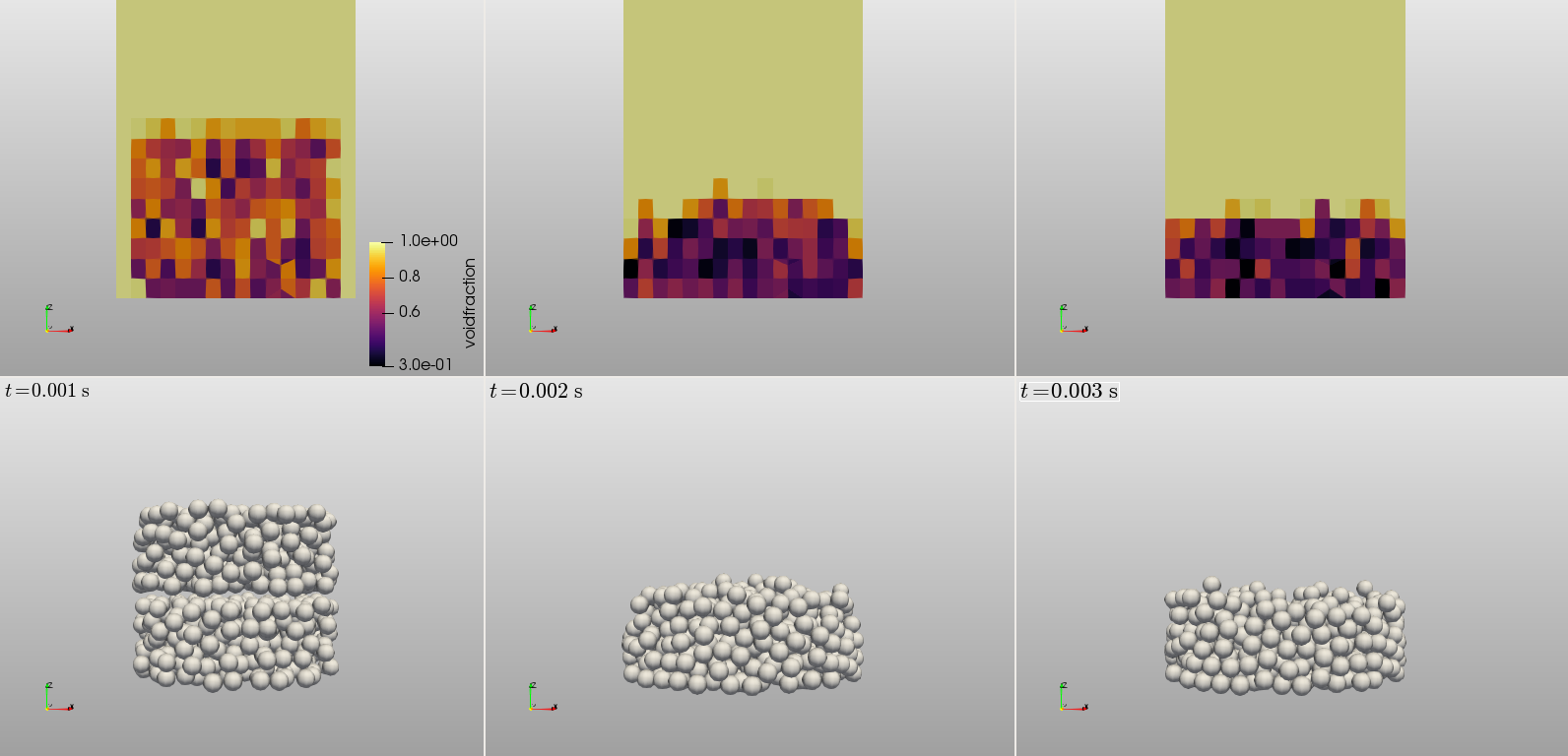
Figure 1: Particle distribution in DEM (top) and resulting voidfraction calculated by cfdemPostproc (bottom) over time.