 Home
HomeRotating Distributor
Warning
This tutorial is included in and relies on functionality that is available in the CFDEMcoupling-PREMIUM package.
The rotatingDistributor examples showcase functionalities on how to handle rotating geometries in coupled cases. In a 4-way coupled simulation the usage of mesh interfaces (AMI) to rotate the internal region on the CFD side is imperative. This is the most accurate but also most costly setup and is used as reference to the variants discussed in the following.
If the particles have a small influence on the flow field, for instance because there are only few particles, one can resort from a full coupling to a 1-way coupled setup, where only the drag on the particle is taken into account but not the particle’s impact on the fluid. For one-way coupled setups with rotating geometries two options how to describe the velocity field in the rotating region are possible:
A static field in a moving reference frame (MRF). In this case a stationary field is rotated with the given rotation rate.
Use transient a transient velocity field. Compared to the MRF approach this approach requires more IO operations but is also more accurate, especially when the velocity field is not stationary in the moving reference frame, for instance due to the rotating geometry passing obstacles.
In the present case, we use the transient one way-coupling although it does not provide a benefit over the MRF variant in terms of accuracy.
Models used
The drag force is computed on the DEM side from a Schiller-Naumann correlation, see dragforce/field.
Particles are mapped to CFD cells by the turboEngine locateModel. This locateModel is specifically enhanced for moving geometries. In the present case it must be used to correctly locate the particles in the moving mesh region which requires the locateModel to track mesh updates. This tracking must be activated by the user by setting
allowParticlesInMovingRegion true.The voidfraction is computed by the divided voidfraction model.
Momentum exchange between particles and fluid is computed in an implicit manner, see Zhou et al. (2010), JFM.
Note
The domain is decomposed in such a way that the AMI patch is kept on one
processor. The AMI patch itself may also be distributed to several CPUs.
However, reconstruction of the particles – then – does not work.
The current setting is required to run reconstructPar on Lagrangian
objects.
Results
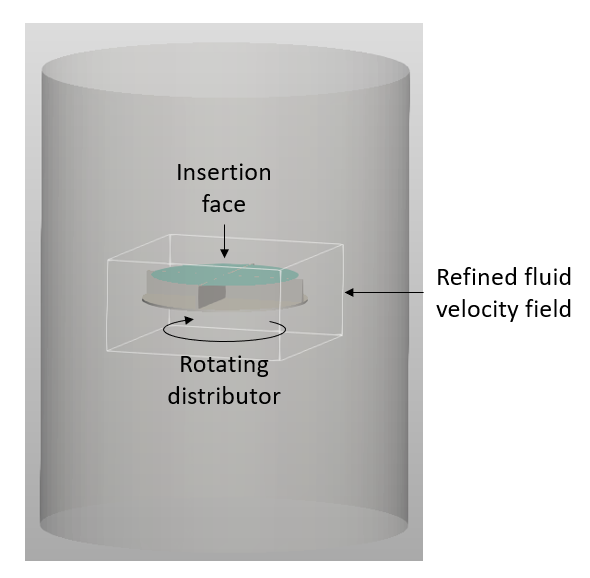
Figure 1: Case setup with rotating geometry and region of refined fluid velocity field.
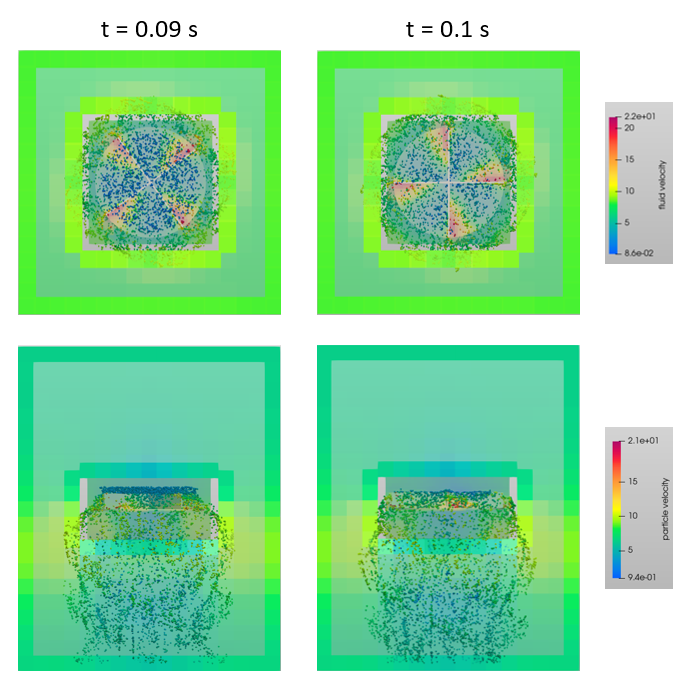
Figure 2: Particle distribution and fluid velocity field as represented in Aspherix for two different instances in time.