 Home
HomeRotating drum with spray particle capturing, attrition and evaporation
Warning
This tutorial is included in and relies on functionality that is available in the CFDEMcoupling-Chemistry package.
This rotating drum example shows how to set up simulations including the interaction between particles and Lagrangian spray. Two variants are available:
attrition: The Lagrangian spray adds a coating to the particles which is subsequently attrited by collisions and dispersed in in the fluid as dust.
drying: The Lagrangian spray wets the particles. The added liquid subsequently evaporates when the particles are heated by the walls and the water vapor is accounted for as distinct species in the fluid.
Models used
LaEuScalarTemp models the temperature exchange between particles and fluid.
LaEuScalarEmit models the dust transfer from particles to fluid – used in the attrition variant.
Results
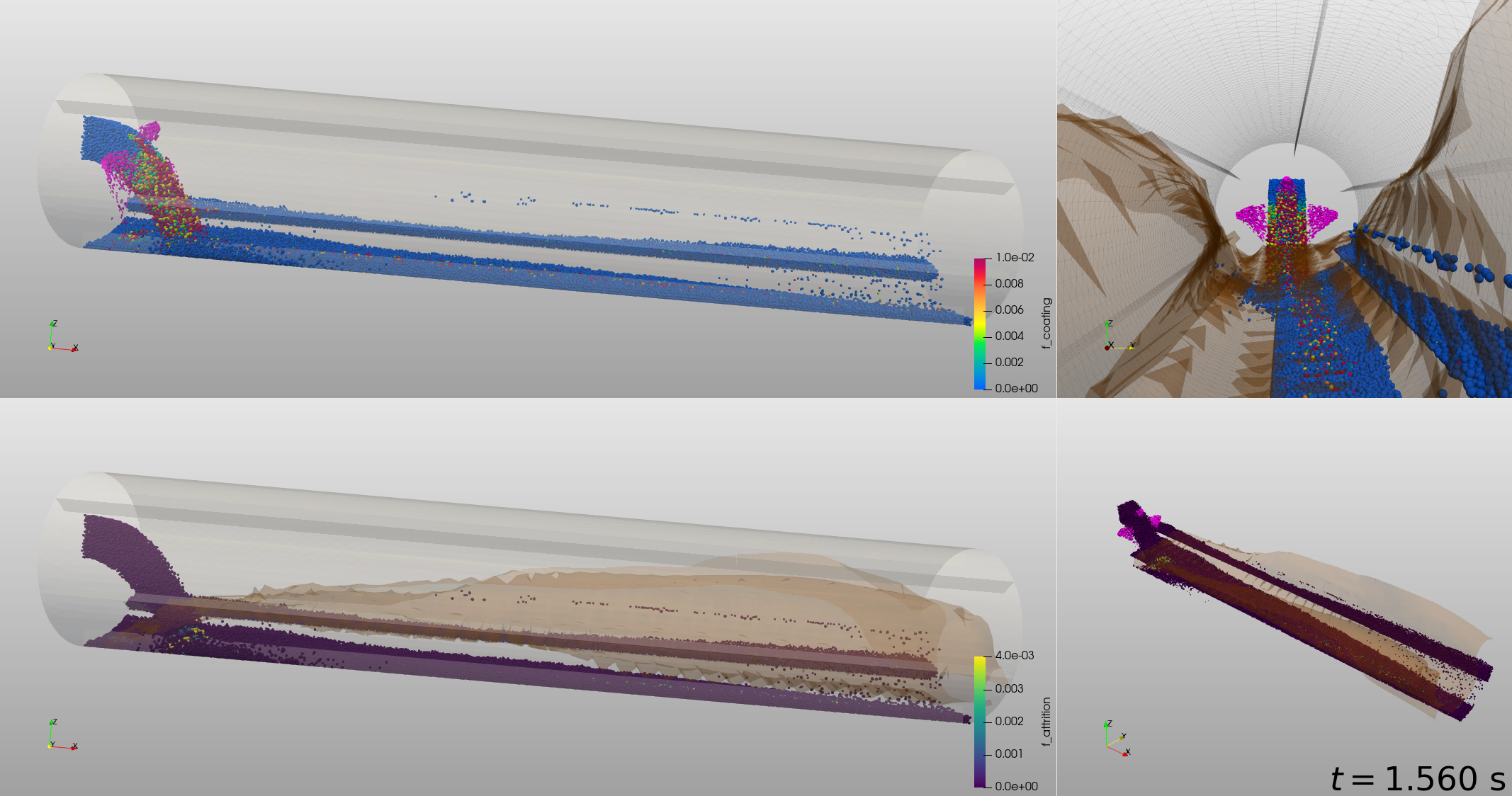
Figure 1: Particle coating (in mass percent) and current attrition. The particles are sprayed with a mixture of carbon and water (pink) shortly after entering the domain. Attrition is only generated on coated (i.e. sprayed) particles and can decrease by dust emission to the fluid. The dust concentration is shown as 0.5% iso-surface of dust concentration in the fluid. Watch also the full attrition video
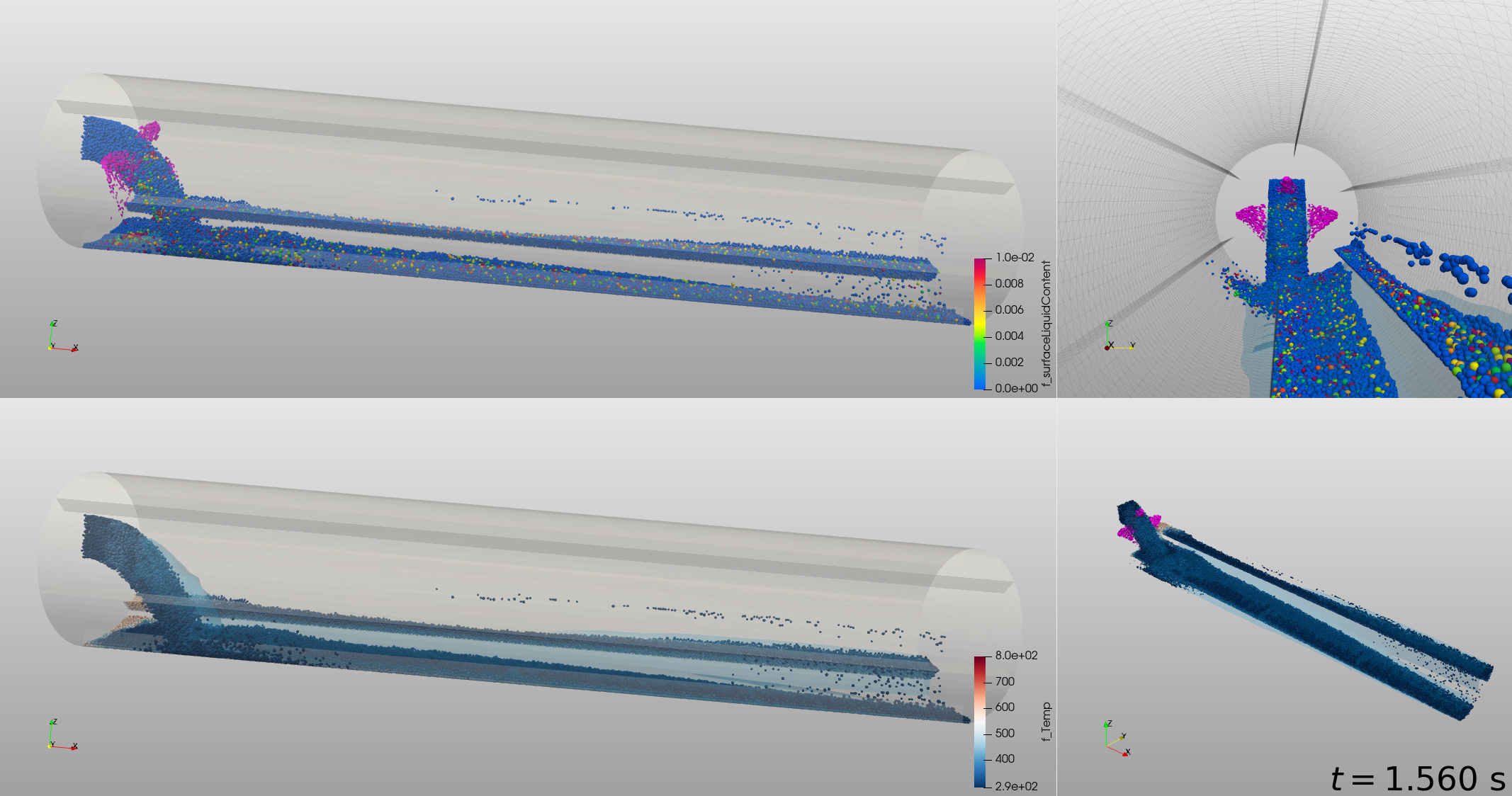
Figure 2: Particle surface liquid content (in mass percent) and temperature together with the 0.1% iso-surface of water concentration in the fluid. The particles are sprayed with water (pink) shortly after entering the domain and then dry slowly while being heated by the drum wall. Watch also the full evaporation video
Note
Thermodynamic properties like specific heat capacity or latent heat have been reduced significantly to speed up the process.