 Home
HomebulkDensityTest
Template Info
- Target Parameters: rho_p
- Contact Models: tangential no_history tangential history rolling_friction epsd rolling_friction epsd2 cohesion sjkr cohesion sjkr2 cohesion adaptive
- Particle Shapes: sphere multisphere
Overview
The setup consists of a cylindrical bin entirely filled with particles; see Figure 1. The contained mass is calculated and divided by the volume of the cylinder. The simulation bulk density is then compared with a reference bulk density and the particle density is adjusted to match the simulated with the reference value.
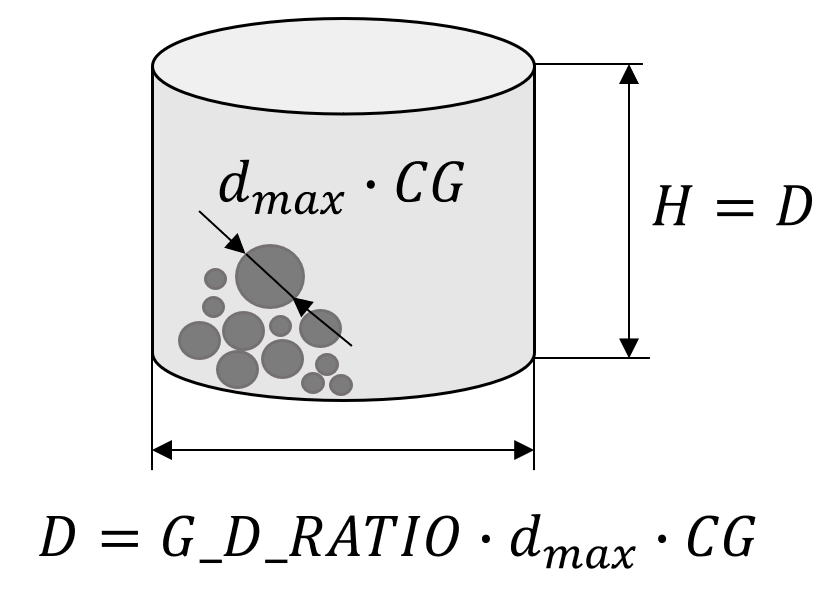
Figure 1: sketch of the simulation setup. An equilateral
cylinder is filled with particles and the particle density
is calibrated to match a desired bulk density.  denotes the maximum particle radius (in case of polydisperse
system),
denotes the maximum particle radius (in case of polydisperse
system),  is the coarsegraining factor and
G_D_RATIO is the ratio between the diameter of the
cylinder and the diameter of the largest coarsegrained particle.
is the coarsegraining factor and
G_D_RATIO is the ratio between the diameter of the
cylinder and the diameter of the largest coarsegrained particle.
The reference bulk density of the material,  ,
is provided indirectly by the user through two parameters:
the measured bed height,
,
is provided indirectly by the user through two parameters:
the measured bed height,  , and the minimum
fluidization pressure of the Ergun Test,
, and the minimum
fluidization pressure of the Ergun Test,
 , where
  is the minimum fluidization velocity.
This template is designed to work in conjunction with the
volumeFracTest and ErgunTest templates. The intended
calibration procedure works as follows: in an appropriate experiment,
the pressure drop is measured as function of the inlet velocity,
 . From this measurement curve, both
the slope of the pre-fluidization pressure buildup and the minimum
fluidization velocity can be extracted. First, the bulk
density of the material needs to be calibrated. At the minimum
fluidization velocity, the drag force acting on the whole bed is equal
to the gravity force:
. From this measurement curve, both
the slope of the pre-fluidization pressure buildup and the minimum
fluidization velocity can be extracted. First, the bulk
density of the material needs to be calibrated. At the minimum
fluidization velocity, the drag force acting on the whole bed is equal
to the gravity force:
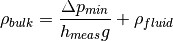
where  is the density of the fluid in which the
particles are immersed. Note that this expression neither depends on
the drag coefficient of the particles, nor does it explicitly depend
on the actual minimum fluidization velocity .
This calibration step merely ensures that fluidization occurs
at the correct pressure drop. Thus, it is crucial that this calibration
is performed prior to calibrating the scale drag with the
ErgunTest template.
is the density of the fluid in which the
particles are immersed. Note that this expression neither depends on
the drag coefficient of the particles, nor does it explicitly depend
on the actual minimum fluidization velocity .
This calibration step merely ensures that fluidization occurs
at the correct pressure drop. Thus, it is crucial that this calibration
is performed prior to calibrating the scale drag with the
ErgunTest template.
Simulation phases
Initialization
During the initialization, particles are poured into a cylindrical bin. The simulation automatically stops when the bin is full and the particles have settled. This is achieved by monitoring their kinetic energy. The finished packing is then written to a restart file.
Optimization
The optimization run only performs a single time step to recalculate the bulk density of the material in the cylinder.
Quality function
The quality function is the magnitude of the normalized difference of the target density and the current simulation density.
Measurement file
The reference bulk density is calculated using the pressure drop at
minimum fluidization velocity, dpUmf, and the height of the particle
bed, hbed. Both parameters needs to be specified by the user in the
calibration_case command via the parameter_overrides
keyword. Nonetheless, due to current restrictions of the framework,
Aspherix® Calibration needs a measurement file to be present. The content
of this file is irrelevant and will not affect calibration.
Template parameters
General settings
Parameter |
Default |
|---|---|
scaleweight |
1 |
pairGranModel |
hertz |
pairTangential |
history |
pairCohesion |
off |
pairRollingFriction |
epsd |
pairSurface |
default |
NPROC |
4 |
dumpT |
0.01 s |
dump |
0 |
G_D_RATIO |
20 |
Note
G_D_RATIO is the ratio of cylinder diameter and largest coarsegrained particle diameter
Specific settings
Variable |
Default |
Meaning |
|---|---|---|
dpUmf |
undefined |
Reference pressure drop at minimum fluidization velocity [Pa] |
hbed |
undefined |
Reference bed height [m] |
si_units |
1 |
Units (1 = si, 0 = cgs) |
binning_type |
monodisperse_binning |
Binning type in neighborlist algorithm |
Note
In case of small non-coarsegrained particles (of the order of the micron), it is necessary to set si_units to 0 (see documentation). In case of highly polydisperse system, it is necessary to set binning_type to polydisperse_binning (see documentation).