 Home
HomeErgunTest
Template Info
- Target Parameters: CFD_scaleDrag CFD_scaleDH
- Contact Models:
- Particle Shapes: sphere multisphere
This case simulates the fluidization of a packed bed in a cylindrical
container; see Figure 1. The inlet velocity increases linearly from the initial
velocity CFD_Ustart (normally 0 m/s) to the final velocity CFD_Uend
(which should be around 80% of the reference fluidization velocity).
This calibration template is used to calibrate one of the two scaling
factors for the drag model, namely CFD_scaleDrag or CFD_scaleDH.
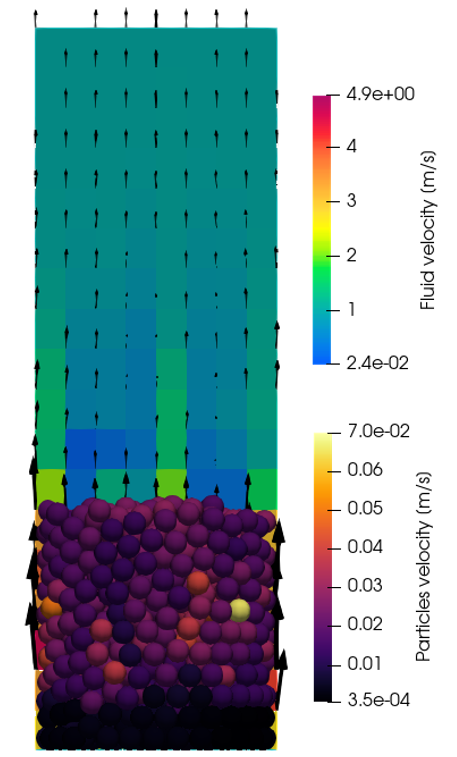
Figure 1: Simulation result obtained from ErgunTest calibration
template. A fluid flow enters through the lower base of the cylinder
and fluidizes the packed bed.
This template is designed to work in conjunction with the
bulkDensityTest and volumeFracTest templates, and relies
on properly calibrated bulk density and (if necessary) scaled volume
fraction. While the pressure drop at the minimum fluidization velocity
 only depends on the bulk density of the material, the
minimum fluidization velocity itself, and consequently the slope of
the pressure drop as function of inlet velocity,
only depends on the bulk density of the material, the
minimum fluidization velocity itself, and consequently the slope of
the pressure drop as function of inlet velocity,  , also depends on the drag coefficient of the
particles.
, also depends on the drag coefficient of the
particles.
This case is sensitive to the CFD_scaleDrag and CFD_scaleDH
parameters. The former scales the hydrodynamic drag force directly, while the
latter scales the hydraulic diameter of the particles prior to drag force
computation.
Note
Both parameters need to be provided as either param_calibration or param_fixed.
Warning
Only use one of the two parameters as target_parameter. Calibrating both target parameters at the same time does not make sense, and will most likely yield unsatisfactory results.
Simulation phases
Initialization
During the initialization, particles are poured into a cylindrical
bin. The simulation automatically stops when the bin is full and the
particles have settled. This is achieved by monitoring their kinetic
energy. Then particles above  , where
  is the
diameter of the cylinder, are removed and a short settling period is run.
is the
diameter of the cylinder, are removed and a short settling period is run.
Optimization
The optimization run is a CFDEMcoupling simulation where the fluid flow
is linearly increased from CFD_Ustart to CFD_Uend over the
timespan CFD_Uramptime.
Quality Function
The quality function is the sum of the squared distances between the scaled pressure profiles obtained from the referece and the simulation at several sampling points:

Measurement file
This case requires measurement data in either CSV or a space-delimited
format. Lines beginning with # are discarded. The first two
columns of the data file are interpreted as inlet velocity in m/s and
pressure drop in Pa, respectively. Example measurement files could
look like
# Ergun measurement data
# u_in dp
0.1     1e2
0.2     2e2
........
or like
# measurement 1.1.2020
# [other header info]
# ....
# u_in,dp,expansion,temperature
0.1,1e2,1.0,300
0.2,2e2,1.01,307
.....
where in the second example all other columns except the first two are discarded.
Note
ErgunTest expects the measurement file to contain data up to at least 80% of the fluidization velocity, but to end prior to fluidization. Including velocity/pressure data above the minimum fluidization velocity will inevitably yield wrong calibration results.
Template parameters
General settings
Parameter |
Default |
|---|---|
scaleweight |
1 |
pairGranModel |
hertz |
pairTangential |
history |
pairCohesion |
off |
pairRollingFriction |
epsd |
pairSurface |
default |
NPROC |
4 |
dumpT |
0.01 s |
dump |
0 |
G_D_RATIO |
10 |
Note
G_D_RATIO is the ratio of cylinder diameter and largest coarsegrained particle diameter
Specific settings
Variable |
Default |
Meaning |
|---|---|---|
CFD_timestep |
5e-4 |
Timestep for the CFD part of the simulation [s] |
CFD_writeInterval |
0.01 |
CFD write interval [s] |
CFD_Ustart |
undefined |
Inlet velocity at start of simulation [m/s] |
CFD_Uramptime |
undefined |
Velocity ramp time [s] |
CFD_Uend |
undefined |
Inlet velocity at end of simulation (~80% Umf) [m/s] |
hbed_ref |
undefined |
Height of the particle bed in the reference experiment [m] |
cfdemSolverBinary |
cfdemSolverPimple |
CFD-DEM solver |