 Home
HomeMathematical Background
This document explains some of the mathematical terms used throughout the Aspherix® Calibration documentation.
Squared Curve Distance
The squared curve distance ( ) is often employed in
computation of quality functions. A curve is a list of points
) is often employed in
computation of quality functions. A curve is a list of points
 , ordered by increasing
  value. It is assumed
that the
value. It is assumed
that the  are unique within a curve. Now,
assume two curves
are unique within a curve. Now,
assume two curves  and
and  with
with
 and
and  points, respectively. The distance from
 to
to 
 is then computed
as follows:
is then computed
as follows:
For each point in ,  , the
quantity
, the
quantity

where  is the linear interpolation
of the curve to the point . The squared curve
distance is then given by
is the linear interpolation
of the curve to the point . The squared curve
distance is then given by

where 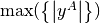 is the maximum
absolute
is the maximum
absolute  value in .
Note
Generally,  , although both values are a proper
measurement for the similarity of the curves.
, although both values are a proper
measurement for the similarity of the curves.