 Home
HomevolumeFracTest
Template Info
- Target Parameters: CFD_volFracScale
- Contact Models:
- Particle Shapes: sphere multisphere
The setup consists of a cylindrical bin entirely filled with particles;
see Figure 1. The total particle volume is measured on an Eulerian CFD grid.
If real particles are porous, the volume representation might need to
be corrected, since the volume fraction (defined as the ratio between
the particle volume and the total volume of the bin) is an important factor
in drag laws. This calibration template tries to match the volume fraction
calculated by the CFD-DEM model with a reference volume fraction (e.g.,
from experimental measure) by varying the scaling factor CFD_volFracScale.
The latter corresponds to the volScale factor of the CFD-DEM voidfraction
models (see CFDEM®coupling documentation for more information), which is
a factor scaling up (if volScale > 1) or down (if volScale < 1)
the particle volume seen by the CFD field.
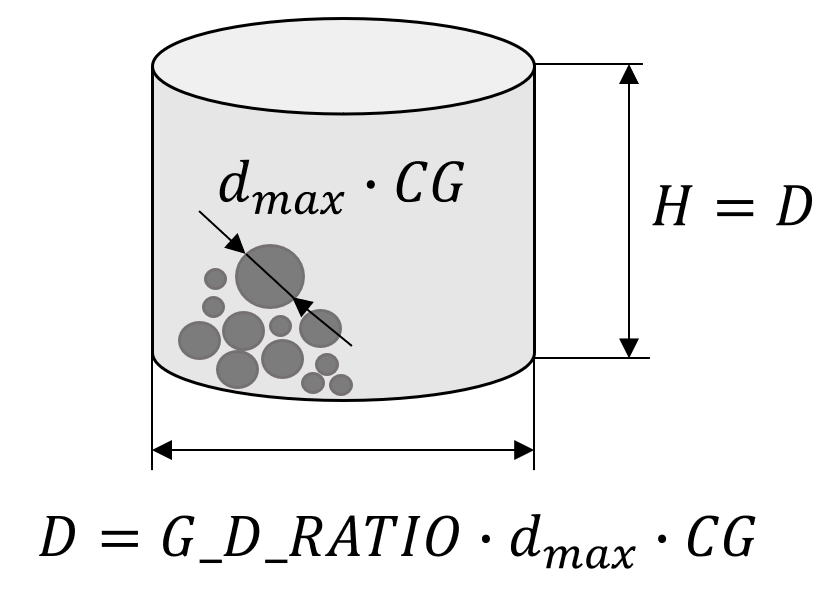
Figure 1: sketch of the simulation setup. An equilateral
cylinder is filled with particles and the volume fraction
is calculated on an Eulerian CFD grid.  denotes the maximum particle radius (in case of polydisperse
system),
denotes the maximum particle radius (in case of polydisperse
system),  is the coarsegraining factor and
G_D_RATIO is the ratio between the diameter of the
cylinder and the diameter of the largest coarsegrained particles.
is the coarsegraining factor and
G_D_RATIO is the ratio between the diameter of the
cylinder and the diameter of the largest coarsegrained particles.
This template is designed to work together with bulkDensityTest and ErgunTest. The volume fraction scale factor, as well as the bulk density, should be calibrated before the ErgunTest.
Simulation Setup
Initialization
During the initialization, particles are poured into a cylindrical bin. The simulation automatically stops when the bin is full and the particles have settled. This is achieved by monitoring their kinetic energy. The finished packing is then written to a restart file. Then one CFDEMcoupling timestep is run and the volume fraction of the granular phase is measured.
Optimization
The optimization run only performs a single time step calulation to recalculate the volume fraction in the cylinder.
Quality Function
The quality function is the magnitude of the normalized difference of the target volume fraction and the current simulation volume fraction.
Measurement file
The relevant information for the calibration is the parameter
CFD_particle_volume_fraction. However, due to current restrictions
of the framework, Aspherix® Calibration needs a measurement file to be
present. The content of this file is irrelevant and will not affect
calibration.
Template parameters
General settings
Parameter |
Default |
|---|---|
scaleweight |
1 |
pairGranModel |
hertz |
pairTangential |
history |
pairCohesion |
off |
pairRollingFriction |
epsd |
pairSurface |
default |
NPROC |
4 |
dumpT |
0.01 s |
dump |
0 |
G_D_RATIO |
10 |
Note
G_D_RATIO is the ratio of cylinder diameter and largest coarsegrained particle diameter
Specific settings
Variable |
Default |
Meaning |
|---|---|---|
CFD_particle_volume_fraction |
undefined |
The measured volume fracition of the material [-] |
cfdemSolverBinary |
cfdemSolverPimple |
CFD-DEM solver |