 Home
HomeinclinedWall
Overview
Template Info
- Target Parameters: c_frict_xx c_rollingFrict_xx roll_damp_xx cohesion_energy_xx cohStrength_xx maxCohStress_exp_xx
- Contact Models: tangential no_history tangential history rolling_friction cdt rolling_friction epsd rolling_friction epsd2 cohesion sjkr cohesion sjkr2 cohesion adaptive
- Particle Shapes: sphere multisphere
The inclined wall experiment tests if particles on an inclined plate start to roll or slide. When they start to move, the angle of the plate is measured.
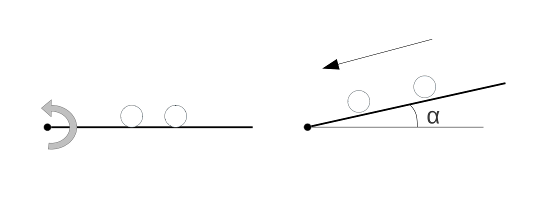
Experimental setup
The experiment consists of a plate made of the wall material and particles on it. The plate slowly increases its steepness, and when the particles start to move, the angle of the plate is measured. This angle is called “target angle”. With this experiment, both the the rolling friction and the sliding friction between the particles and the wall material can be characterized. The amount of particles is rather low, no particle-particle interactions should appear, since only particle-wall properties are of interest. Depending on particle shape and surface properties, the particles can either move or slide. This needs to be determined by the experimentator, and the results should be used to calibrate the correct parameter.
Simulation setup
Target parameter
This simulation setup is designed to support calibration of the coefficient of sliding or rolling friction, but only one at a time.
Note
The simulation setup is designed to work with both sliding and rolling friction. If one of the two parameters is to be calibrated, the user should make sure that the other one is set significantly higher than the expected value for the target parameter to avoid sliding in case rolling friction needs to be calibrated or vice versa.
Configuration
This case is so small that it is not execute using MPI, hence the
settings for NPROC and nChunks/coresPerChunk are ignored. The only
tunable parameter is the number of particles used for calibration via
the setting nParticles.
Initialization
During the initialization, 100 particles are placed on a horizontal wall, and the state of the simulation is written to a restart file.
Optimization
The restart file written during initialization is loaded. During the optimization run, the gravity vector is set to emulate an inclination of the plane equal to the measured angle. In the lateral direction, periodic boundary conditions are used. The particles are then allowed to move freely, and the kinetic energy is measured to evaluate the quality function.
Measurement data
The relevant quantity for calibration is the target angle, or the angle at which the particles in the experiment startet to move. It is supplied via a file with the following structure:
targetAngle xx
where xx is the value of your target angle in degrees.
Quality Function
The quality function is computed as
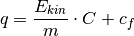
where  is the total kinetic energy of all particles in
the simulation,
is the total kinetic energy of all particles in
the simulation,  their total mass,
  is the
coefficient of (sliding/rolling) friction used in the simulation, and
is the
coefficient of (sliding/rolling) friction used in the simulation, and
 is a constant determined by experiments.
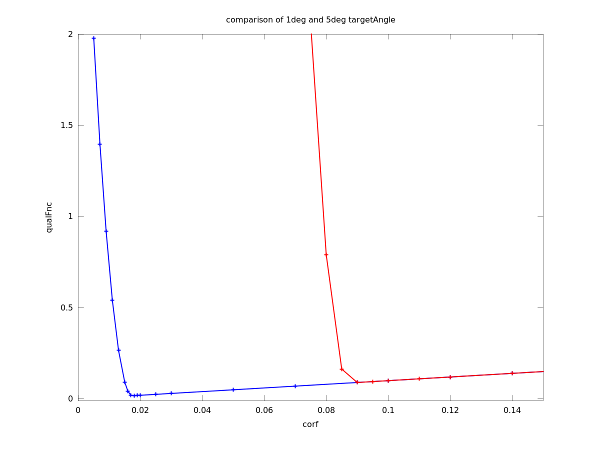
Quality function for a target angle of 1° and 5°, respectively. When the particles move, the contribution of kinetic energy to the quality function drastically increases, creating a minimum exactly at the onset of motion.
Template parameters
General settings
Parameter |
Default |
|---|---|
scaleweight |
1 |
pairGranModel |
hertz |
pairTangential |
history |
pairCohesion |
off |
pairRollingFriction |
epsd |
pairSurface |
default |
NPROC |
1 |
dumpT |
0.01 s |
dump |
0 |
G_D_RATIO |
25 |
nChunks |
1 |
coresPerChunk |
1 |
Specific settings
Variable |
Default |
Meaning |
|---|---|---|
nParticles |
1000 |
Number of particles simulated |