 Home
HomeoscillatoryRheometerBurgers
Overview
Template Info
- Target Parameters: maxw_Y kelv_Y kelv_nu
- Contact Models: cohesion asphalt tangential burgers_asphalt
- Particle Shapes: sphere
This case simulates an oscillatory rheometer sweeping different angular
frequencies and it is used to calibrate the viscoelastic models gran
cohesion asphalt and tangential
burgers_asphalt (see section
Calibration suggestions for more information on
the models). The calibration template is sensitive to the target parameters
maxw_Y, kelv_Y, kelv_nu, which stand for the Young’s Modulus of the
Maxwell body, the Youngs’s Modulus and the viscosity of the Kelvin body
respectively.
The setup consists of a laterally-unconfined packet of particles
which undergoes periodic shear. The height of the packing is
defined via the numberOfParticlesInZ keyword and the shape
via the lattice_type keyword. Two different packing types are
possible: cubic (see sketch below) and hexagonal close packing.
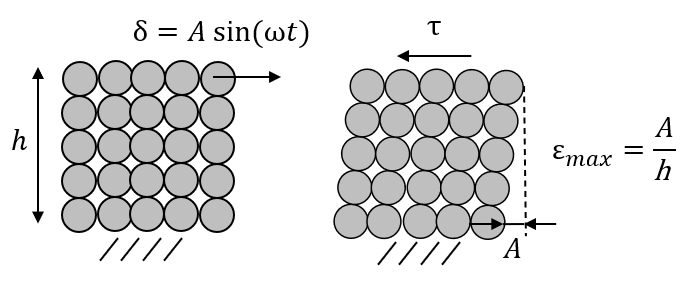
The amplitude of the oscillation in percentage of the packing height
(i.e., the maximum shear strain times 100) is expressed via the
strainPercentage keyword. A maximum of 30 angular frequencies
can be selected via the angularVelocity_1, ..., angularVelocity_30
keywords. The viscosity of the material, defined as
 where
where  is the maximum shear stress,
  is the maximum
shear strain and
is the maximum
shear strain and  is the angular frequency, is calculated
and compared to reference values.
is the angular frequency, is calculated
and compared to reference values.
Calibration suggestions
For small shear strains (e.g., istrainPercentage = 5) the
gran cohesion asphalt model model does not play an effective
role, as the particles very rarely have a negative overlap (i.e.,
particles are mostly attached). Hence, a calibration of the parameters
of the cohesion asphalt model should not be pursued in this case.
Regarding the parameters of the gran tangential burgers_asphalt
model, it has been observed that by changing the Young’s modulus of
the Maxwell body it is possible to match the viscosity in magnitude,
while by changing the viscosity of the Kelvin body it is possible to
change the shear-thinning behaviour of the material at the different
angular frequencies.
The viscosity of the Maxwell body controls the thixotropic behaviour of the material. Small values of the Maxwell viscosity requires longer simulation times before the viscosity can reach a steady-state. Since the reference information is the material viscosity at steady-state, this parameter can be kept constant and high enough to guarantee a rapid convergence to the steady-state viscosity. By changing the Young’s modulus of the Kelvin body no significant changes has been observed.
The oscillatory rheometer can be run in parallel when using runMode
shellScript. Then, the frequency sweep is computed on multiple
partitions, the number can be controlled via the
NPROC parameter. Note that usually there is no real gain beyond NPROC 2:
one processor then runs the lowest frequency, and the other one runs all other
frequencies. Only when running very narrowly spaced frequencies (eg.  ), increasing NPROC will result in actual increase in simulation
speed.
), increasing NPROC will result in actual increase in simulation
speed.
Quality function
The quality function is calculated as the mean-square deviation between the experimental and the simulation data, normalized by the maximum simulation value squared:

where  and
and  are the simulated and
experimental viscosities,
are the simulated and
experimental viscosities,  is the generic angular
frequency and
is the generic angular
frequency and  is the number of angular frequency spanned
during the frequency sweep.
is the number of angular frequency spanned
during the frequency sweep.
Measurement file
The text file containing the experimental measurements must have two columns: one for the angular frequencies (expressed rad/s) and the other for the material viscosity (expressed in Pa s). The data in each row should be either space-, tab- or comma-separated. An example of measurment file is given below.
# frequency [rad/s] viscosiy [Pa s]
1.279960886 78120.16628
3.189839968 45214.52292
6.572892445 28462.25023
15.77531671 15699.21565
20.24841882 13253.5802
53.19975448 6684.952969
111.5981209 3952.995275
226.6055466 2452.652682
340.6875271 1883.825665
513.3246147 1461.785542
Template parameters
General settings
Parameter |
Default |
|---|---|
scaleweight |
1 |
pairGranModel |
hertz |
pairTangential |
burgers_asphalt |
pairCohesion |
asphalt |
NPROC |
1 |
dumpT |
0.01 s |
dump |
1 |
Specific settings
Variable |
Default |
Meaning |
|---|---|---|
numberOfParticlesInZ |
4 |
Number of particles in z direction |
strainPercentage |
5.0 |
Maximum amplitude in percentage of packing height (i.e., maximum shear strain times 100) |
lattice_type |
1 |
0 = cubic packing (sc), 1 = hexagonal close packing (hcp) |
timestep |
2.5e-6 |
time step size |
nPeriods |
5 |
Number of periods to be simulated for each angular frequency |
angularVelocity_1 |
6.283185307 |
Angular frequency nr. 1 [rad/s] |
angularVelocity_2 |
12.566370614 |
Angular frequency nr. 2 [rad/s] |
angularVelocity_3 … angularVelocity_30 |
0 |
Angular frequency nr. 3 to 30 [rad/s] |