Home
HomeCharge Transfer
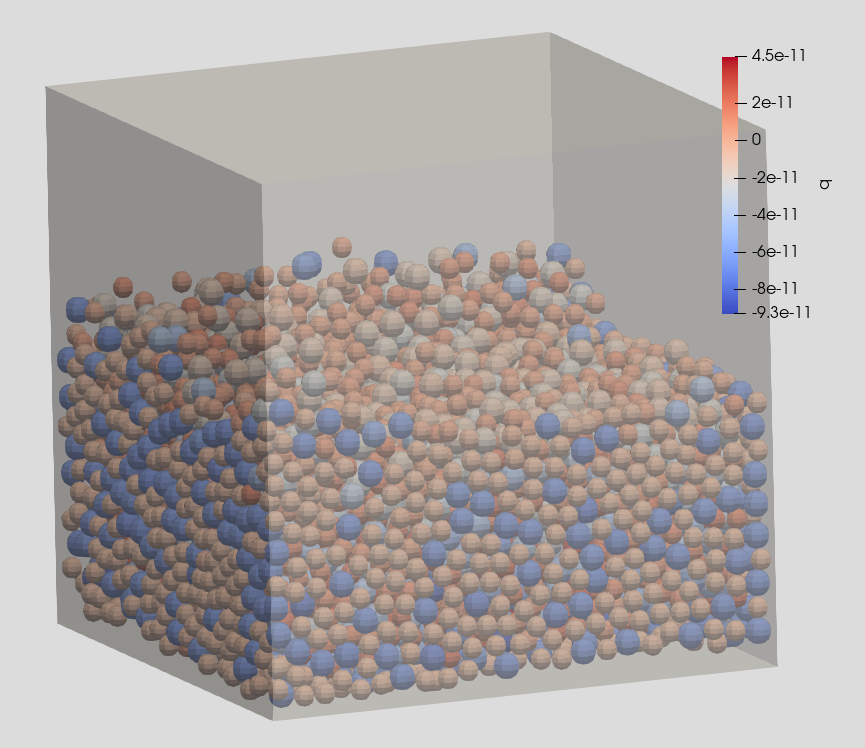
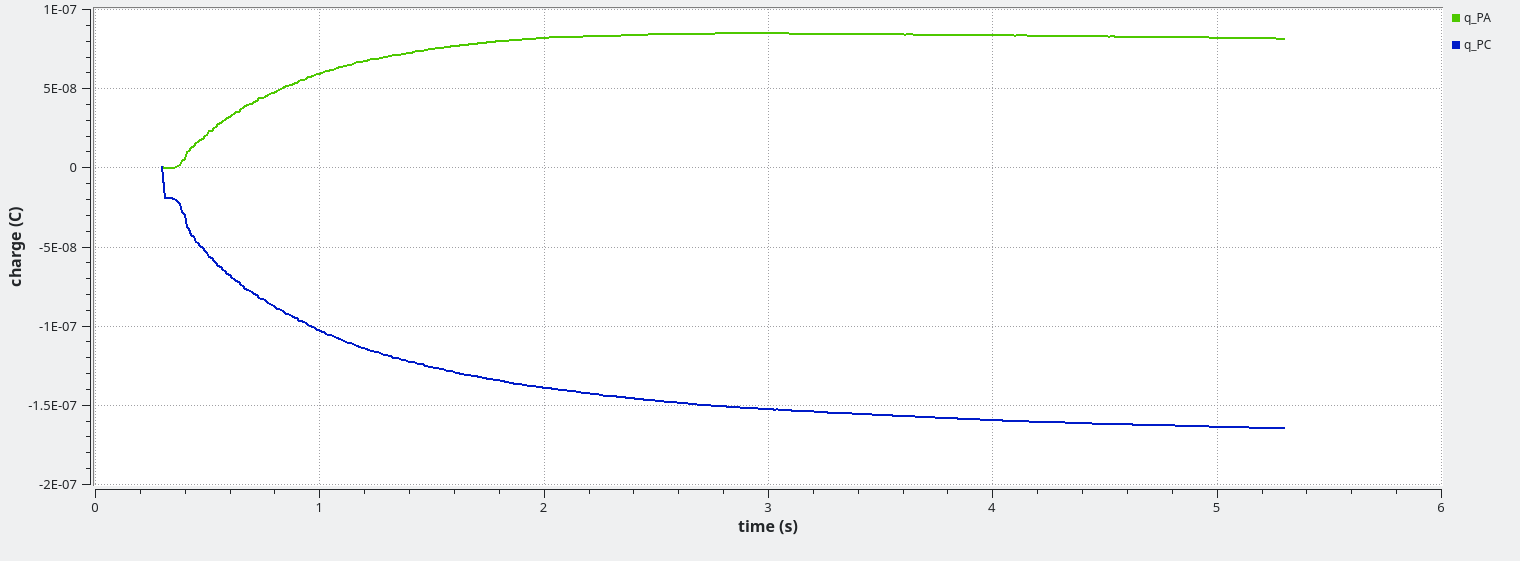
This project showcases the abilities of the enable_electric_field command command. It is modelled after a tribocharging experiment in Kolehmainen et al. (2013): Particles made of two different polymers (polyamide, polycarbonate) are put in a grounded, cubic metal box. The box vibrates, and due to triboelectric effects, charge separation occurs. Charge in both materials is measured over time.
Name of the case: Project_Charge_Transfer
General
This tutorial uses a fairly low Young’s Modulus of 1e7Pa. This value was chosen to allow for a large simulation timestep. Young’s Modulus is the major influence on the maximum contact area, which in turn governs the amount of charge transfered/generated per contact. For production simulations, it is therefore necessary to use the real material value.
The value for
workFunctionhas to be defined in (SI) energy units, but is usually given in eV - make sure to convert!
Case 1: Insertion
Three materials are defined:
Polyamide (
PA)Polycarbonate (
PC)Aluminum (
metal)
metal is only used for the cubic wall, while the other two materials are
used for the particles. The case defines two particle distributions: PA particles have a diameter of 2mm, while
PC particles have a diameter of 2.5mm.
A cube with edge length of 5cm is defined. 20g of each material are filled in the cube, and are allowed to settle under gravity.
A note on material parameters: it is necessary to define workFunction in the
insertion case, but it is set to 0 to avoid tribocharging taking place during
insertion.
Case 2: Tribocharging
The mesh is now vibrated at a frequency of 50Hz with an amplitude of 1mm in
vertical direction (parallel to gravity). This vibration creates contacts, which
in turn lead to charge separation due to the materials’ different values for
workFunction.