cohesion easo/capillary/viscous model
Purpose
This model can be used to add a liquid bridge force caused by a surface liquid film to a pair of particles.
Syntax
cohesion easo/capillary/viscous
zero or more keyword/value pairs may be appended to the end (after all models are specified)
tangential_reduce values = 'on' or 'off'
  on = tangential model does not see normal force computed by this model
  off = tangential model does see normal force computed by this model
Associated material properties
Material properties
contactAngle( ): contact angle of particle of this material and the fluid in degrees [
 ]
]minLiquidLayerThickness: the minimal thickness of the liquid film (default: 0) [length]liquidRedistributionFactor: ( ) multiplicative factor for particle redistribution upon bridge breaking (default: 1) [
![- ; [0,1]](_images/math/91350c97a022a773c9f70e4cf785078f9f703adb.png) ]
]
Global scalars
minRelativeSeparationDistance( ): minimum separation distance (e.g., 0.01) [
![-; ]0, \cdot]](_images/math/14ce57814ce8bb9c04ef5328d8cba8b262c58284.png) ]
]maxRelativeSeparationDistance( ): maximum separation distance (e.g., 0.1) []
surfaceLiquidContentInitial( ): initial surface liquid content, fraction of the solid volume [
![-; [0, 1]](_images/math/824da319f42f7f615f9f978e8e945dea26af4d1b.png) ]
]surfaceTension( ): surface tension of the liquid [force/length; [0,
  ]]
]]fluidViscosity( ): fluid viscosity of the surface liquid [pressure*time; [0, ]]
Description
This model can be used as part of pair gran
It adds a liquid bridge force, caused by a surface liquid film on the particles,
to a pair of particles, which consists
of a capillary and a viscous part. Furthermore, it solves for the
transfer of surface liquid from one particle to the other as the bridge breaks up.
The model uses a parameter, maxRelativeSeparationDistance, to apply a cut-off
to the liquid bridge force, i.e. radius * maxRelativeSeparationDistance is
the effective surface distance of the particles. The model follows a composition
of models suggested by (Easo)
Bridge formation and break-up, surface liquid transfer
 , the volume of surface liquid involved in the bridge, is given by

where  is the surface liquid volume attached to particle i/j.
This model assumes that both formation distance and rupture distance
is the surface liquid volume attached to particle i/j.
This model assumes that both formation distance and rupture distance  are given as follows by (Lian) :

When the bridge breaks, it is assumed that the surface liquid volume
distributes evenly to the two particles by default. This behavior can be
adjusted by setting the material property liquidRedistributionFactor
(). The liquid forming the bridge is distributed according to the
volume ratio of the particles involved in the contact where each volume is
adjusted by this property, i.e. the ratio is given as:
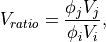
and the volume weight is then
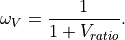
Capillary force
The capillary force is given by (Soulie) as:

where
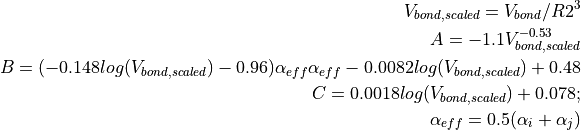
 is the distance between the particles’ surfaces, is the surface tension
of the fluid,
is the distance between the particles’ surfaces, is the surface tension
of the fluid,  ,
,  are the contact angles for particle i/j and the fluid. R2 is the
radius of the larger of the two particles in contact.
are the contact angles for particle i/j and the fluid. R2 is the
radius of the larger of the two particles in contact.
Viscous force
The normal and tangential parts of the viscous force are calculated as given by (Nase) :
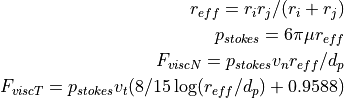
where  and
and  are the normal and tangential relative velocities of the
particles at the contact point, is the viscosity of the fluid
and
are the normal and tangential relative velocities of the
particles at the contact point, is the viscosity of the fluid
and  and
and  are the particle radii. An additional parameter,
minRelativeSeparationDistance (), is used to prevent the value of the viscous force from
becoming too large, i.e. radius * minRelativeSeparationDistance is assumed to be
the minimum separation distance.
are the particle radii. An additional parameter,
minRelativeSeparationDistance (), is used to prevent the value of the viscous force from
becoming too large, i.e. radius * minRelativeSeparationDistance is assumed to be
the minimum separation distance.
Computation of liquid transport and effect of liquid content on other particle properties
Per default, this model automatically instantiates a scalar transport equation that solves for the surface liquid content of each particles, expressed in volume fraction of solid volume (4/3 pi * radius ^3). The surface liquid volume is assumed to be small, i.e. it is assumed to have no effect on the particle mass, diameter and density.
The user can override the default behavior by explicitly specifying a fix that solves for the surface liquid transport between particles. Such fixes are fix liquidtransport/porous or fix liquidtransport/sponge
Minimum thickness of liquid film
If minLiquidLayerThickness is set to a value larger than 0, the liquid film covers
the particle completely only if the resulting liquid film thickness is larger than
the value set for minLiquidLayerThickness. Otherwise the particle is covered only
partially by a liquid film of the minimal thickness. The extent of the patch depends
on the liquid volume stored on the particle.
In case of a partial liquid coverage the liquid bridge model is not invoked if the dry sections of two particles or the dry section of the particle collide. If a “dry” collision without or a “wet” collision with liquid bridge occurs is determined stochastically for each collision event based on the ratio of wetted and dry surface area of the particles.
This additional modelling setp will be skipped if the material definitions of
both involved collision partners have set minLiquidLayerThickness 0.
Note
Stochastic nature of collisions, as mentioned above, means that to some extent the deterministic nature of the simulation is lost! E.g. the number of particles will change their behaviour, or the number of cores will also change behaviour!
Initialization
The optional keyword tangential_reduce defines if the tangential force model should “see” the additional normal force exerted by this model. If it is ‘off’ (which is default) then the tangential force model will be able to transmit a larger amount of tangential force If tangential_reduce = ‘on’ then the tangential model will not take the normal force from this model into account, typically leading to a lower value of tangential force (via the Coulomb friction limit)
Output
This gran model stores a couple of per-particle properties, for access by various output commands.
You can access the property surfaceLiquidContent by f_surfaceLiquidContent (units fraction of solid particle volume), liquidFlux (units fraction of solid particle volume/time) by accessing f_liquidFlux and liquidSource (units fraction of solid particle volume/time) by accessing f_liquidSource. The latter can be used to manually set a surface liquid source via the set command.
Currently, there is a restriction that these properties can only be accessed after a run 0 command.
Restrictions
This model can ONLY be used as part of pair gran, not as part of a fix wall/gran.
Coarse-graining information:
Using coarsegraining in combination with this command might lead to different dynamics or system state and thus to inconsistencies.
References
(Easo) Easo, Wassgreen, Comparison of Liquid Bridge Volume Models in DEM Simulations, AIChE Annual Conference (2013).
(Lian) Lian, Thornton, Adams, Journal of Colloid and Interface Science, p134, 161 (1993).
(Nase) S. T. Nase, W. L. Vargas, A. A. Abatan, and J. J. Mc-carthy, Powder Technol 116, 214 (2001).
(Shi) Shi, McCarthy, PowderTechnology, p64, 184 (2008)
(Soulie) Soulie, Cherblanc, Youssoufi, Saix, Intl. J Numerical and Analytical Methods in Geomechanics, p213, 30 (2006)
Default
tangential_reduce = ‘off’