cohesion model lubrication
Purpose
Modelling lubrication as proposed by Zhang et al. and Tomac and Gutierrez.
Syntax
cohesion lubrication
Associated material properties
Global scalars
dynamicFluidViscosity( ): dynamic viscosity of the fluid [pressure*time]
Description
The model computes the lubrication force between two particles or between a particle and a wall according to the formula:
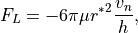
where  is the surface distance,
  is the normal component of
the relative velocity, and
is the normal component of
the relative velocity, and  is the effective radius given by

with  and
and  being the respective particle radii.
The lubrication force is only computed if the surface distance
is within the interval  .
.
Literature
[1] Zhang, W., Noda, R., & Horio, M. (2005). Evaluation of lubrication force on colliding particles for DEM simulation of fluidized beds. Powder technology, 158(1-3), 92-101.
[2] Tomac, I., & Gutierrez, M. (2013). Discrete element modeling of non-linear submerged particle collisions. Granular matter, 15(6), 759-769.