cohesion model fiber
Purpose
Basic contact model for fibers
Syntax
cohesion fiber [other model_type/model_name pairs as described here ] general_keyword general_value
zero or more general_keyword/general_value pairs may be appended to the end (using the settings keyword)
keep_original_shape general_value = 'on' or 'off'
    on = fibers will attempt to return to their original shape
    off = fibers will attempt to return to a straightened form [default]
Associated material properties
Material properties
fiberStiffnessYM( ): The Youngs Modulus of a fiber material, i.e. its stiffness [pressure]
fiberPoissonsRatio( ): The Poisson’s ratio, i.e. the ratio of transverse to axial strain, of the fiber [
 ]
]
Material interaction properties
fiberNormalDampingRatio( ): The damping ratio in normal direction []
fiberTangentialDampingRatio( ): The damping ratio in tangential direction []
maxDistanceBond( ): The maximum separation distance of two particles in a fiber [length]
Description
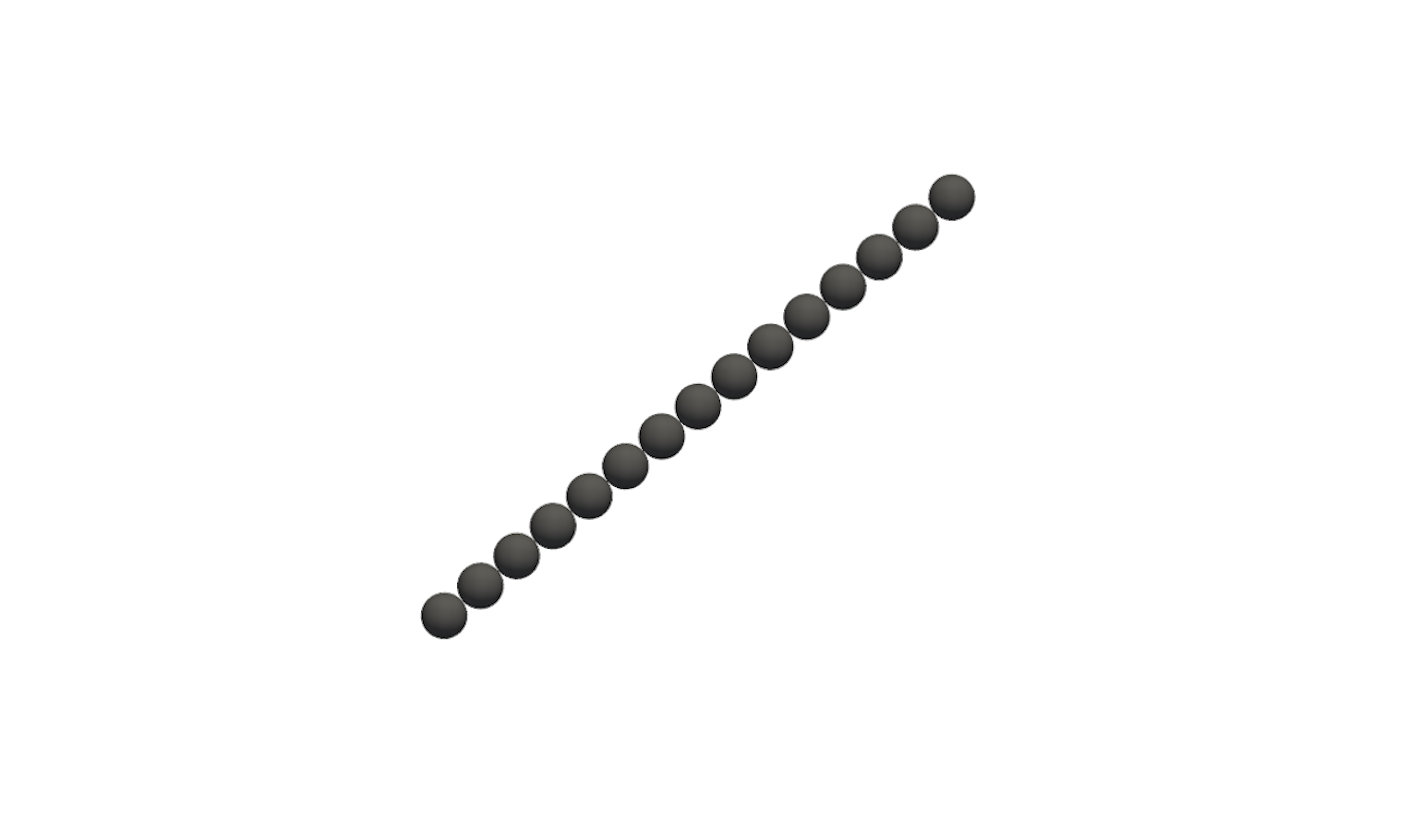
This model can be used as part of a particle_contact_model.
The current implementation creates the bond with zero forces and torques
between the bonded particles. Due to relative motion forces and torques will
act on the particles, where the normal force  and the tangential
force
and the tangential
force  are calculated explicitly:
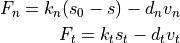
with the stiffness coefficient  , the damping coefficient
  ,the relative velocity
  , the initial distance
  , and the
current distance
, and the
current distance  . The indices
  and
and  stand for
normal and tangential, respectively.
stand for
normal and tangential, respectively.
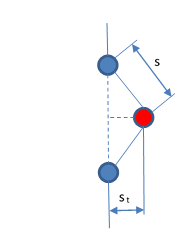
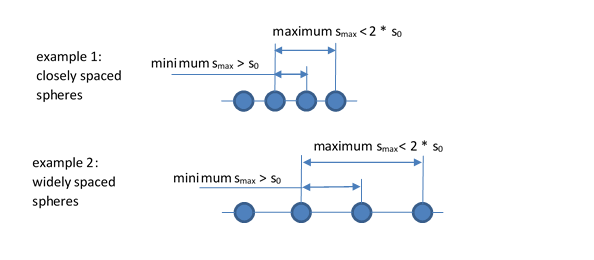
The maximum distance two spheres may have is the maxDistanceBond, .
Since the centre-point distance between two spheres is used as breakage criterion and also used
for bond creation, this value needs to be above the initial distance and below the distance
to the next neighbor. Otherwise the bonds would not be created or a bond with the neighbor and
the next neighbor would be created.
The stiffness and damping coefficients are calculated from several material properties, namely fiberStiffnessYM, fiberPoissonsRatio, fiberNormalDampingRatio, and fiberTangentialDampingRatio:
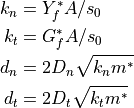
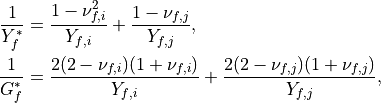
where the effective Young’s modulus  and Shear modulus
  depend on the Young’s modulus
  and the Poisson’s ratio
  from
the material/particle combination (i and j).
from
the material/particle combination (i and j).  is the effective mass, and
  is the corresction area of
the bond, computed as
is the corresction area of
the bond, computed as  with
with  being the effective radius. The effective Young´s modulus and
Shear modulus are computed as
being the effective radius. The effective Young´s modulus and
Shear modulus are computed as
and are the fiberXXXDampingRatio. In theory, valid
values can vary from  underdamped,
  critically
damped to
critically
damped to  overdamped. Due to numerical accuracy the simulated
behaviour may be slightly shifted (e.g. still oscillating although ).
In most cases a damping ratio of 1 is a good first starting point. An undamped
system
overdamped. Due to numerical accuracy the simulated
behaviour may be slightly shifted (e.g. still oscillating although ).
In most cases a damping ratio of 1 is a good first starting point. An undamped
system  will lead to an unstable system in nearly all cases.
Note
Stronger damping yields to higher forces. To guarantee a stable simulation this may require to lower the time step.
If keep_original_shape is not enabled a fiber will always attempt to relax itself into a completely straight state. If it is enabled then the fiber will try to relax into the state it had upon insertion.
There are also several advanced fiber models which can model plastic deformation or buckling and cohesion between disjoint fibers.
Restrictions
This model cannot be used as a wall contact model.
Using coarsegraining in combination with this command might lead to different dynamics or system state and thus to inconsistencies.