cohesion model bubble/coalescence
Purpose
Implementing the bubble coalescence model from Lau et al..
Warning
This is an experimental feature. It may produce unexpected results, and its behaviour may change without announcement in a future versionSyntax
cohesion bubble/coalescence [other model_type/model_name pairs as described here ] settings keyword values
zero or more keyword/value pairs may be appended after the keyword settings (after all models are specified)
use_radius_max values = 'on' or 'off'
  on = once a bubble has reached a defined maximum radius growth is stopped
  off = no upper limit on bubble growth
use_vel_max values = 'on' or 'off'
  on = only if one of two bubbles velocity in contact is below a defined threshold they can coalesce
  off = no limit on bubble coalescence
Associated material properties
Global scalars
surfaceTension( ): surface tension coefficient [force/length]
radiusBubbleMax( ): maximum bubble radius [length]
velBubbleMax( ): maximum contact velocity for bubble coalescence [length/time]
Description
This model implements bubble coalescence as described in Lau et al.. For coalescence to occur, the kinetic energy of the collision must exceed the surface energy for the bubble:
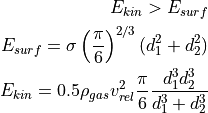
where is the surface tension coefficient,  and
and  are the diameters of the colliding bubbles,
  is the gas density,
and
is the gas density,
and  is the relative velocity between the bubbles.
When coalescence occurs (i.e., above criterion is satisfied), the merging of the bubbles is performed by continuously growing the larger of the two bubbles, and shrinking the smaller of the two bubbles, which is then finally deleted when it reached some threshold radius.
This model can be used as part of pair bubble.
Restrictions
None
Coarse-graining information:
Using coarsegraining in combination with this command might lead to different dynamics or system state and thus to inconsistencies.
Default
use_radius_max = off, use_vel_max = off
Literature
[1] Lau, Deen and Kuipers, Chemical Engineneering Science, 108, p 9 (2014).