liquidtransport/evaporation command
Purpose
Command
Warning
GPU support for this command has not been tested and may not work as expected.Syntax
liquidtransport/evaporation keyword value
With the following keyword argument pairs:
Keywords |
Description |
|---|---|
transport |
bool (
yes or no) determining if liquid can be transferred between particles upon contactdefault:
yes |
liquid_species_name |
name of the species of the composition that can undergo evaporation
; units: [-]
|
variable_properties |
list of properties that are changed due to evaporation or spray->particle mass transfer, available properties are
mass and size(default:
{}) |
selector for the evaporation model. Available options:
simple, boil, Gunndefault:
simple |
|
liquid_density (deprecated -> use |
scalar value setting the liquid density
; units: [mass/volume units]
|
Examples
liquidtransport/evaporation transport no liquid_species_name liquid variable_properties {mass,size}
Description
This command solves for the evolution of liquid for each particle. Every time step, the liquid content of each particle is updated based on the sum of liquid fluxes with other particles and additional sources.
This command internally creates four properties instances, that store the following variables:
|
liquid content of a particle |
volume % of solid (core+pore) volume |
|
liquid flux of a particle, as computed by a liquid bridge model |
volume % of solid (core+pore) volume / time |
|
liquid source via surface films, as computed by a liquid bridge model |
volume % of solid (core+pore) volume / time |
|
liquid mass evaporated during a CFD coupling interval |
mass |
The per-particle variable surfaceLiquidContent is defined as the volume
of liquid carried by the particle divided by the volume of the solid particle. There
is no upper boundary for the liquid content; neither the particle radius nor its
thermal capacity change with liquid content.
Liquid transport between particles, denoted by the variable liquidFlux, occurs only
if transport = yes and a liquid bridge model has been defined, e.g.
cohesion easo/capillary_viscous or
cohesion washino/capillary_viscous.
In order to use this fix, the initial liquid content of each particle must be defined as follows:
global_scalar id surfaceLiquidContentInitial value <value>
In case the evaporation model is activated, the following additional properties must be defined for all materials
latentHeat
tempEvaporate
liquidHeatCapacity
Please note that when inserting particles with liquid content, the massflow rate of the insertion command only accounts for the mass of the dry material. For inserting the correct amount of material please scale the massflow rate down by the mass of the defined liquid film.
Evaporation models
The evaporation_model allows for the following choices:
simple: Evaporation only occurs if the particle reaches the evaporation temperature. At or above the evaporation temperature all excess and incoming heat is used to evaporate liquid. This also means that a particle does not increase its temperature during an ongoing evaporation processs.This approach is similar to the one taken in fix_heat_gran_melting. The property
evaporatedMassAccumulatedcan be communicated to CFD and used there by the LaEuScalarMass model as source term in the CFD.boil: The liquid content may evaporate already below the evaporation temperature. At each time step, the evaporation mass rate is computed according to the Stefan–Fuchs equation based on the vapour saturation density at the particle’s surface (set by the
 surface_fluid_densitykeyword), on the particle’s cross-section area , on the particle’s diameter
  , on the
Sherwood number
, on the
Sherwood number  , on the diffusion coefficient
  , and on the vapour
concentrations at the particle’s surface
, and on the vapour
concentrations at the particle’s surface  and far away
  :
:
where the Sherwood number is defined according to Frössling as:

The Reynolds
 and Schmidt
  numbers are defined as:
where
 is the kinematic viscosity of the environmental fluid,
  is the relative
velocity between particle and fluid. The diffusion coefficient is defined as:
is the relative
velocity between particle and fluid. The diffusion coefficient is defined as: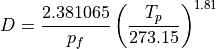
where
 is the pressure of the environmental fluid and
  is the particle temperature.
This evaporation model requires the following additional keywords:
Keywords for evaporation_model boil
Keywords
Description
fluid_viscosity
scalar value setting the kinematic viscosity of the environmental fluiddefault:1.5e-5; units: [length^2/time]fluid_pressure
scalar value setting the pressure of the environmental fluid if not obtained from the CFD simulationdefault:101325; units: [force/length^2]surface_fluid_density
scalar value setting the vapour saturation density at the particle’s surfacedefault:1; units: [mass/length^3]Note
If running in a coupled simulation data for the local pressure and the vapour concentration are received from the CFD. On the CFD side the transferVapour forceModel is required to match the communication requirements.
Note
The
surface_fluid_densityin reality is not constant, as the vapour saturation density of a certain substance depends on the temperature of the vapour. For example, the saturation density of water vapour in air is 0.005 kg/m3 at 0 °C, 0.03 kg/m3 at 30 °C, and 0.13 kg/m3 at 60 °C. TheGunn modelautomatically calculates the vapour saturation density.
Gunn: The liquid content may evaporate already below the evaporation temperature. At each time step, the evaporation mass rate is computed according to the Stefan–Fuchs equation based on the vapour saturation density at the particle’s surface, on the particle’s cross-section area ,
on the particle’s diameter , on the Sherwood number , on the diffusion
coefficient , and on the vapour concentrations at the particle’s surface
and far away .where the Sherwood number is defined according to the empirical Gunn correlation:

where
 is the local fluid volume fraction, and are the Reynolds and Schmidt numbers
respectively.
is the local fluid volume fraction, and are the Reynolds and Schmidt numbers
respectively.where
is the kinematic viscosity of the environmental fluid, is the relative
velocity between particle and fluid. The diffusion coefficient is defined as:where
is the pressure of the environmental fluid and is the particle temperature.
The vapour saturation density at the particle’s surface is calculated according to the following formula: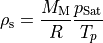
where
 is the molar mass of the evaporating liquid,
  is the saturation pressure
of the vapour, and
is the saturation pressure
of the vapour, and  is the temperature of the environmental fluid.
This model requires the following additional keywords:
Keywords for evaporation_model Gunn
Keywords
Description
fluid_viscosity
scalar value setting the kinematic viscosity of the environmental fluiddefault:1.5e-5; units: [length^2/time]fluid_pressure
scalar value setting the pressure of the environmental fluid if not obtained from the CFD simulationdefault:101325; units: [force/length^2]fluid_temperature
scalar value setting the fluid temperature if not obtained from the CFD simulationdefault:303; units: [temperature]liquid_molar_mass
scalar value setting the molar mass of the evaporating liquiddefault:0.01801528; units: [mass/mole]Note
If running in a coupled simulation, data for the local temperature, pressure, and the vapour concentration are received from the CFD. On the CFD side the transferVapour forceModel is required to match the communication requirements. Further note, that for this model combination the flags
transferTemperature true;andtransferVoidfraction true;should be activated incouplingProperties/transferVapourProps.If this model is used in a pure DEM case, the voidfraction
is set to
unity and the following options can be used to set the other parameters globally:fluid_viscosity: the fluid (kinematic) viscosity (default: 1.5e-5)fluid_pressure: the fluid pressure (default: 101325)fluid_temperature: the fluid temperature (default: 303)liquid_molar_mass: the evaporating liquids molar mass (default: 0.01801528)
Also note that
fluid_temperatureis not set from a temperature field provided by an eventually present fix temperature/fluid/field command.
If using at least one droplet_solid custom material, liquidtransport/evaporation command
tracks the volume of solid volume deleted due to the droplet_solid being dried up
completely. The deleted solid volume of every droplet_solid material stored as an
additional quantity accessible via <fix_id>.total_deleted_solid_<material_id>.
Output info
This gran model stores a couple of per-particle properties, for access by various output commands.
You can access the property surfaceLiquidContent by f_surfaceLiquidContent (units % of solid particle volume), liquidFlux (units % of solid particle volume/time) by accessing f_liquidFlux and liquidSource (units % of solid particle volume/time) by accessing f_liquidSource. The latter can be used to manually set a surface liquid source via the set command.
Currently, there is a restriction that these properties can only be accessed after a run 0 command.
Restart, fix_modify, run start/stop:
The all of the quantities used by this fix are written to binary restart files so simulations can continue properly. None of the fix_modify options are relevant to this fix.
No parameter of this fix can be used with the start/stop keywords of the run command.
Restrictions
liquid_density is a deprecated input for defining the density the surface film. Please use the new composition_properties framework.
Literature
[1] Gunn, D. J. Transfer of heat or mass to particles in fixed and fluidised beds. Int. J. Heat Mass Transfer 1978, 21 (4), 467−476
[2] Frössling, F, Über die Verdunstung Fallender Tropfen. Gerlands Beitr. Geophys. 1938, 52, 107−216