 Home
HomeSpray granulation
Warning
This tutorial is included in and relies on functionality that is available in the CFDEMcoupling-Premium package.
This tutorial shows how to perform a simple simulation of a pure liquid being sprayed onto a fluidized powder bed. The physics being represented include:
Momentum and energy transfer between fluid and particles (i.e., spray droplets and carrier)
Liquid transfer from spray droplets to carrier upon impact
Evaporation of spray droplets and liquid on wet carrier
The simulation model does not account for:
Gas compressibility
Air-vapour mixture
Mass transfer from liquid to gas during evaporation
Realistic droplet evaporation based, e.g., on a Sherwood number correlation
Solute or suspended solid in spray liquid droplets
Note
This tutorial is located in CFDEMcoupling/useCases/sprayGranulation
A compressible, multi-species simulation with more advanced evaporation models is possible with the CFDEMcoupling-Chemistry package.
Models used
cfdemSolverPimple with solution of scalar transport equation for the temperature.
Koch-Hill drag models the momentum coupling between particles and fluid.
LaEuScalarTemp models the temperature exchange between particles and fluid.
Evaporation model of type
simple
To speed up this simulation, a very low evaporation temperature was chosen for the liquid.
Note
The default setup of this case runs for a shorter time and acquires statistics for
a very short time. To recreate the results shown in this article comment the
settings changes in prerun_TH.sh.
Results
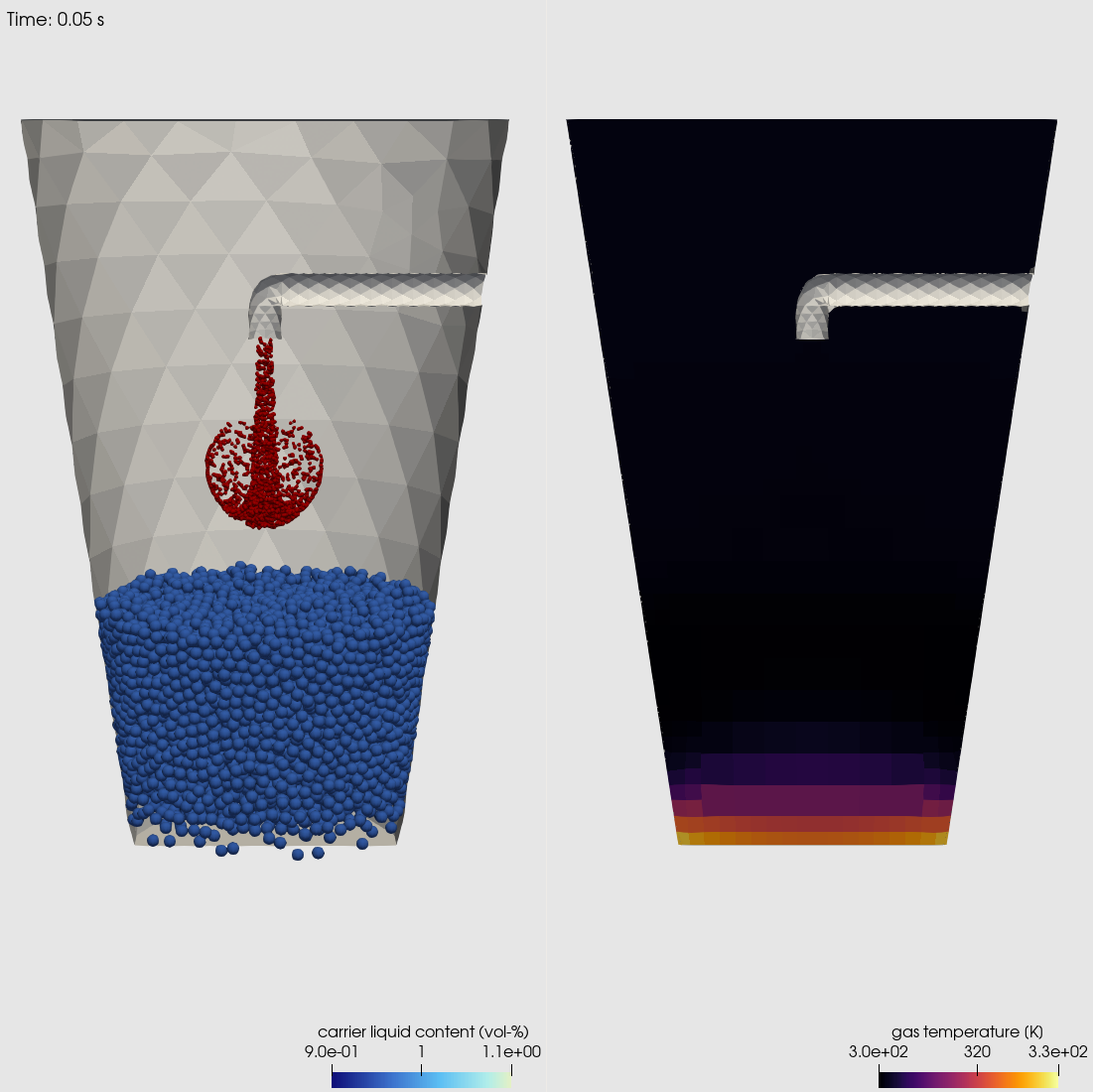
Figure 1: The carrier has an initial surface liquid content equal to 1% of the solid particle’s volume. The spray, colored in red, is injected from the top nozzle with a downward velocity of 30 m/s. An air current with a velocity of 0.5 m/s and temperature of 333.15 K fluidizes the powder bed. This picture shows the particles (left) and a cross-section coloured with the gas temperature (right) shortly after the beginning of the simulation.
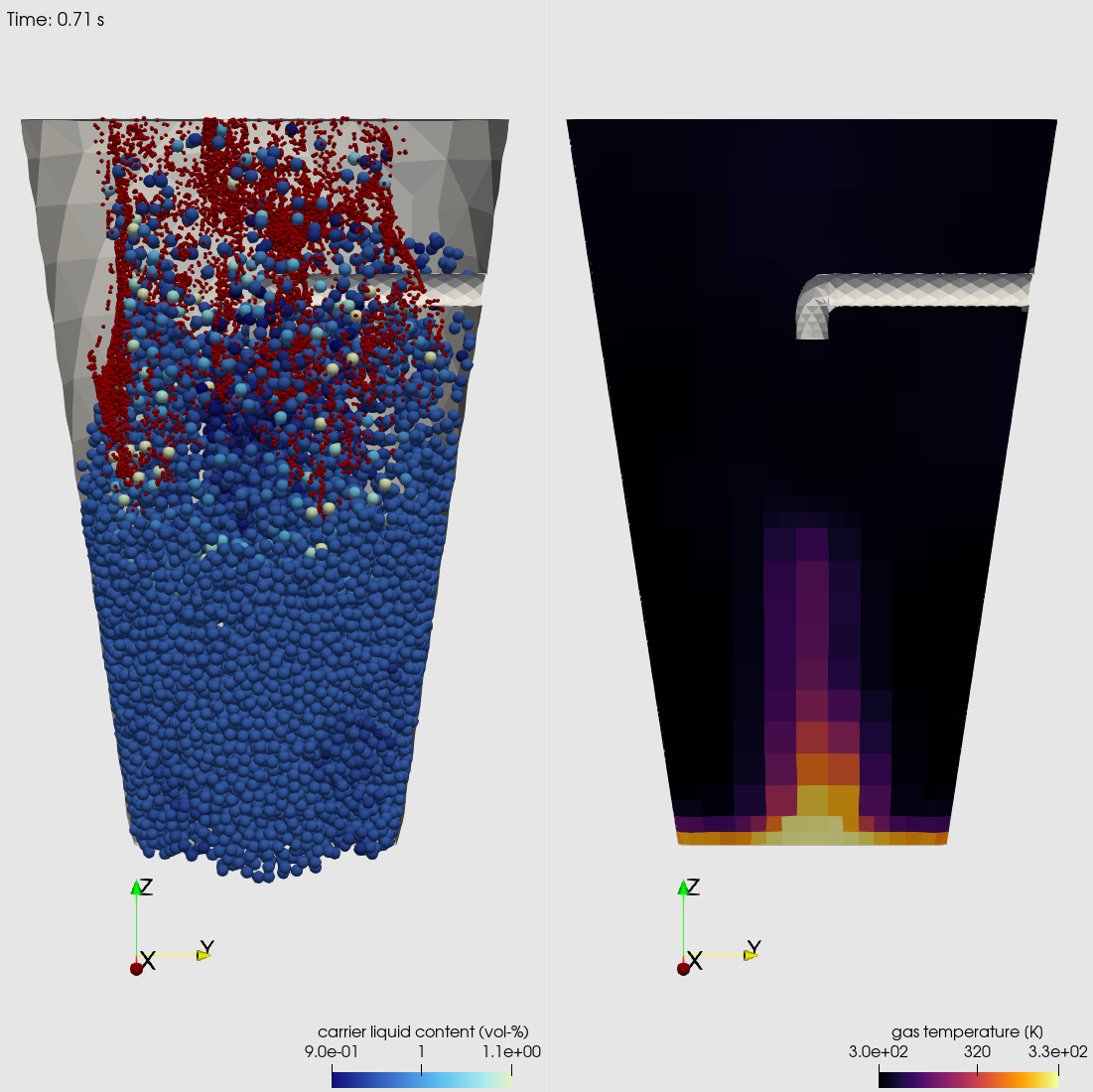
Figure 2: same as Figure 1, but after 0.71 seconds. On some carrier particles initial liquid content has evaporated (dark blue particles), others have received liquid due to collisions with spray droplets (white particles).