 Home
HomeErosion around an obstacle
Warning
This tutorial is included in and relies on functionality that is available in the CFDEMcoupling-Multiphase package. You can run this case in any version of CFDEMcoupling when omitting the liquid-gas interface.
A particle bed at the bottom of a channel erodes over time due to fluid forces.
Note
This tutorial is located in CFDEMcoupling/useCases/erosionAroundObstacle
Insertion strategy
The insertion part of this setup aims to insert an even particle bed with equal bed height across the entire domain. For that reason, the insertion is performed in the following steps:
Insert more particles than needed for the desired bed height in the entire domain excluding the footprint of the obstacle. This operation is performed with the
until settledmode of the simulate command which tracks the kinetic energy in the region to be filledRemove all excess particles once this criterion is fulfilled. As the mass of the packing changes a second settling step is required. Moreover, during this time the buoyancy in water is accounted for. The latter point is crucial to avoid bed expansion when starting the coupled simulation.
Boundary conditions
top |
totalPressure |
pressureInletOutletVelocity |
inletOutlet |
bottom |
fixedFluxPressure |
noSlip |
fixedValue = 1 |
pillar |
fixedFluxPressure |
noSlip |
zeroGradient |
inlet |
fixedFluxPressure |
fixedValue = (1 0 0) |
fixedValue = 1 |
airInlet |
fixedFluxPressure |
fixedValue = (1 0 0) |
fixedValue = 0 |
bedInlet |
fixedFluxPressure |
noSlip |
fixedValue = 1 |
outlet |
fixedFluxPressure |
outletPhaseMeanVelocity |
variableHeightFlowRate |
bedOutlet |
fixedFluxPressure |
noSlip |
zeroGradient |
front|back |
fixedFluxPressure |
slip |
zeroGradient |
Models used
Particle forces:
The drag force is computed by the DiFelice drag model.
Alteration of effective gravity forces due the difference of fluid and particle densities is modelled by the Archimedes force model.
Particles are mapped to CFD cells by the engine locateModel.
The voidfraction is computed by the divided voidfraction model.
This case runs using cfdemSolverInter and models the liquid-gas interface using a Volume-of-Fluid method. on temperature was chosen for the liquid.
Note
The default setup of this case runs for a shorter time.
To recreate the results shown in this article comment the
settings changes in prerun_TH.sh.
Results
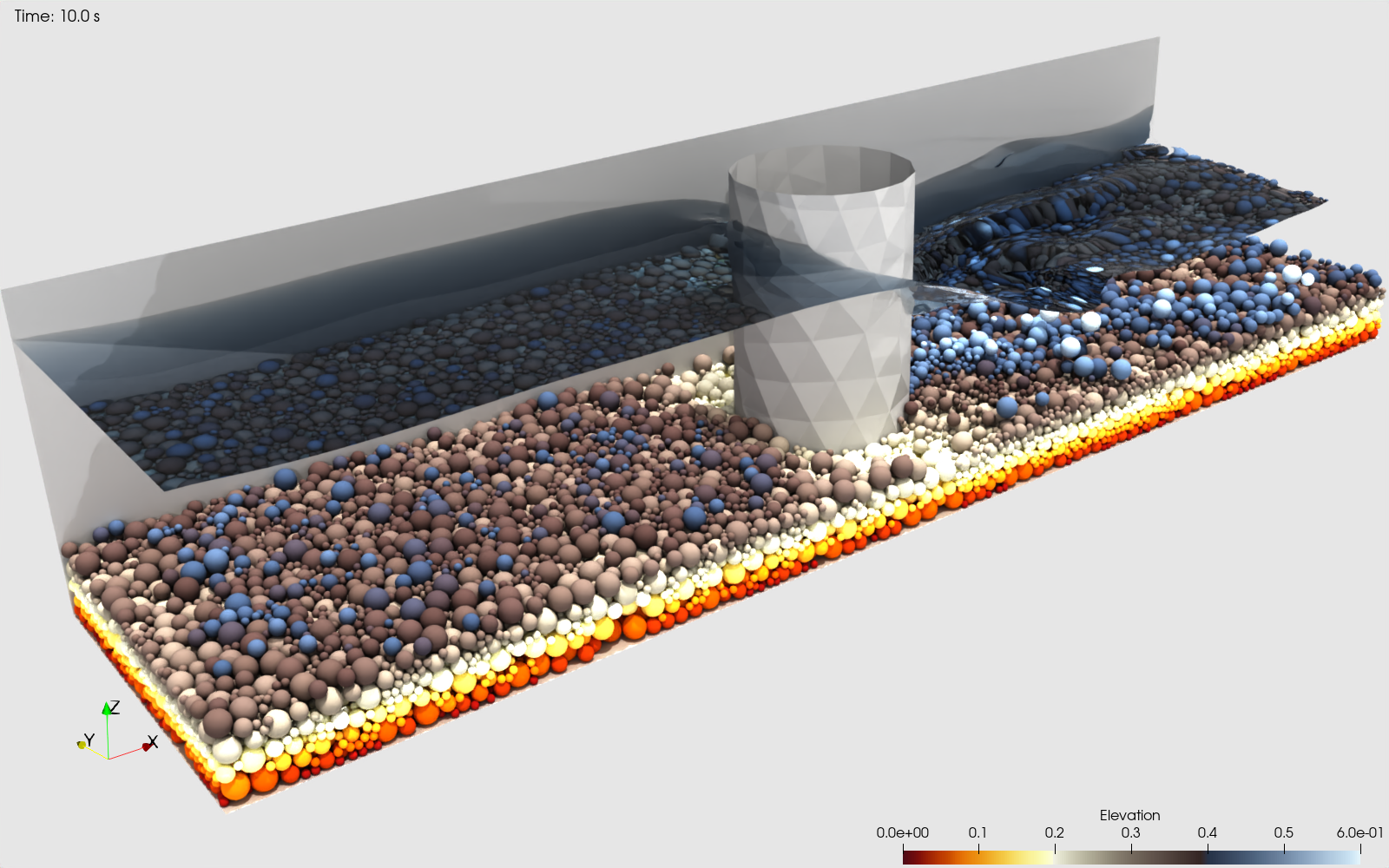
Figure 1: The liquid-gas interface and the particles colored by the vertical location of their center point after 10 seconds of simulation time. The initial bed height is 0.4 meters.
Scaled up simulation
This simulation setup can easily be scaled up to simulate processes in realistically-sized domains.
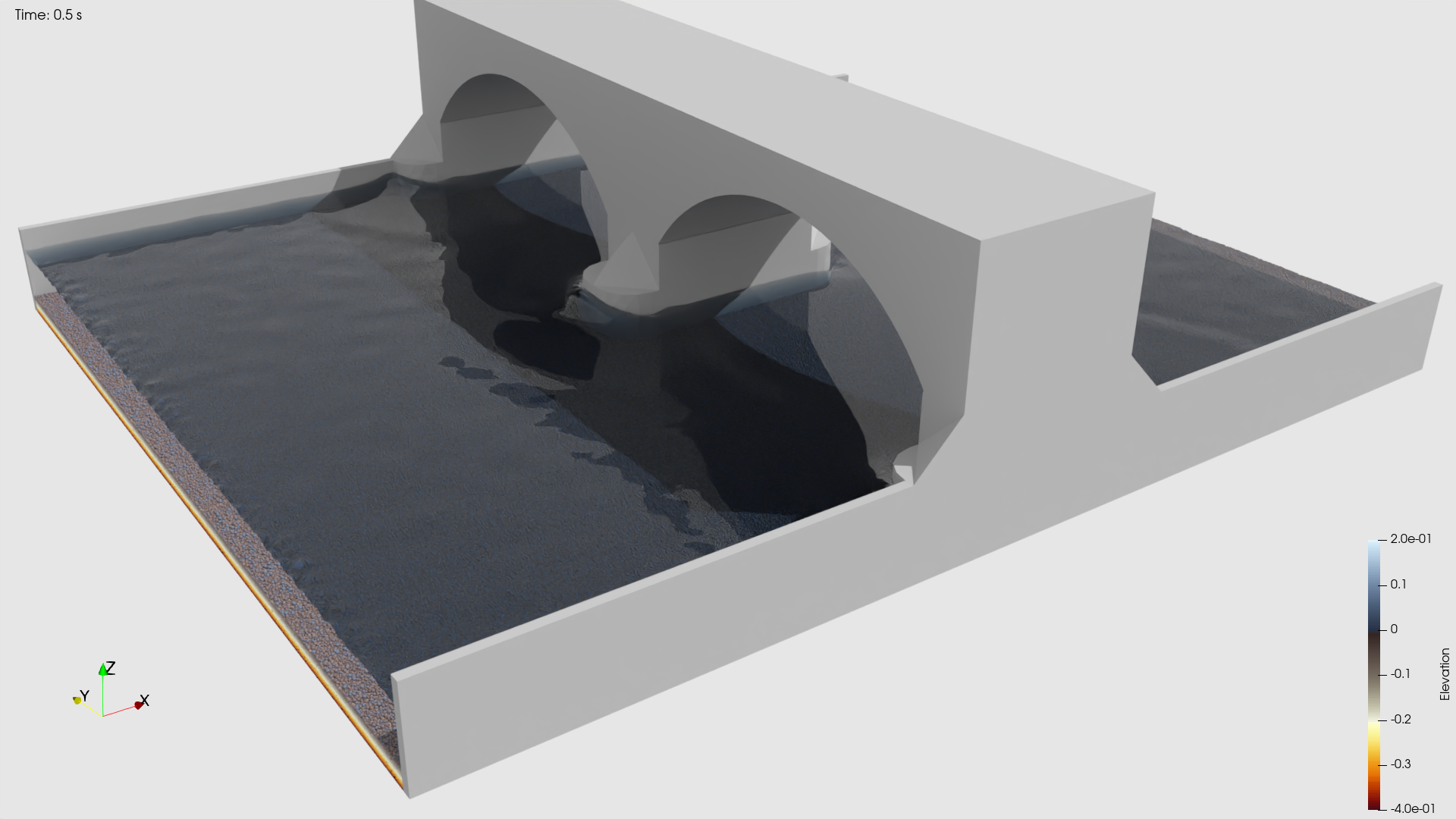
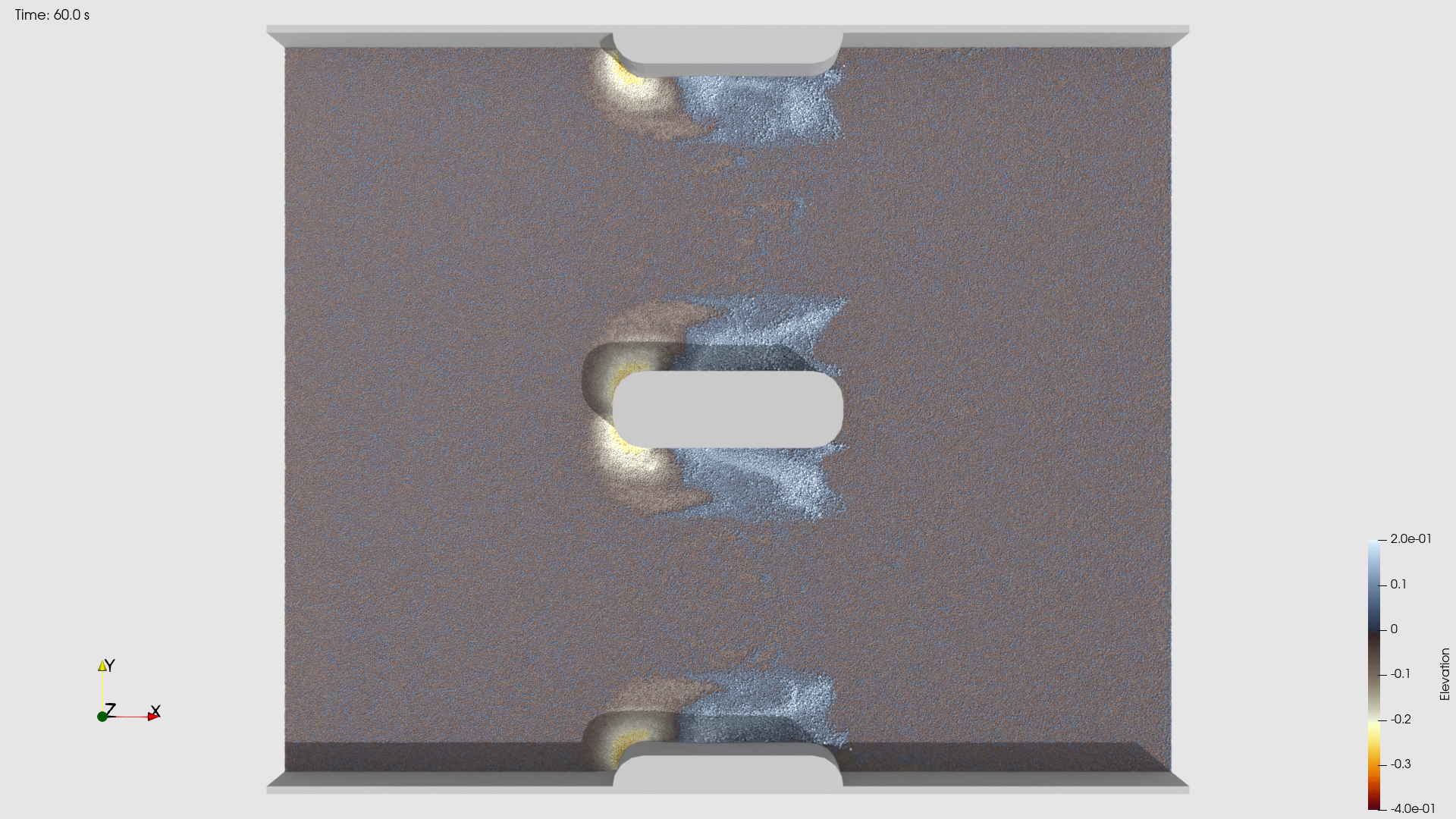
Figure 2: River bed erosion around a bridge. Left: Initial conditions. Right: Bed erosion at the end of the simulation seen from the top. Watch the entire video.
Comparison to scouring investigations reported in literature
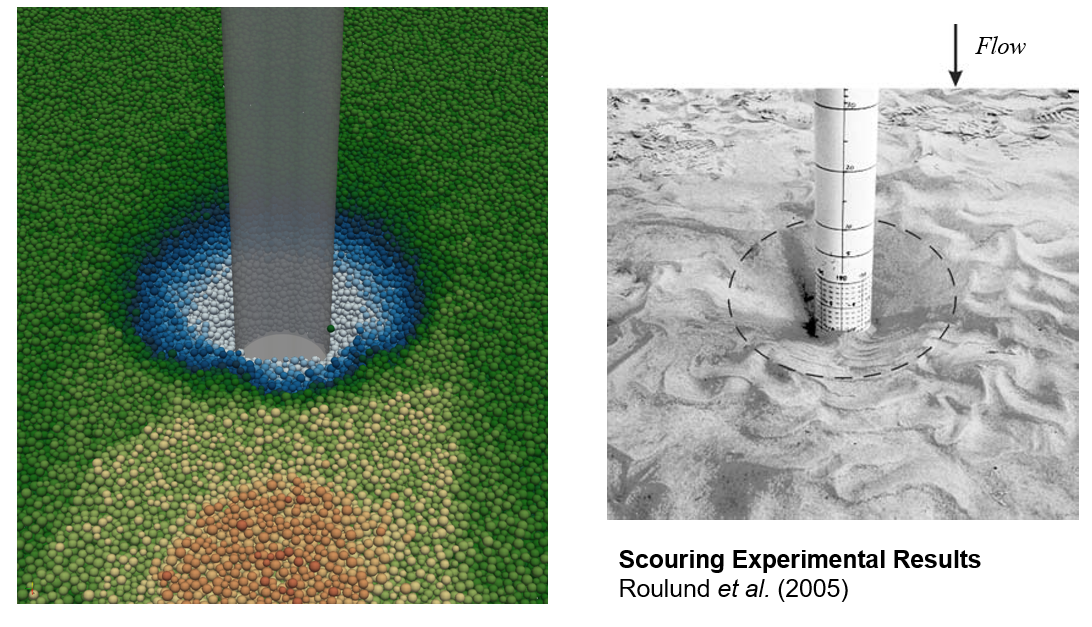
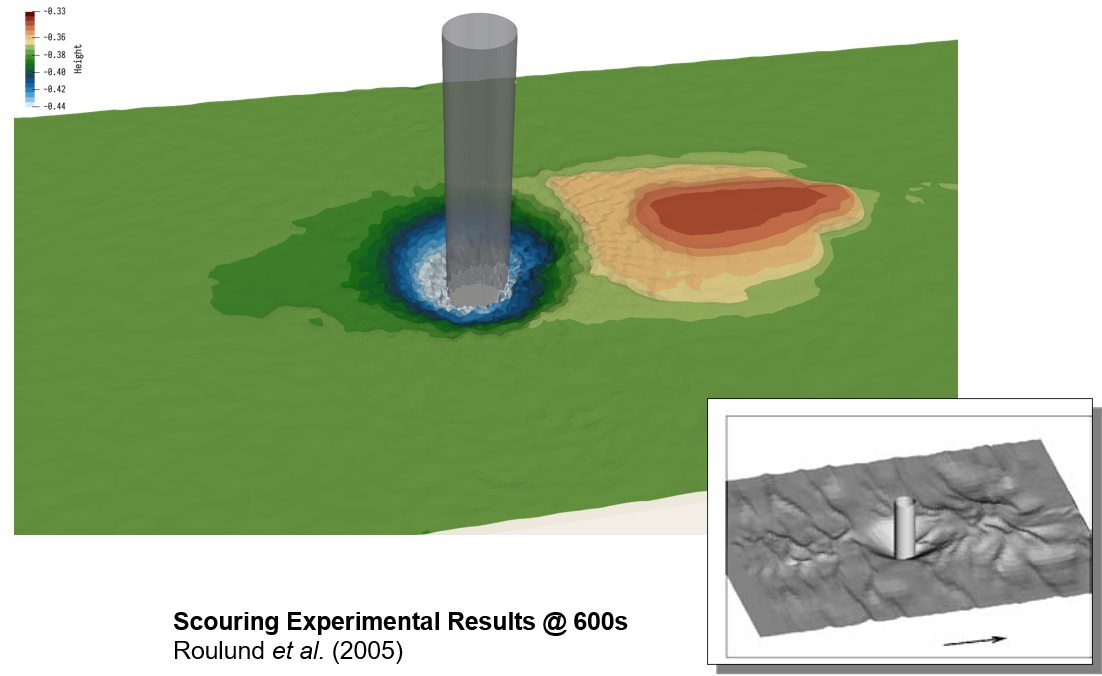
Figure 3: Comparison of numerical results from a larger setup with those reported by Roulund et al.. Top and bottom image show the same simulation from different perspectives. The bottom images uses an iso-surface of the particle volume fraction to visualize the surface of the particle bed.
Literature
[1] A. Roulund, et al. Numerical and experimental investigation of flow and scour around a circular pile. Journal of Fluid Mechanics 534 (2005): 351-401. doi:10.1017/S0022112005004507