normal model thornton_ning
Purpose
The Thornton and Ning normal model which is a cohesive model with plastic dissipation
Syntax
model thornton_ning [other model_type/model_name pairs as described here ] keyword values
zero or more keyword/value pairs may be appended after the keyword settings (after all models are specified)
create_bonds_at_timestep values = 'on' or 'off'
  on = bonds are created at a specific, user-defined timestep
  off = no bonds are created
create_bonds_at_first_run values = 'on' or 'off'
  on = bonds are created in the first run of the current simulation
  off = no bonds are created
disable_cohesion_for_unbounded values = 'on' or 'off'
  on = cohesive part of contact model is ignored for pairs that do not share a bond
  off = force computation is unaltered
break_at_max_force values = 'on' or 'off'
  on = contact breaks at maximum of cohesive force
  off = bond breaks at 5/9 of the maximum cohesive force like in the standard JKR model
Associated material properties
Material properties
youngsModulus( ): The Youngs Modulus of a material, i.e. its stiffness [pressure]
poissonsRatio( ): The Poisson’s ratio, i.e. the ratio of transverse to axial strain [-]
coefficientYieldRatio( ): The yield ratio for a particular material [-]
Material interaction properties
surfaceEnergy( ): This is the cohesive surface energy between two materials [energy/length]
Global scalars
The following value is required if create_bonds_at_timestep is on:
tsCreateBondThorntonNing: specifies the timestep at which bonds are created
Description
This granular normal model uses the contact law proposed by (Thornton and Ning). The main feature is the different un-/loading behaviour. The force formulation is provided in a differential form, thus the current force is always calculated by updating the force from the last timestep.

In case of plastic deformation the differential force component is given by

where  and
and  name the pressure and contact area for the yield limit.
The user can define the area by defining the global property coefficientYieldRatio, since
it holds
name the pressure and contact area for the yield limit.
The user can define the area by defining the global property coefficientYieldRatio, since
it holds
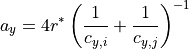
Further the elastic loading is described by
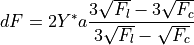
and the elastic recovery is given by
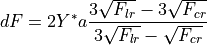
where  is the cohesive force. It is
defined by the surface energy that must be provided by the user.
is the cohesive force. It is
defined by the surface energy that must be provided by the user.
 is a function of the cohesive force and the current force.
In the above equations  and
and  are the effective Young’s modulus
and effective radius as mentioned in model hertz.
are the effective Young’s modulus
and effective radius as mentioned in model hertz.
This model requires several material properties, namely youngsModulus, poissonsRatio, surfaceEnergy and coefficientYieldRatio. To define those material properties, it is mandatory to use multiple fix property/global commands:
The model is capable of creating bonds. These bonds have no impact on force computation, but they can be used for postprocessing, eg. to track which of the initial contacts in a packing broke during the simulation. The number of bonded contacts of a particle can be computed via compute coordination_number. Bonds can be created either at a certain timestep (create_bonds_at_timestep) or at the beginning of the first simulate or run command in the current simulation. The latter is useful if the first timestep of a simulation is unknown, eg. because a restart file is read.
disable_cohesion_when_unbonded disables the cohesive part of the contact model
for particle pairs that do not share a bond. The contact is handled as if
 .
.
break_at_max_force changes the point at which the contact is considered broken. According to JKR theory, some cohesive force remains when the surfaces are no longer in contact. This cohesive force reaches a maximum absolute value of
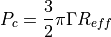
where  is the effective radius of the contact partners, then
decreases with increasing separation, and the contact breaks when the magnitude
reaches
is the effective radius of the contact partners, then
decreases with increasing separation, and the contact breaks when the magnitude
reaches  . If break_at_max_force is on, this decrease
does not happen, instead the contact breaks when the cohesive force reaches its
maximum absolute value
. If break_at_max_force is on, this decrease
does not happen, instead the contact breaks when the cohesive force reaches its
maximum absolute value  .
.
Restrictions
Warning
The yield stress given by 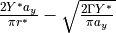 must be positive.
Coarse-graining information
Using coarsegraining in combination with this command should lead to statistically equivalent dynamics and system state.
Default
none
(Thornton and Ning) Thornton, C. & Ning, Z. A theoretical model for the stick/bounce behaviour of adhesive, elastic-plastic spheres. Powder Technol. 99, 154–162 (1998).