normal model hertz/stiffness
Purpose
Implement the normal contact model Hertz with user-defined non-linear stiffness and damping.
Syntax
model hertz/stiffness [other model_type/model_name pairs as described here ] settings keyword values
zero or more keyword/value pairs may be appended to the end (after all models are specified)
limitForce values = 'on' or 'off'
  on = ensures that the normal force is never attractive (an artefact that can occur at the end of a collision).
  off = standard implementation that might lead to attractive forces.
tangential_damping values = 'on' or 'off'
  on = activates tangential damping
  off = no tangential damping
Associated material properties
None.
Material interaction properties
kn( ): modified elastic modulus for normal contact of the two materials [pressure]
kt( ): modified elastic modulus for tangential contact of the two materials [pressure]
gamman( ): viscoelastic damping coefficient for normal contact of the two materials [pressure*time/mass]
gammat( ): viscoelastic damping coefficient for tangential contact of the two materials [pressure*time/mass]
Description
This model extends the normal contact model Hertz by
allowing a non-linear normal stiffness  and viscoelastic
damping coefficient
and viscoelastic
damping coefficient  , namely:
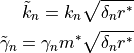
where  is the particles’ overlap,
  is the
effective radius and
is the
effective radius and  is the effective mass.
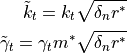
The model also defines the tangential stiffness  and viscoelastic
damping coefficient
and viscoelastic
damping coefficient  to be used by the
tangential models as follows:
to be used by the
tangential models as follows:
Restrictions
None.
Coarse-graining information:
Using coarsegraining in combination with this command should lead to statistically equivalent dynamics and system state.
Default
tangential_damping = ‘on’, limitForce = ‘off’