normal model hooke/hysteresis
Syntax
model hooke/hysteresis [other model_type/model_name pairs as described here ] settings keyword values
zero or more keyword/value pairs may be appended after the keyword settings (after all models are specified)
tangential_damping values = 'on' or 'off' on = activates tangential damping off = no tangential damping viscous = 'on' or 'off' on = restitution coefficient varies with a local Stokes number of the particle. Requires additional global properties to be specified off = no modification to the restitution coefficient useCharacteristicVelocity values = 'on' or 'off' on = if bothcharacteristicVelocityandelasticStiffnessare defined, thecharacteristicVelocitywill be used off = if bothcharacteristicVelocityandelasticStiffnessare defined, theelasticStiffnesswill be used [default]
Associated material properties
Material properties
youngsModulus( ): Young’s modulus of the material [pressure]
poissonsRatio( ): Poisson’s ratio of the material [
 ]
]
Material interaction properties
coefficientRestitution( ): coefficient of restitution of the two materials []
elasticStiffness( ): elastic (normal) stiffness of the two materials in contact [force/length] (required only if
 characteristicVelocityis not defined)coefficientMaxElasticStiffness( ): ratio between the maximum elastic stiffness
 and the normal stiffness []
coefficientAdhesionStiffness( ): ratio between the adhesion stiffness
  and the normal stiffness []
coefficientPlasticityDepth( ): coefficient of plasticity depth []
pullOffForce( ): constant pull of force (usually negative) [force] (optional)
FluidViscosity( ): dynamic viscosity of the fluid between two particles [pressure*time] (required only if viscous on)
CriticalStokes( ): critical Stokes number [] (required only if viscous on)
MaximumRestitution( ): maximum coefficient of restitution [] (required only if viscous on)
Global scalars
characteristicVelocity( ): characteristic impact velocity [length/time] (required only if
 elasticStiffnessis not defined)
Description
This granular model implements the adhesive, elasto-plastic modification of the Hooke contact model according to Luding. Similarly to the Hooke model, it calculates the force between two granular particles in contact. In particular, this model allows to specify a hysteric behaviour, meaning there is a different behaviour between loading and unloading.
The normal force is given by

where the damping term  is made zero with the setting
 tangential_damping off, and the
adhesive, plastic (hysteretic) force is
defined as follows:

where  (see right figure below). The lines
with slope and
(see right figure below). The lines
with slope and  define the range of possible force
values. Between these two extremes, unloading and reloading follow a line
with slope
define the range of possible force
values. Between these two extremes, unloading and reloading follow a line
with slope  , which interpolates between and a maximum
stiffness .
, which interpolates between and a maximum
stiffness .
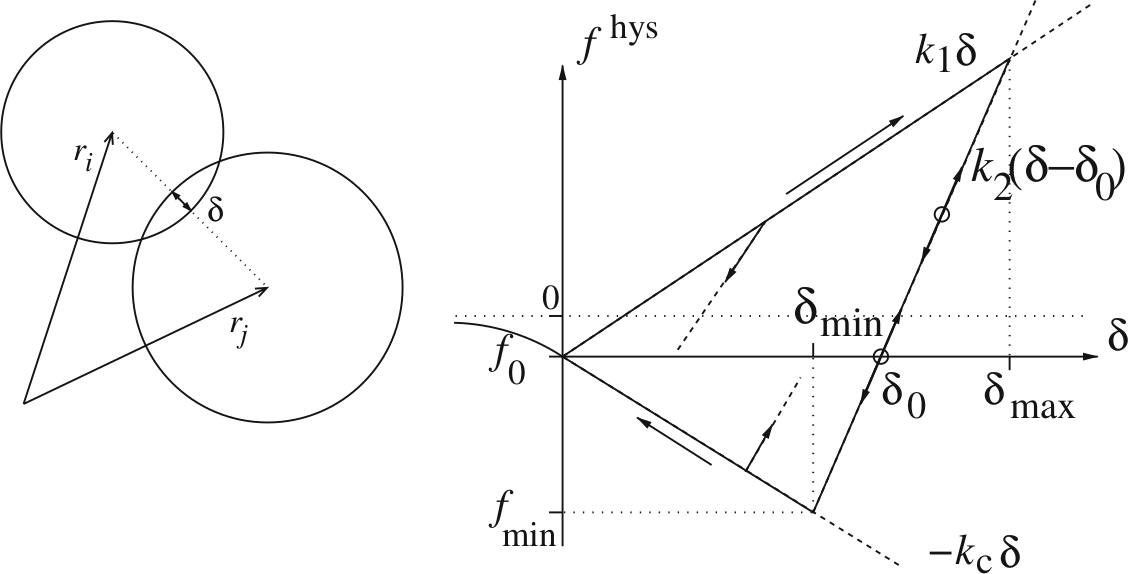
During initial loading the force increases linearly with the overall  ,
until the maximum overlap
,
until the maximum overlap  is reached. The line with slope
thus defines the maximum force possible for a given .
During unloading the force drops on a line with slope , which depends,
in general, on as follows:
is reached. The line with slope
thus defines the maximum force possible for a given .
During unloading the force drops on a line with slope , which depends,
in general, on as follows:
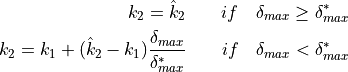
where  is the plastic flow limit overlap, defined as:
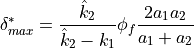
where is the plasticity depth,  and
and  are the particles’
radii.
are the particles’
radii.
Unloading below  leads to attractive adhesion forces until the
minimum force
leads to attractive adhesion forces until the
minimum force  is reached at the overlap
 , a function of the
model parameters , , , and the history parameter
. Further unloading leads to attractive forces
, a function of the
model parameters , , , and the history parameter
. Further unloading leads to attractive forces
 on the adhesive branch with slope .
In summary, the adhesive, plastic, hysteric normal contact model contains the
four parameters , , and
that respectively account for 1) loading and 2) reloading stiffness and
plastic deformation, 3) adhesion strength and 4) plastic overlap range
of the model.
The initial spring stiffness is equal to  in the
original Hooke model; hence, the remaining
stiffnesses and are defined relative to
, i.e., as
in the
original Hooke model; hence, the remaining
stiffnesses and are defined relative to
, i.e., as  and
and  .
.
The non-contact force that results when the overlap is negative is
the same as the one used in the Luding model.
Viscous model:
Using option viscous on, the coefficient of restitution is calculated as proposed by Legendre et al., while for viscous off no modification is performed. The viscous model option requires several additional material properties as mentioned above. The resulting coefficient of restitution is calculated as follows:
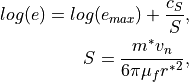
where  is the relative normal velocity.
Restrictions
If using SI units, must be bigger than 5e6.
If using CGS units, must be bigger than 5e5.
When using viscous on, must be bigger than 0.
Coarse-graining information:
Using coarsegraining in combination with this command might lead to statistically different dynamics and system state. To the best knowledge of the developers, the cross-influence between this command and coarse-graining is unknown.
Default
pullOffForce = 0, viscous = ‘off’, tangential_damping = ‘on’
Literature
[1] Luding, S. (2008). Cohesive, frictional powders: contact models for tension. Granular matter, 10(4), 235.
[2] Legendre, D., Daniel, C., & Guiraud, P. (2005). Experimental study of a drop bouncing on a wall in a liquid. Physics of Fluids, 17(9), 097105.