normal model hooke/scale_invariant
Purpose
Implement a scale-independent version of the Hooke model as proposed by Obermayr et al.
Syntax
model hooke/scale_invariant [other model_type/model_name pairs as described here ]
Associated material properties
Material properties
youngsModulus( ): Young’s modulus of the material [pressure]
poissonsRatio( ): Poisson’s ratio of the material [
 ]
]
Material interaction properties
tangentialStiffness( ): tangential stiffness of the two materials in contact [force/length]
normalDampingCoefficient( ): normal damping coefficient of the two materials in contact [force*time/length]
tangentialDampingCoefficient( ): tangential damping coefficient of the two materials in contact [force*time/length]
Description
The model calculates the normal force between two particles in contact as follows:

where  is the normal stiffness,
  is the overlap of
the two particles,
is the overlap of
the two particles,  is the contact normal, is
the damping coefficient,
is the contact normal, is
the damping coefficient,  is the relative normal velocity
of the two particles. The overlap of spherical particles is defined as
is the relative normal velocity
of the two particles. The overlap of spherical particles is defined as
 , where
  and
and  are the
particles’ radii and
are the
particles’ radii and  is the centroid distance.
The normal stiffness is calculated from the deformation of an elastic
rod with cross-section  , Young’s modulus and length
  connecting the centers of the particles
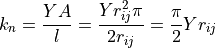
where  is the average radius.
This definition of the spring constant ensures that a scaling of the particles will retain the correct contact behavior, which considerably facilitates the practical usage of the model.
This model defines also the stiffness and damping coefficient of the tangential force defined as:

where  is the tangential overlap and
  is the relative tangential velocity. Please, refer to the documentation
of the tangential models for more
information.
is the relative tangential velocity. Please, refer to the documentation
of the tangential models for more
information.
Restrictions
If using SI units, must be bigger than 5e6.
If using CGS units, must be > 5e5.
Coarse-graining information:
Using coarsegraining in combination with this command might lead to different dynamics or system state and thus to inconsistencies.
Literature
[1] Obermayr et al. Journal of Terramechanics 53, 93-104 (2014).