normal model hertz
Purpose
This is the default normal contact model that can be used in a wide variety of contexts.
Note
This command is supported by Aspherix GPU.Syntax
model hertz [other model_type/model_name pairs as described here ] settings keyword values
zero or more keyword/value pairs may be appended after the keyword settings (after all models are specified)
Keywords |
Description |
|---|---|
on: ensures that the normal force is never attractive (an artefact
that can occur at the end of a collision),
off: standard implementation that might lead to attractive forcesdefault:
off |
|
tangential_damping |
on (activates tangential damping) or offdefault:
on |
on: model contributes to surface heating in the frame of
enable_surface_heating,
off: model does not contributes to surface heatingdefault:
off |
|
on: if the cohesion bond model is used, then
the normal force is only added if the two particles are not bonded,
off: the normal force is always added if two particles overlapdefault:
off |
|
computeDissipatedEnergy |
on: the normal model saves the dissipated energy for each contact for the
use in fix calculate/dissipated_energy,
off: no values are saveddefault:
off |
on: the force that a wall excerts on a particles is limited,
off: no force limiting is performeddefault:
off |
|
on: on excessive overlap the force is artificially increased,
off: no force modification is applieddefault:
off |
Associated material properties
Material properties
youngsModulus( ): Young’s modulus of the material [pressure]
poissonsRatio( ): Poisson’s ratio of the material [
 ]
]
Material interaction properties
coefficientRestitution( ): coefficient of restitution of the two materials
Global scalars
hertzOverlapLimit( ): relative overlap after which the force is limited (requires
 wallForceLimiter on) [].hertzModifiedExponent(): shape of force limiting or hardening curve (requires wallForceLimiter onorwallHardening on) [].hertzTargetValue(): force multiplier for excessive overlap (requires wallHardening on) [].
Description
This granular model uses the following formula for the normal force between
two spherical particles, when the distance  between two particles of
radius
between two particles of
radius  and
and  is less than their contact distance
  . There is no force from this model between the particles when
 :
:

where  is the spring stiffness,
  is the overlap of the
two particles (
is the overlap of the
two particles ( for spheres),
  the contact normal,
 the damping constant and
  the relative normal
velocity of the two particles.
the relative normal
velocity of the two particles.
In case of non-spherical particles the model is adapted with equivalent definitions. The radius is substituted with the volume equivalent radius and the overlap is defined as the minimum distance between two points on the particles surfaces that lie opposite of each other with respect to the contact point. The latter is the midpoint of the intersection of the two particles.
The spring stiffness for the Hertz model is defined as
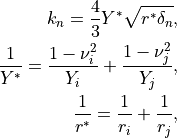
where and are the Youngs Modulus and Poisson’s ratio,
respectively.
The damping constant is given by
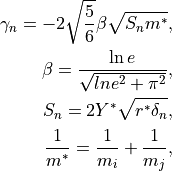
where and  are the coefficient of restitution and particle
mass, respectively.
are the coefficient of restitution and particle
mass, respectively.
This model contributes to surface heating in the frame of enable_surface_heating if the appropriate flag is activated.
When the cohesion model bond is used the
disableNormalWhenBonded keyword can be used. If this parameter is set to on
then the normal model will only compute its contribution if the two neighboring
particles do not have an active bond. If a bond breaks and the particles overlap
the current  will be set to zero so that no sudden repulsion takes
place. This is handled internally by having an offset value that shrinks to zero
once the particles start drifting apart.
will be set to zero so that no sudden repulsion takes
place. This is handled internally by having an offset value that shrinks to zero
once the particles start drifting apart.
Force Limiting
Note, that not using limitForce might lead to attractive forces between particles and walls,
especially in case the coefficient of restitution is small. Be sure you include this keyword
for the pair style and the wall model if you would like to avoid this.
Wall hardening and wall force limiting
The keywords wallHardening and wallForceLimiter can be used to improve stability for particle flows in which particles can get trapped by moving geometries. Note, the model is only acting on walls and there is no difference to particle-particle contacts.
The wallHardening keyword makes the walls harder when the relative overlap between particles and walls become too large. The force curve can be seen in the image below.
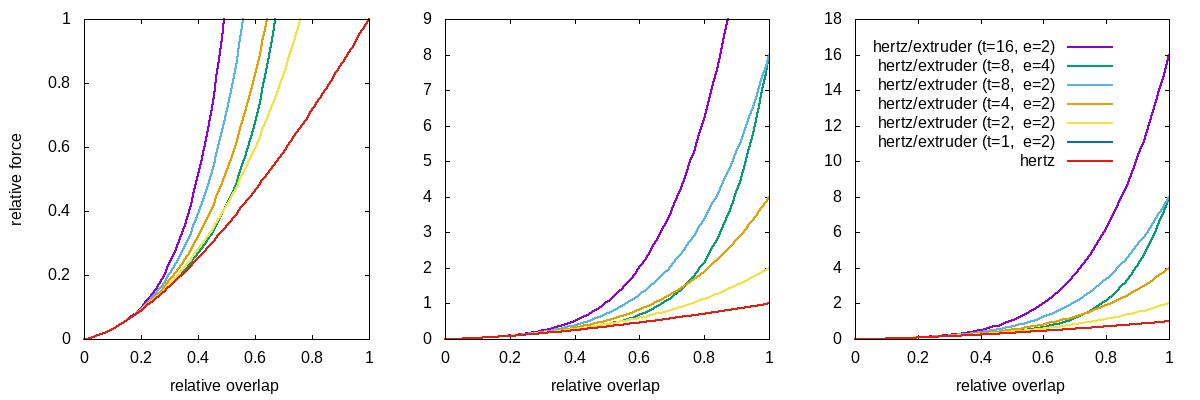
There are two parameters and , which can be set using the global scalars hertzTargetValue and hertzModifiedExponent, respectively. The value determines the maximum force in relation to the normal Hertz model. The second parameter determines the shape of the curve, for larger values the change is less pronounced in the beginning but then more pronounced towards the really high overlap values (compare the blue and green curves above).
The second model can be activated by using the setting wallForceLimiter on in the wall_contact_model command keyword.
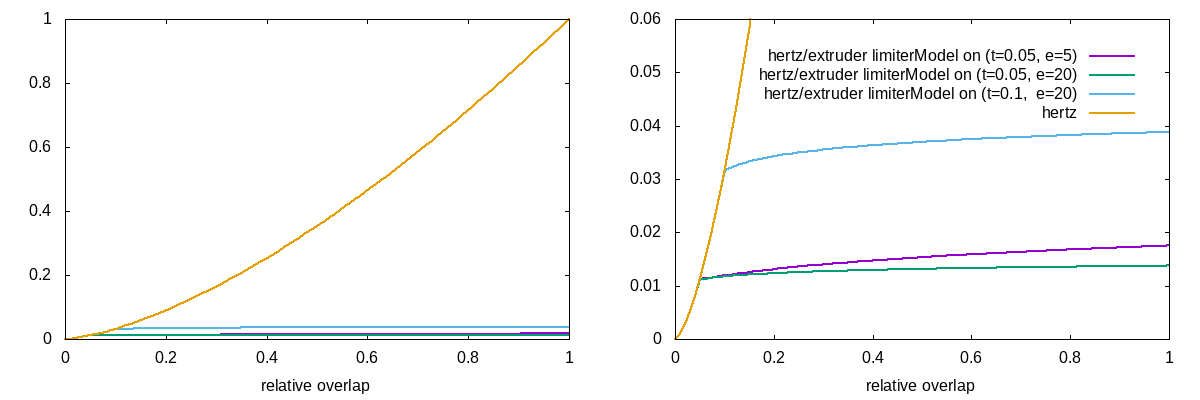
The global scalars hertzOverlapLimit and hertzModifiedExponent can be used to change the behaviour of the model. The parameter (hertzOverlapLimit) determines at what point the limiter starts to become effective whereas the parameter (hertzModifiedExponent) governs how hard the cut-off is. This model is nearly identical to a force limiter, but does the limiting in a more gradual way without ever becoming fully constant.
Note
This model is actively being developed so use with some caution. If you have any feedback please do not hesitate to contact us as we would love to improve it.
Restrictions
If using SI units, youngsModulus must be > 5e6. If using CGS units, youngsModulus must be > 5e5. When using the limitForce keyword, the specified coefficient of restitution is only approximate. This might become problematic for low coefficients of restitution as shown in Schwager and Poschel.
Coarse-graining information
Using coarsegraining in combination with this command should lead to statistically equivalent dynamics and system state.
Literature
(Di Renzo) Alberto Di Renzo, Francesco Paolo Di Maio, Chemical Engineering Science, 59 (3), p 525-541 (2004). (Note: Wrong definition of G_eq in this paper, corrected in (Di Renzo 2))
(Di Renzo 2) Alberto Di Renzo, Francesco Paolo Di Maio, Chemical Engineering Science, 60 (5), p 1303-1312 (2005).
(Ai) Jun Ai, Jian-Fei Chen, J. Michael Rotter, Jin Y. Ooi, Powder Technology, 206 (3), p 269-282 (2011).
(Brilliantov) Brilliantov, Spahn, Hertzsch, Poschel, Phys Rev E, 53, p 5382-5392 (1996).
(Schwager) Schwager, Poschel, Gran Matt, 9, p 465-469 (2007).
(Silbert) Silbert, Ertas, Grest, Halsey, Levine, Plimpton, Phys Rev E, 64, p 051302 (2001).
(Zhang) Zhang and Makse, Phys Rev E, 72, p 011301 (2005).