enable_surface_heating command
Purpose
Modelling frictional heating between solid particles in contact.
Syntax
enable_surface_heating keyword value
Keywords:
Keyword |
Description |
|---|---|
id |
user-assigned name for the command call |
yes or no; do / do not track the surface heatingdefault:
no |
Associated material properties
Material properties
electricalResistivity( ): electric resistivity of the material [
 ]
]thermalConductivity( ): thermal conductivity of the material [
 ]
]
Description
Note
This command enables the general capability to compute surface heating, but heating due to normal or tangential contact still needs to be enabled via the appropriate settings in particle_contact_model and wall_contact_model. An example would be
particle_contact_model normal hertz tangential history settings heating_normal_hertz on heating_tangential_history on
A list of the contact models capable of computing surface heating can be found below
This command reproduces the frictional heating generated by solid particles in contact. The power dissipated (energy per unit of time) by the normal contact between two particles is equal to:

where  is the normal damping force and
  is the normal relative velocity at the contact point.
The same applies to a tangential contact, i.e.
is the normal relative velocity at the contact point.
The same applies to a tangential contact, i.e.

where  is the tangential damping force and
  is the tangential relative velocity at the contact point.
For tangential interaction, there is also a second mode of energy dissipation, which is the dissipation of energy when the surfaces slip over each other when the Coulomb friction limit is reached:

where  is the static coefficient of friction and
 is the total normal force.
The power dissipated is divided among the two particles in contact
(or between the particle and wall) as proposed by Nguyen et al..
The partition coefficient of generated heat  reads as follows:
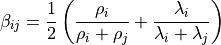
where  and
and  refer to the two material’s in contact.
The energy dissipated by the particle-wall friction generates heat that is transfered to both particle and wall,
therefore increasing their temperatures. This happens even when the wall temperature is not tracked by a mesh_module heattransfer command
i.e. walls are not adiabatic when the enable_surface_heating is used.
Currently, the following models can contribute to surface heating:
model hertz, model hooke,
tangential history. Each one of these contact
models must have explicitly switched on the surface heating contribution (e.g.,
for model hertz, the keyword/value pair
heating_normal_hertz on must be used).
This model also requires the enable_heat_transfer command, which automatically calculates the appropriate heat flux contribution for each particle.
Output information
If track_heating yes, the command additionally registers a per-particle
property with ID ‘surfaceHeating’, which stores the following values for
post-processing for each particle:
id_surfaceHeating[1]: energy dissipated by normal particle-particle contact damping
id_surfaceHeating[2]: energy dissipated by tangential particle-particle contact damping
id_surfaceHeating[3]: energy dissipated by tangential particle-particle contact slip
id_surfaceHeating[4]: energy dissipated by normal particle-wall contact damping
id_surfaceHeating[5]: energy dissipated by tangential particle-wall contact damping
id_surfaceHeating[6]: energy dissipated by tangential particle-wall contact slip
These can be accessed by various output commands.
For example, in a system with three spherical particles, the energy dissipated by normal particle-particle contact damping for each particle can be obtained in the following way:
variable dissipation_pp_normal_damping atom  id_surfaceHeating[1]
variable dissipation_particle_1        equal v_dissipation_pp_normal_damping[1]
variable dissipation_particle_2        equal v_dissipation_pp_normal_damping[2]
variable dissipation_particle_3        equal v_dissipation_pp_normal_damping[3]
status_style all {time, v_dissipation_particle_1, v_dissipation_particle_2, v_dissipation_particle_3}
Restrictions
Currently, only the following models contribute to surface heating:
Normal Models: model hertz, model hertz fragmentation bruchmueller, model hertz time dependent, model hertz vel dependent, model hooke,
Tangential Models: tangential history, tangential history powder, tangential history time dependent, tangential history tempdep, tangential history attrition,
Coarse-graining information: Using coarsegraining in combination with this command might lead to different dynamics or system state and thus to inconsistencies.
Literature
[1] Nguyen, Viet, et al. “Thermomechanical modelling of friction effects in granular flows using the discrete element method.” Journal of Mechanics of Materials and Structures 4.2 (2009): 413-426.