tangential model history
Purpose
This is the default tangential contact model that can be used in a wide variety of contexts.
Note
This command is supported by Aspherix GPU.Syntax
tangential history [other model_type/model_name pairs as described here ] settings keyword values
zero or more keyword/value pairs may be appended after the keyword settings (after all models are specified)
heating_tangential_history values = 'on' or 'off'
  on = model contributes to surface heating in the frame of enable_surface_heating
  off = model does not contributes to surface heating
torsion values = 'on' or 'off'
  on = model calculates friction based on torsion
  off = model ignores rotation around the contact normal
disableTangentialWhenBonded values = 'on' or 'off'
  on = no tangential forces between bonded particles
  off = tangential forces between bonded particles
Associated material properties
Material properties
youngsModulus( ): The Youngs Modulus of a material, i.e. its stiffness [pressure]
poissonsRatio( ): The Poisson’s ratio, i.e. the ratio of transverse to axial strain [
 ]
]
Material interaction properties
coefficientRestitution( ): The coefficient of restitution of two materials []
coefficientFriction( ): The coefficient of friction acting between two materials []
Description
This model can be used in the tangential argument of both particle_contact_model and wall_contact_model.
The tangential force component is given as

where  is the tangential spring stiffness,
  the
tangential damping coefficient,
the
tangential damping coefficient,  the relative tangential
velocity. Finally, the tangential overlap
the relative tangential
velocity. Finally, the tangential overlap  is defined as
the time integral of the relative tangential velocity at the contact point. The
name history stems from this time integral and the resulting influence of
past time steps on the model.
is defined as
the time integral of the relative tangential velocity at the contact point. The
name history stems from this time integral and the resulting influence of
past time steps on the model.
The tangential spring stiffens is calculated via
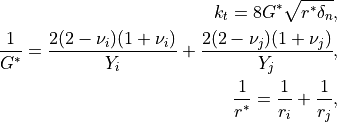
where and are the Youngs Modulus and Poisson’s ratio,
respectively.
The tangential damping coefficient is defined as
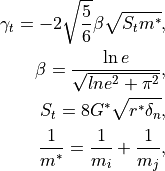
where and  are the coefficient of restitution and particle
mass, respectively.
are the coefficient of restitution and particle
mass, respectively.
The coefficient of friction is the upper limit of the tangential
force through the Coulomb criterion  , where
 and
and  are the tangential spring and total normal
force components. Thus in the Hertzian and Hookean case, the tangential force
between two particles grows according to a tangential spring and dash-pot model
until
are the tangential spring and total normal
force components. Thus in the Hertzian and Hookean case, the tangential force
between two particles grows according to a tangential spring and dash-pot model
until  and is then held at
  until the particles lose contact. If the normal model Luding
is used the and are replaced by
until the particles lose contact. If the normal model Luding
is used the and are replaced by

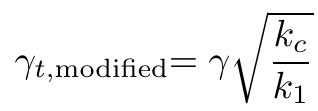
where  ,
,  and
and  are parameters of the normal model Luding,
and the Coulomb criterion limits the total tangential force, instead of only the elastic components, i.e.
are parameters of the normal model Luding,
and the Coulomb criterion limits the total tangential force, instead of only the elastic components, i.e.  .
.
The damping contribution is only added in time-steps where there is no slip, i.e. the Coulomb criterion is not met.
This model contributes to surface heating in the frame of enable_surface_heating if the appropriate flag is activated.
If the keyword torsion is set then the torsion will be calculated using a
spring and a torque is calculated based on  . The
radius
. The
radius  is taken as the radius of the spherical cap that constitutes
the overlap region. For non-spherical particles (superquadric, convex) the same
radius is used assuming the particle to be replaced by its bounding sphere. If
the surface model convexhull/manifold is used
then the manifold points are used to estimate this radius. Which allows to
differentiate between corner and flat face contacts. The torque
is taken as the radius of the spherical cap that constitutes
the overlap region. For non-spherical particles (superquadric, convex) the same
radius is used assuming the particle to be replaced by its bounding sphere. If
the surface model convexhull/manifold is used
then the manifold points are used to estimate this radius. Which allows to
differentiate between corner and flat face contacts. The torque  behaves identical to the tangential force, i.e. there is an equivalent coulomb
criterion and a damping contribution if it is not met.
behaves identical to the tangential force, i.e. there is an equivalent coulomb
criterion and a damping contribution if it is not met.
When the cohesion model bond is used the disableTangentialWhenBonded keyword can be used. If this parameter is set to ‘on’ then the tangential model will only compute its contribution if the two neighboring particles do not have an active bond. This switch can only be used together with disableNormalWhenBonded of gran model hertz
Coarse-graining information:
Using coarsegraining in combination with this command might lead to different dynamics or system state and thus to inconsistencies. However, the influence of this model on the global dynamics or system state might be small so in some cases the results may be valid. This has to be reviewed by a specialist on a case-by-case basis.
Default
heating_tangential_history = ‘off’, torsion = ‘off’