enable_particle_melting command
Purpose
Addition to the enable_heat_transfer command to allow for melting particles.
Syntax
enable_particle_melting keyword value
Keywords:
Keyword |
Description |
|---|---|
minimum particle volume before particles get deleted from the simulation
units: [length^3]
|
|
minimum particle radius before particles get deleted from the simulation
units: [length]
|
|
disable_conduction |
yes or no; calculation of thermal conduction between particles can be switched offdefault:
no |
yes or no; allow solidification of liquid on particles that are colderthan the melting temperature. Requires the enable_cfd_coupling command and the
default:
no |
|
attenuate_solidification |
scalar to reduce (or increase) the amount of liquid solidifying. Must be larger than 1.
default:
1 |
* minimum_volume and minimum_radius are mutually exclusive, the usage of one of them is mandatory.
Examples
enable_heat_transfer initial_particle_temperature 273.15
enable_particle_melting minimum_volume 1e-11
Associated material properties
Material properties
latentHeat( ): specific latent heat of the material [
 ]
]Tmelt( ): melting temperature of the material [
 ]
]thermalCapacity( ): specific thermal capacity of the material [
 ]
]
Description
This model implements the melting of particles when the melting temperature
[K] is exceeded. Depending on the choice of the internal
temperature model (see enable_heat_transfer)
two different melting rate models are available, as described below.
Melting rate for uniform temperature model
The phase change is modelled in two parts
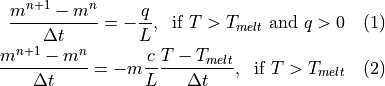
where  [Kg] is the particle mass,
  the time step,
  [J/s] is
the total heat transfer rate into the particle, [J/(KgK)] is the specific thermal capacity and
[J/s] is
the total heat transfer rate into the particle, [J/(KgK)] is the specific thermal capacity and
 [s] the time step size. (1) is a term due to heat flux from
outside, (2) is a term that assures that the particle temperature
[s] the time step size. (1) is a term due to heat flux from
outside, (2) is a term that assures that the particle temperature  [K] satisfies
  in case the particle temperature is changed e.g. by the set command.
Melting rate for shell model
The phase change is modelled by the following equation:
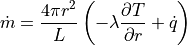
where  [Kg/s] is the melting rate,
  [m]
is the particles radius (volume equivalent radius for non-spherical
particles) and
[m]
is the particles radius (volume equivalent radius for non-spherical
particles) and  [J/(s m2)] is the external heat flux.
The temperature gradient is taken at the particle boundary and it is
calculated explicitly using the temperature from the last two grid points
inside the particle:
[J/(s m2)] is the external heat flux.
The temperature gradient is taken at the particle boundary and it is
calculated explicitly using the temperature from the last two grid points
inside the particle:
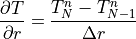
where is current time step and  is the number of the
grid points inside the particle. For all this grid points inside, the shell
model is applied without changes as in
enable_heat_transfer. The temperature
field at the rest of the grid points outside of the shrunken particle is
overwritten by the melting temperature.
is the number of the
grid points inside the particle. For all this grid points inside, the shell
model is applied without changes as in
enable_heat_transfer. The temperature
field at the rest of the grid points outside of the shrunken particle is
overwritten by the melting temperature.
The cooling effect of the phase change is depicted by adjusting the heat transfer rate via
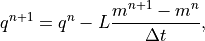
where is the time step. As soon as the particle volume is lower than
the limit specified by minimum_volume or the minimum_radius they are deleted
from the simulation. When the particle is deleted, more accurate values of the corresponding melted mass are obtained as
the value of minimum_volume is decreased.
Additional solification of liquid around a particle may occur if the
enable_liquid_solidification is set:
Solidification
The amount of solidified liquid is determined by the incoming heat transfer rate:
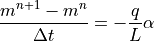
Solidification only occurs if the particle temperature is lower than the melting
temperature and the surrounding fluid is hotter than the particle, i.e. the
heat transfer rate [J/s] in above equation is positive. Furthermore, the amount of
solidified mass is scaled with the non-dimensional attenuation parameter  , set by the
attenuate_solidification keyword.
The amount of solidified liquid mass is further limited by the available liquid in
vicinity of the particle as communicated from the CFD side, see
enable_cfd_coupling command.
At the end of the phase change process, the heat transfer rate is updated considering the heat released by the solidified liquid.
Note
This approach to solification assumes that particle and liquid consist of the same material and that the material properties are identical in solid and liquid state.
Additional information
The initial particle radius is written to binary restart files so simulations can continue properly.
This fix computes a value which can be accessed by various output
commands. This value is the total (accumulated) molten mass which can be
accessed via id_ID.molten_mass where ID is the id of the corresponding
enable_heat_transfer command.
Restrictions
none