 Home
HomecentreVoidFraction
Syntax
Defined in couplingProperties dictionary.
voidfractionModel centre;
centreProps
{
    alphaMin         scalar;
    volScale         scalarList;
    volScaleGlobal   scalar;
}
alphaMin = minimum limit for voidfraction (default: 0.3)
volScale = scaling (per type) of the particle volume to account for porosity or agglomerations. (default: 1 for each particle type)
volScaleGlobal =
volScalefactor to apply for all particle types. This conveniently sets all elements of thevolScalelist to the same value. (default: 1)
Examples
voidfractionModel centre;
centreProps
{
    alphaMin     0.1;
    volScale     ( 1. );
}
Description
The centre voidFraction model calculates the voidfraction in a CFD cell accounting for the volume of the particles whose centres are inside the cell. Consequently, all particle volume is accounted for in the CFD cell which contains the particle center. This procedure is a good model for very small ratios of particle diameter to CFD cell size but becomes inaccurate for in case of large particles (compared to the CFD cell size), where it may lead to very low voidfraction values in CFD cells. It is also clear that this model cannot create a smooth transition of voidfraction when a particle crosses from one CFD cell to another.
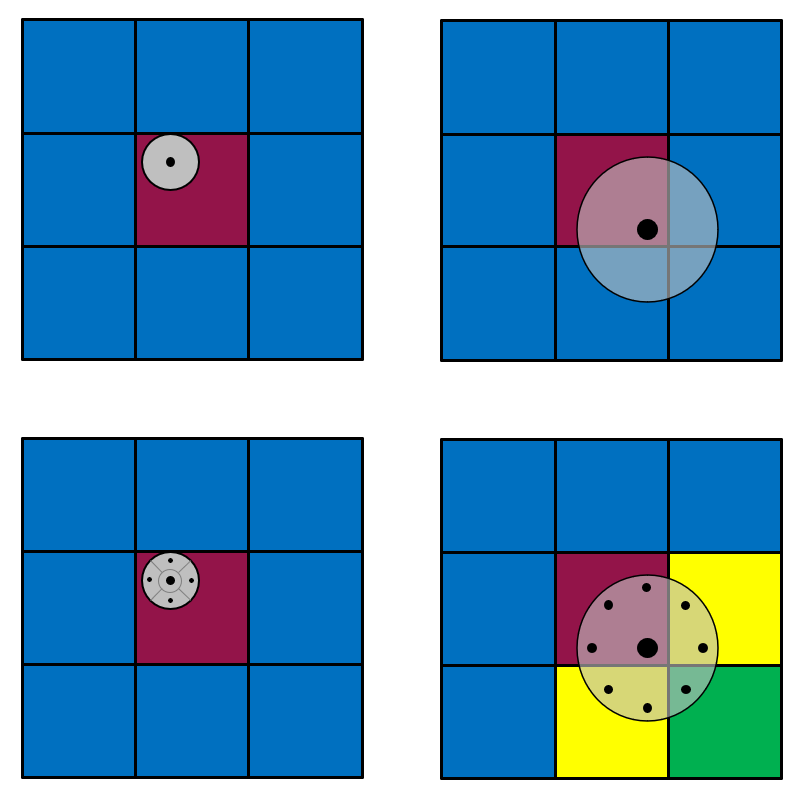
Figure 1: Comparison of center (top) and divided (bottom) voidfraction model. The center model accounts for particle volume in the CFD cell where particle center point is located.
The resulting voidfraction can be limited to a lower value by the alphaMin
keyword which discards excess particle volume.
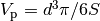
The particle volume occupied in the CFD domain can be adjusted by the parameter
volScale (referred to as  ), using
 .
.
Note
The divided model yields more accurate results in case of large particles and for particles at cell boundaries by distributing the particle volume also across neighboring CFD cells.
Restrictions
None.