 Home
HomeforceSubModel: stochasticDispersion
Syntax
Activate for a certain forceModel in its properties sub-dictionary in
couplingProperties:
couplingProperties sub-dictionary of the force model in use.
forceSubModels
(
    stochasticDispersion;
);
Furthermore, the model settings in the additional constant/dispersionModel.dict
file are applied:
kFieldName           word;
epsilonFieldName     word;
writeFields          Switch;
partTimeName         word;
partUfluctName       word;
ck                   scalar;
cl                   scalar;
randomTimeE          Switch;
kFieldName = name for internal turbulent kinetic energy field
epsilonFieldName = name for internal turbulent dissipation field
writeFields = write internal fields for postProcessing (default: false)
partTimeName = name of Lagrangian field for the dispersion time scale (default: “dispersionTime”)
partUfluctName = name of Lagrangian field for the dispersion velocity (default: “dispersionVel”)
ck = model constant for turbulent kinetic energy term. Identical with
 for a
for a  -model.
cl = model constant to calculate Lagrangian integral time (0.15 for k-epsilon model)
randomTimeE = Switch to use random particle relaxation time (default: false)
Description
This forceSubModel enhances a given forceModel with a stochastic dispersion due to turbulence acting as an additional, randomic force term on the particles.
Starting from the Reynolds decomposition  , the
fluctuation
, the
fluctuation  can be expressed as
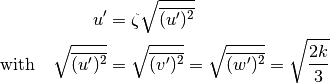
for a turbulence model, where  is a normal-
distributed random number and
is a normal-
distributed random number and  is the turbulent kinetic energy.
This fluctuating velocity component is saved and calculated for each individual
particle. It is constant for the minimum of the eddy crossing time
is the turbulent kinetic energy.
This fluctuating velocity component is saved and calculated for each individual
particle. It is constant for the minimum of the eddy crossing time
 and the eddy lifetime
  .
Afterwards the above equation is recalculated for the particle.
.
Afterwards the above equation is recalculated for the particle.
The eddy crossing time is defined as

where  denotes the particle relaxation time,
 is the eddy length scale, and
  is the magnitude of the relative velocity. Further,
and are calculated by
is the magnitude of the relative velocity. Further,
and are calculated by
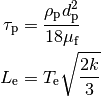
Here  is the particle density which is retrieved from the
DEM side.
is the particle density which is retrieved from the
DEM side.  stands for the particle diameter
and
stands for the particle diameter
and  denotes the dynamic viscosity of the fluid.
The eddy lifetime is calculated by
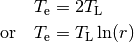
where  is a uniform random number between 0 and 1. By default the
first variant is used. The second one is selected by the flag
is a uniform random number between 0 and 1. By default the
first variant is used. The second one is selected by the flag randomTimeE
in the model properties. Both use the Lagrangian integral time  which is defined as

with the simulation constant  defined in the model
properties.
defined in the model
properties.
Details on implementation and background of this model are given in [1] and [2].
Literature
[1] M.C. Gruber, S. Radl, J.G. Khinast. Coalescence and Break-Up in Bubble Columns: Euler-Lagrange Simulations Using a Stochastic Approach. Chem. Ing. Tech. 85 (2013): 1118–1130.
[2] J. Pozorski, J.P. Minier. On the Lagrangian turbulent dispersion models based on the Langevin equation. Int. J. Multiphase Flow 24 (1998): 913–945.
Restrictions
Note
This model does not work on dynamic meshes.
Note
This model may create instabilities in setups using an explicit momentum coupling term. To prevent this issue, use this model only in simulations with a pure implicit handling of momentum coupling on the CFD side by setting
momCoupleModels ( implicitCouple );
in constant/couplingProperties.