 Home
HomeconstDiffSmoothing
Syntax
Defined in couplingProperties dictionary.
smoothingModel constDiffSmoothing;
constDiffSmoothingProps
{
    lowerLimit           scalar;
    upperLimit           scalar;
    smoothingLength      "lengthScale";
    smoothingLengthReferenceField lengthScaleRefField;
    calcSmoothLenEvery   label;
    verbose              switch;
}
lowerLimit = scalar fields will be bound to this lower value (default: 0.1)
upperLimit = scalar fields will be bound to this upper value (default: 1e10)
smoothingLength = length scale over which the exchange fields will be smoothed out (default:
 )
)smoothingLengthReferenceField = (optional) length scale over which reference fields (e.g., the average particle velocity) will be smoothed out. Should be always larger than
lengthScale. If not specified, will be equal tolengthScale.calcSmoothLenEvery = perform automatic (re)calculation of smoothingLength in this interval of coupling steps (default: 20)
verbose = flag for debugging output (default: false)
Examples
constDiffSmoothingProps
{
    lowerLimit 0.1;
    upperLimit 1e10;
    smoothingLength 1500e-6;
    smoothingLengthReferenceField 9000e-6;
}
Description
The constDiffSmoothing model is a basic smoothingModel model which reads
a smoothing length scale being used for smoothing the exchange fields
(voidfraction, Ksl, f if present). This model can be used for smoothing
explicit force coupling fields, as well as implicit force coupling algorithms.
The smoothing itself is performed by solving an additional diffusion equation for the
field to be smoothed in every time step, e.g. for the scalar phi:
 .
.
DT is the diffusion coefficient with  , i.e. on the square
of the user defined smoothingLength. This means that a larger
, i.e. on the square
of the user defined smoothingLength. This means that a larger smoothingLength
will lead to more smoothing in a larger area, see Figures 1. Hoewever, this is only
the case if a curvature is present on the field sinvce diffuson will only occur
for non-zero second derivatives.
As a general rule, if the user desires to smooth the field in a region with diameter
D, this value should be specified for the smoothing length.
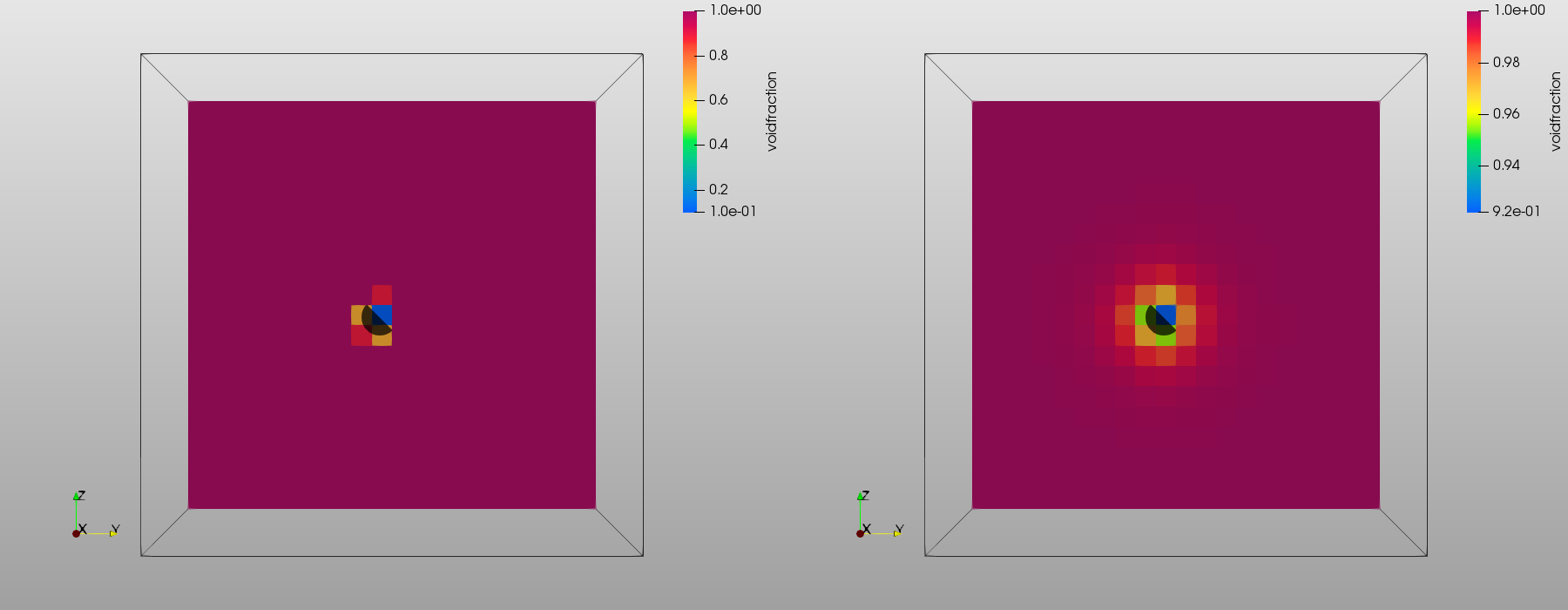
Figure 1: Examples test case with a particle in the range of the CFD cell size. Left: no smoothing – The divided model generates voidfraction in a small halo but otherwise the lower limit is reached and the voidfraction capped. Right: The same case with a smoothing model and the smoothing length at the same value as the particle diameter. The voidfraction is distributed over a larger area.
By default, i.e. when the user does not manually enter this setting, the smoothing
length is determined automatically and set to the maximum particle diameter on a
process times 1.5. This check and setting is repeated every calcSmoothLenEvery
CFD time steps to take also changing particle distributions into account.
Refer to [2] for a more detailed overview on the choice of the
smoothing length.
Note
This model will reduce the minimum voidfraction setting alphaMin of your
voidfraction to yo 0.01.
Smoothing for reference fields is performed to “fill in” values in cells in which these reference fields are not specified. Values calculated in the cells (via Lagrangian-To-Euler mapping) are NOT changed! These reference fields are, e.g., the average particle velocity, which are not specified in all cells in case the flow is rather dilute.
Note
If you do not specify a smoothingLength keyword, the smoothingLength is
calculated automatically based on the diameter of the largest particle
currently present in the simulation. This calculation is performed each time the
number of particles changes on any processor.
If you specify a smoothingLength, the automatic calculation is switched off
regardless of a calcSmoothLenEvery being given or not.
If verbose true, the model will write the reference fields used for the
smoothing operations.
Model implementation follows the description in [1].
Literature
[1] S. Radl, B.C. Gonzales, C. Goniva, S. Pirker. “State of the art in mapping schemes for dilute and dense Euler-Lagrange simulations.”. 10th International Conference on CFD in Oil & Gas, Metallurgical and Process Industries, 2014.
[2] C.M. de Vrijer, “CFD-DEM simulations of particle-laden flows coarse-graining and smoothing strategies”. Master thesis, TU Eindhoven, 2022. https://pure.tue.nl/ws/portalfiles/portal/211121187/1221039_Vrijer.pdf
Restrictions
This model is tested in a limited number of flow situations.