 Home
HomeThermal abuse
Syntax
Defined in an fvModels dictionary in the constant folder of the CFD case.
Can only be applied if a solver can handle fvModels.source.
heatSource
{
    type            heatSourceTR_4eq;

    selectionMode   all;

    // SEI Decomposition reaction
    Asei      dimensionedScalar;
    Hsei      dimensionedScalar ;
    Esei      dimensionedScalar;
    Wc        dimensionedScalar;
    c_sei     scalar;

    //Negative-solvent reaction
    Ane       dimensionedScalar;
    Hne       dimensionedScalar;
    Ene       dimensionedScalar;
    // here W = Wc
    c_ne     scalar;
    z        scalar;

    // Positvive-solvent reaction
    Ape       dimensionedScalar;
    Hpe       dimensionedScalar ;
    Epe       dimensionedScalar;
    Wp        dimensionedScalar;
    alpha     scalar;

    // Electolyte Decomposition Reaction
    Ae        dimensionedScalar;
    Ee        dimensionedScalar;
    He        dimensionedScalar;
    We        dimensionedScalar;
    c_e       scalar;

    R        dimensionedScalar;


    //ODE solver details

    relTol  scalar;
    absTol  scalar;
    dxEst   scalar;
    solver   word;
    maxSteps scalar;
}
selectionMode= selection mode (allorcellSet)cellSet= cellSet on which to apply the burner.
Abuse model parameters
Asei= SEI-decomposition frequency factor (s-1).Hsei= SEI-decomposition heat release (J/g).Esei= SEI-decomposition activation energy (J/mol)Wc= Specific carbon content in jellyroll (g/m3)c_sei= Initial value of
Ane= Negative-solvent frequency factor (s-1).Hne= Negative-solvent heat release (J/g).Ene= Negative-solvent activation energy (J/mol)c_ne= Initial value of
z= Initial value of
Ape= Positive-solvent frequency factor (s-1).Hpe= Positive-solvent heat release (J/g).Epe= Positive-solvent activation energy (J/mol)Wp= Specific positive active content in jellyroll (g/m3)alpha= Initial value of
Ae= Electrolyte decomposition frequency factor (s-1).He= Electrolyte decomposition heat release (J/g).Ee= Electrolyte decomposition activation energy (J/mol)We= Specific electrolyte content in jellyroll (g/m3)c_e= Initial value of
ODE solver parameters
relTol= Relative convergence tolerance per step.absTol= Absolute convergence tolerance per step.dxEst= Max allowed time step.solver= Name of the solver. Here you can find a list of the available solvers (https://cpp.openfoam.org/v10/classFoam_1_1ODESolver.html).maxSteps= The maximum number of sub-steps allowed for the integration step.
Examples
heatSource
{
    type            heatSourceTR_4eq;

    selectionMode   all;

    // SEI Decomposition reaction
    Asei      Asei  [0 0 -1 0 0 0 0] 1.667e15;
    Hsei      Hsei [0 2 -2 0 0 0 0] 257e3 ;
    Esei      Esei  [1 2 -2 0 -1 0 0] 1.3508e5;
    Wc        Wc [1 -3 0 0 0 0 0] 610.4;
    c_sei    0.15;

    //Negative-solvent reaction
    Ane       Ane   [0 0 -1 0 0 0 0] 2.5e13;
    Hne       Hne [0 2 -2 0 0 0 0] 1714e3;
    Ene       Ene   [1 2 -2 0 -1 0 0] 1.3508e5;
    // here W = Wc
    c_ne     0.75;
    z        0.033;

    // Positvive-solvent reaction
    Ape       Ape   [0 0 -1 0 0 0 0] 2.25e14;
    Hpe       Hpe [0 2 -2 0 0 0 0] 790e3 ;
    Epe       Epe   [1 2 -2 0 -1 0 0] 1.54e5;
    Wp        Wp [1 -3 0 0 0 0 0] 1293;
    alpha     0.04;

    // Electolyte Decomposition Reaction
    Ae        Ae    [0 0 -1 0 0 0 0] 5.14e25;
    Ee        Ee    [1 2 -2 0 -1 0 0] 2.74e5;
    He        He [0 2 -2 0 0 0 0] 155e3;
    We        We [1 -3 0 0 0 0 0] 406.9;
    c_e       1;

    R        R  [1 2 -2 -1 -1 0 0] 8.314;


    //ODE solver details

    relTol  1e-5;
    absTol 1e-5;
    dxEst   1e-5;
    solver "seulex";
    maxSteps 100000;
}
Description
Li-ion battery thermal abuse reactions are modeled for three-dimensional battery simulation by listing component reactions that occur at elevated temperatures:
The volumetric heat generation that originated from Li-ion battery component reactions at increasing temperatures is decomposed as [1]

where  is the heat from the SEI (solid electrolyte interphase) decomposition reaction,
  the reaction between the negative active material and electrolyte,
 the reaction between the positive active material and electrolyte,
  the electrolyte decomposition, and
  is the reaction
between the negative active and binder.
is the reaction
between the negative active and binder.
The four contributions can be computed using Arrhenius-like equations
- is the heat from the SEI decomposition reaction
![R_{sei} = A_{sei}\exp\left[-\frac{E_{a,sei}}{R T}\right]c^{m_s}_{sei}](_images/math/c81521670614879c06be0952beb80bfca64f1808.png)

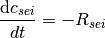
where is the dimensionless amount of lithium-containing meta-stable
species in the SEI.  ,
,  ,
,  are reaction parameters. Specific heat release
  is evaluated as Joule
per gram of carbon, and
is evaluated as Joule
per gram of carbon, and  is the volume-specific carbon content in the jellyroll.
- is the heat from the negative-solvent reaction
![R_{ne} = A_{ne} \exp\left[-\frac{z}{z_{ref}}\right] \exp\left[-\frac{E_{a,ne}}{R T}\right]c^{m_n}_{ne}](_images/math/c97043e332064a40e543709d91a119914f2b776d.png)

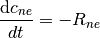
where is the dimensionless amount of lithium intercalated between
the carbon.  ,
,  ,
,  are reaction parameters. Specific heat release
  is evaluated as Joule
per gram of carbon, and is the volume-specific carbon content in the
jellyroll. is a dimensionless measure of the SEI layer thickness and it
is computed by [2]
is evaluated as Joule
per gram of carbon, and is the volume-specific carbon content in the
jellyroll. is a dimensionless measure of the SEI layer thickness and it
is computed by [2]
![\frac{\mathrm{d} z}{dt} = A_{ne} \exp\left[-\frac{z}{z_{ref}}\right] \exp\left[-\frac{E_{a,ne}}{R T}\right]c^{m_n}_{ne}](_images/math/896e5c4f82082978e4a9109bdc33bce2814f031c.png)
- is the heat from the positive-solvent reaction


where
is the degree of conversion. , ,
are reaction parameters. Specific heat release  is
evaluated as Joule per gram of carbon and
is
evaluated as Joule per gram of carbon and  is the volume-specific,
positive-active content in the jellyroll.
is the volume-specific,
positive-active content in the jellyroll. - is the heat from the electrolyte decomposition reaction

![R_{e} = A_{e}\exp\left[-\frac{E_{a,e}}{R T}\right]c^{m_e}_{e}](_images/math/79942d7e8c94e5417192fb0b29fa3343c4d07091.png)

where
is the dimensionless concentration of electrolyte.  ,
,
 ,
,  are reaction parameters. Specific heat release
 is the
volume-specific electrolyte content in the jellyroll.
is the
volume-specific electrolyte content in the jellyroll.
In the end, we have to solve the following ODE system
![\begin{eqnarray}
\frac{\mathrm{d} c_{e}}{dt} & = & - A_{e}\exp\left[-\frac{E_{a,e}}{R T}\right]c^{m_e}_{e} \\
\frac{\mathrm{d} \alpha}{dt} & = & A_{pe} \alpha(1-\alpha) \exp\left[-\frac{E_{a,pe}}{R T}\right]\\
\frac{\mathrm{d} c_{ne}}{dt} & = & - A_{ne} \exp\left[-\frac{z}{z_{ref}}\right] \exp\left[-\frac{E_{a,ne}}{R T}\right]c^{m_n}_{ne}\\
\frac{\mathrm{d} z}{dt} & = & A_{ne} \exp\left[-\frac{z}{z_{ref}}\right] \exp\left[-\frac{E_{a,ne}}{R T}\right]c^{m_n}_{ne}\\
\frac{\mathrm{d} c_{sei}}{dt} & = & - A_{sei}\exp\left[-\frac{E_{a,sei}}{R T}\right]c^{m_s}_{sei}
\end{eqnarray}](_images/math/3366c1bf8c471eb0bf1b4483284b4eec83efab35.png)
Symbol |
Description |
Units |
|---|---|---|
|
SEI-decomposition frequency factor |
|
|
Negative-solvent frequency factor |
|
|
Positive-solvent frequency factor |
|
|
Electrolyte decomposition frequency factor |
|
|
SEI-decomposition activation energy |
|
|
Negative-solvent activation energy |
|
|
Positive-solvent activation energy |
|
|
Electrolyte decomposition activation energy |
|
|
SEI-decomposition heat release |
|
|
Negative-solvent heat release |
|
|
Positive-solvent heat release |
|
|
Electrolyte decomposition heat release |
|
|
Specific carbon content in jellyroll |
|
|
Specific positive active content in jellyroll |
|
|
Specific electrolyte content in jellyroll |
|


Literature
[1] Kim, Gi-Heon, Ahmad Pesaran, and Robert Spotnitz. “A three-dimensional thermal abuse model for lithium-ion cells.” Journal of power sources 170.2 (2007): 476-489.
[2] Hatchard, T. D., et al. “Thermal model of cylindrical and prismatic lithium-ion cells.” Journal of The Electrochemical Society 148.7 (2001): A755.