particle_template fragments command
Purpose
Command for defining fragments for particle breakage (examples).
Warning
GPU support for this command has not been tested and may not work as expected.Syntax
particle_template [general_keywords] shape fragments keyword value
General particle_template keywords are documented here. This document only describes
the specific keywords for the definition of fragments for particle breakage.
Return to the particle_template documentation.
Keyword |
Description |
|---|---|
obligatory; name of the file containing the center coordinates and the radius
of the spheres forming the fragmented particle (
*.csv or *.txt) |
|
scale |
factor for scaling up or down the sphere positions and radii
default: 1; range: (0,∞); units: [-]
|
check_template |
yes or no; yes: during the particle template creation checks are performed(if particles overlap) are performed;
no: skip all checks (it is expected thatparticles are non-overlapping!), which will speed up particle template creation
default:
yes |
monte_carlo_steps |
number of tries for Monte Carlo approach
default: 10000
|
radius value position vector; value = radius of the bounding spherevector = position of the center of the bounding sphere
units: [length]
|
Examples
particle_template id myFragmentsParticles material limestone shape fragments file myFile.txt

particle_template id pts1 material limestone shape fragments file frag.txt scale 0.1 &
     monte_carlo_steps 1000

particle_template id pts1 material mat1 shape fragments file myFile.txt &
     bounding_sphere radius 1e-2 center (1e-3,0,0)
Description
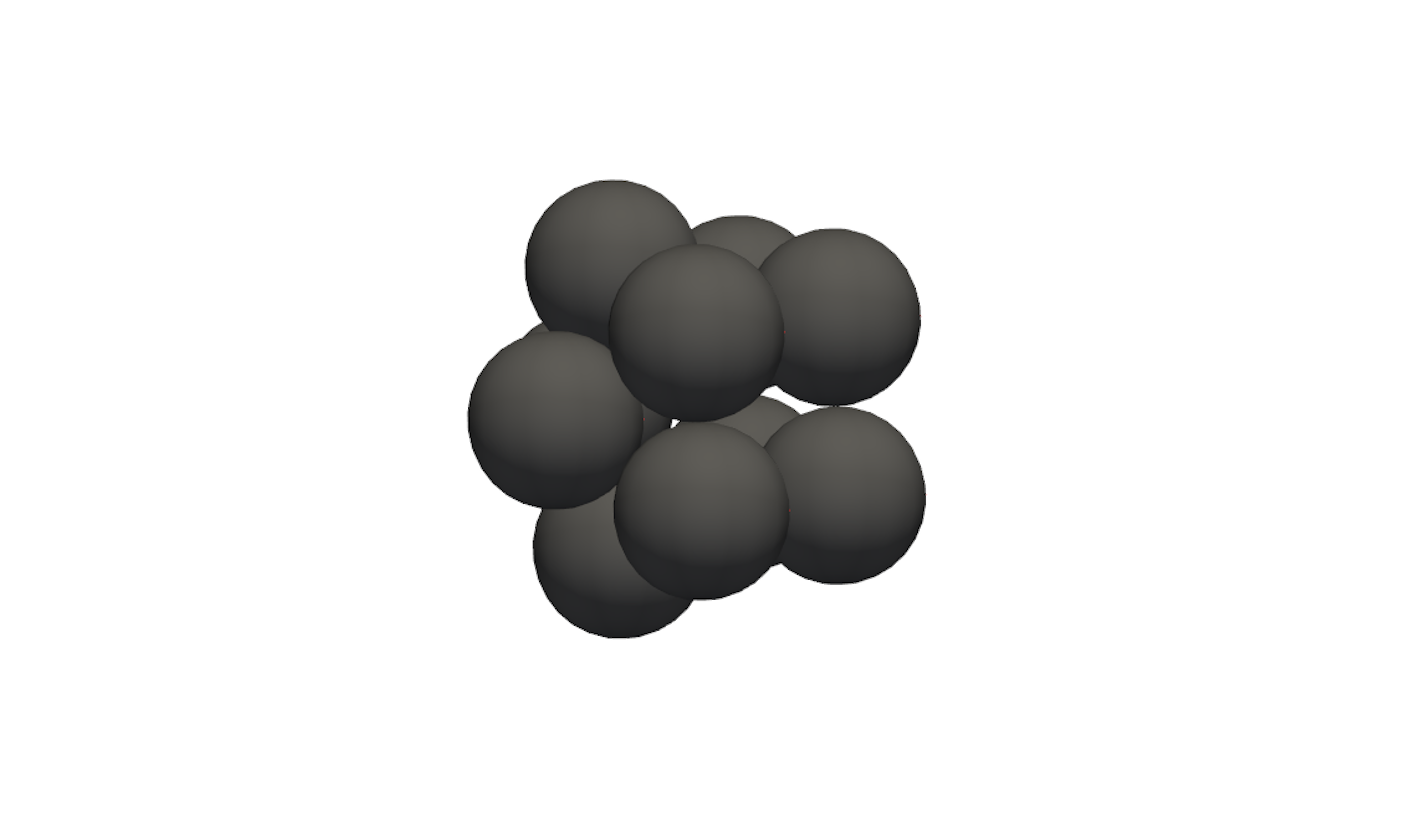
Fragments are made of spherical particles that are not bonded together. The particle
parameters (i.e., positions and radii) are defined via a text file, which name is set
by the obligatory keyword file. The format of this text file is:
x1 y1 z1 r1
x2 y2 z2 r2
...
xn yn zn rn
where n is the total number of spheres. Comments can be made in this file via the ‘#’ character.
After the spheres are read, a Monte Carlo procedure is used to assess everything that is needed for the motion integration: mass, center of mass, and the inertia tensor including its eigensystem. The values calculated are written to the logfile.
Per default, also the bounding sphere of the fiber is determined with a Monte Carlo
approach. By using the keyword bounding_sphere followed by radius and position
this can be done explicitly.
Simulating the breakage of particles requires the usage of the breakparticle/force command.