rolling_friction model cdt
Purpose
A very basic rolling friction model
Syntax
rolling_friction cdt [other model_type/model_name pairs as described here ] settings keyword values
zero or one keyword/value pair may be appended after the keyword settings (after all models are specified)
torsionTorque values = 'on' or 'off'
  on = also the normal, relative rotation (torsion) contributes to the resulting torque
  off = only the tangential, relative rotation contributes to the resulting torque
Associated material properties
Material interaction properties
coefficientRollingFriction( ): Coefficient of rolling friction [–]
Description
This model can be used in the rolling_friction argument of both particle_contact_model and wall_contact_model.
The constant directional torque (CDT) model adds the following torque
contribution  [Nm] to the angular momentum equation:
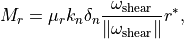
where  [radians/s] is the projection of
  into the shear plane,
  and are the angular velocity
vectors of particles i and j, respectively,
and are the angular velocity
vectors of particles i and j, respectively,
 [N/m] is the normal spring stiffness obtained from the normal contact law,
  [m] is the
the normal overlap,
[m] is the
the normal overlap,
 [m] is the effective radius (see here) and
  indicates the Euclidean norm of a vector.
Torque information:
By default the relative, normal rotation (torsion) is subtracted and does not contribute to the resulting torque. By setting the torsionTorque keyword to ‘on’, the full relative rotation contributes to the rolling friction torque.
Coarse-graining information:
Using coarsegraining in combination with this command might lead to different dynamics or system state and thus to inconsistencies.
Default
torsionTorque = ‘off’
References
Jun Ai, Jian-Fei Chen, J. Michael Rotter, Jin Y. Ooi, Powder Technology, 206 (3), p 269-282 (2011).