rolling_friction model simplistic
Purpose
Extremely simplistic rolling friction model, only for reference (see below).
Syntax
rolling_friction simplistic [other model_type/model_name pairs as described here ]
Associated material properties
Material interaction properties
coefficientRollingFriction( ): Coefficient of rolling friction [–]
Description
This model can be used in the rolling_friction argument of both particle_contact_model and wall_contact_model.
The simplistic rolling friction model adds the following torque
contribution  [Nm] to the angular momentum equation:
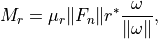
where [–] is the non-dimensional coefficient of rolling friction,
 [N] is the magnitude of the normal force arising from the contact,
  [m] is the
effective radius,
[m] is the
effective radius,  [radians/s] is the angular velocity vector of the particle and
 is the Euclidean norm of a vector.
Warning
Due to the fact that that  of particle i is not equal to
 of particle j, since they have different ,
this model is not recommended for use in a production
run. For a discussion on different rolling friction models see Ai et al. (2011).
For a good basic rolling friction model see the EPSD2 model.
of particle j, since they have different ,
this model is not recommended for use in a production
run. For a discussion on different rolling friction models see Ai et al. (2011).
For a good basic rolling friction model see the EPSD2 model.
Coarse-graining information:
Using coarsegraining in combination with this command might lead to different dynamics or system state and thus to inconsistencies.
References
Jun Ai, Jian-Fei Chen, J. Michael Rotter, Jin Y. Ooi, Powder Technology, 206 (3), p 269-282 (2011).