fix powder/update command
Purpose
Powder/update can be used to simulate extreme plastic compression of particles (e.g. tabletting, uniaxial compression)
Warning
GPU support for this command has not been tested and may not work as expected.Syntax
fix ID group powder/update keyword value
ID, group are documented in fix command
powder/update = style name of this fix command
zero or more keyword/value pairs may be appended
keyword = alpha_relaxation_time or use_hardening or pressure_avg_time or slow_compression
keyword/value = optional keyword-value pair
alpha_relaxation_time keyword = time time = a limiting value that ensures that(the compression ratio) does not change too much over consecutive time steps use_hardening keyword = 'yes', 'no', 'base', 'exponent', 'exponential' no = do not use a hardening law 'yes', 'base', 'exponent', 'exponential' = specific hardening model is activated pressure_avg_time keyword = time time = weight in the sliding average of pressure computation slow_compression keyword = 'yes' or 'no' yes, no = determines whether particles will compress instantaneously elastic_dilation value = 'yes' or 'no' yes, no = determines whether an elastic component in the compression is present non_linear value = 'yes' or 'no' yes, no = determines whether hardening is linear in compression density
Examples
fix powder all powder/update
fix powder all powder/update alpha_relaxation_time 0.5 pressure_avg_time 0.01 use_hardening yes elastic_dilation yes non_linear yes
Associated material properties
Material properties
alphaI_min( ): minimum compression density [
 ]
]compressibility( ): measure on how easy it is to compress a particle []
dilatability( ): coefficient for determining how much a particle dilates []
hardening( ): coefficient for modifying the compressibility for compacted particles. Only required if use_hardening is not no []
compression_exponent( ): exponent for the non-linear hardening model (only required if non_linear yes) []
Description
This fix implements a powder compression model. The current compression state of
each particle is given by a scalar . This scalar can be imagined as a
relative particle density.
All particles are initialized with an equal to which
corresponds to an uncompressed state. If a particle is compressed its
will reach up to a maximum of 1 which corresponds to the fully compressed state.
During a simulation a simplistic instantaneous particle pressure is computed based on the contact forces, i.e.
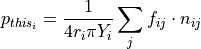
where f are the forces and n the normals between two particles and Y is
the Youngs Modulus. The pressure is computed as sliding average where the
current particle is weighted by  , where
 is the pressure_avg_time parameter, i.e.
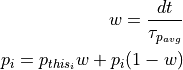
If the previous maximum pressure ( ) exceeds the current particle
pressure, which was initialized as zero, then the particle is compressed
according to the compressibility scalar and the pressure difference, i.e.
) exceeds the current particle
pressure, which was initialized as zero, then the particle is compressed
according to the compressibility scalar and the pressure difference, i.e.
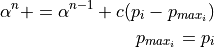
In case the pressure is lower than zero (e.g. when using cohesion) the particle is dilated according to the pressure difference and the dilatability * compressibility scalar, i.e.
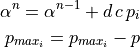
where the change in is negative as  is.
is.
If the keyword elastic_dilation is set, the dilation will also occur if the
pressure is lower than the previously experienced . After such an
elastic dilation the particle can be compressed again. However, in this case it
will be first compressed with a rate equal to dilatability * compressibility
until the all-time maximum is attained again. Then, the normal
compression rate of compressibility is assumed.
Note that in the case of dilation, is actually not set directly. Instead
a target value of is defined. The real value of is then allowed to
slowly approach this target value. The maximum rate of change is governed by the
alpha_relaxation_time value that is specified with the fix. Within one
time-step is allowed to change by dt/alpha_relaxation_time, thus this
parameter specifies the time scale over which relaxes to its uncompressed
minimum value. In order to apply the same algorithm to the compression case, the
slow_compression needs to be set. This option will also use the
alpha_relaxation_time as time scale to allow particles to compress over
several time steps.
In case use_hardening is activated, the compressibility parameter is varied
according to . There are three different models available. For
use_hardening yes or use_hardening base the model is
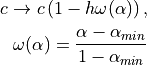
with a hardening set to 0.5 this would imply that the compressibility is only
half as large if the particles are fully compressed. If additionally
non_linear is activated a compression exponent alters the equation
above to read

This allows for a better control over the loading curve.
The second hardening model can be activated using use_hardening exponent, where the linear model is given by

and the non-linear version is

The non-linear model in particular is not recommended as the hardening parameter is rather useless as it is usually chosen to be close to one.
The third and final model can be activated with use_hardening exponential, where the linear model reads

and the non-linear version is

Restart, fix_modify, output, run start/stop
No information about this fix is written to binary restart files.
fix_modify cannot be used on the parameter of this fix.
This command adds a per-particle pressure vector, which can be accessed via
id_pressure. Its components are average (index 1), max_lower (index 2)
and max_lower (index 3). These can be accessed via id_pressure.component_name
or id_pressure[index], and will be output automatically as a particle property
via the output_settings command.
Restrictions
None.
Default
alpha_relaxation_time = 0.01, pressure_avg_time = 0.01, use_hardening = ‘no’, slow_compression = ‘no’