tangential model adhesive_elasto_plastic
Purpose
The tangential model to go with the adhesive_elasto_plastic normal model (Edinburgh model).
Syntax
tangential adhesive_elasto_plastic [other model_type/model_name pairs as described here ] settings keyword values
zero or more keyword/value pairs may be appended after the keyword settings (after all models are specified)
disableTangentialWhenBonded values = 'on' or 'off'
  on = no tangential forces between bonded particles
  off = tangential forces between bonded particles
Associated material properties
Material properties
youngsModulus( ): The Youngs Modulus of a material i.e. its stiffness [pressure]
poissonsRatio( ): The Poisson’s ratio i.e. the ratio of transverse to axial strain [–]
Material interaction properties
coefficientRestitution( ): The coefficient of restitution bewteen two materials [–]
coefficientFriction( ): The coefficient of friction acting between two materials [–]
coefficientSlidingFriction( ): The coefficient of sliding friction acting between two materials [–]
springPowerValue( ): power value for loading and unloading springs [–]
pullOffForce( ): constant pull of force (usually negative) [force]
tangentialStiffnessMultiplier( ): factor relating the normal and tangential stiffnesses [–]
Description
This tangential model can only be used with the adhesive_elasto_plastic normal model.
The tangential force  [force] is given by

where  [force/length] is the tangential stiffness,
  [length] is the tangential overlap (tangential velocity integrated over time),
 [force] is the damping component of the tangential force,
is the non-dimensional coefficient of sliding friction,
[force] is the damping component of the tangential force,
is the non-dimensional coefficient of sliding friction,  [force] is the hysteresis force obtained from the
normal model and
[force] is the hysteresis force obtained from the
normal model and  [force] is the Coulomb limit force.
The tangential stiffness is given by

where  [pressure] and
  [length] are the effective shear modulus and particle radius, respectively,
  [length] is the normal overlap
and is a non-dimensional scaling factor.
[length] is the normal overlap
and is a non-dimensional scaling factor.
The Coulomb limit force is given by

where all parameters on the r.h.s. of the equation are obtained from the normal model formulation. The damping component of the tangential force is calculated by the following equation
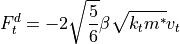
where the value of the  parameter is also obtained from the normal model formulation,
 [mass] is the effective particle mass
and
[mass] is the effective particle mass
and  [length/time] is the relative tangential velocity of the particle pair.
Default
disableTangentialWhenBonded = ‘off’
(Morrissey) John P. Morrissey, Ph.D. Thesis, University of Edinburgh (2013)