compute erotate/asphere command
Syntax
compute ID group-ID erotate/asphere general_keyword general_values
Examples
compute 1 all erotate/asphere
Description
Define a computation that calculates the rotational kinetic energy of a group of aspherical particles. The aspherical particles can be ellipsoids, or line segments, or triangles. See the atom_style and read_data commands for descriptions of these options.
For all 3 types of particles, the rotational kinetic energy is computed as
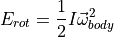
where  is the inertia tensor for the multisphere body, and
 is its angular velocity vector which is computed
from the angular momentum if needed.
is its angular velocity vector which is computed
from the angular momentum if needed.
Warning
For 2d models, ellipsoidal particles are treated as ellipsoids, not ellipses, meaning their moments of inertia will be the same as in 3d.
Output info:
This compute calculates a global scalar (the KE). This value can be used by any command that uses a global scalar value from a compute as input. See Section_howto 15 for an overview of Aspherix® output options.
The scalar value calculated by this compute is “extensive”. The scalar value will be in energy units.
Restrictions
This compute requires that ellipsoidal particles atoms store a shape and quaternion orientation and angular momentum as defined by the atom_style ellipsoid command.
This compute requires that line segment particles atoms store a length and orientation and angular velocity as defined by the atom_style line command.
This compute requires that triangular particles atoms store a size and shape and quaternion orientation and angular momentum as defined by the atom_style tri command.
All particles in the group must be finite-size. They cannot be point particles.
Related commands: none
Default: none