 Home
Homeenable_dem_drag command
Purpose
Command for adding a drag force to particles in a coupled CFD-DEM simulation. The command requires three types of user input: (i) the selection of a drag correlation, (ii) use of a coupling command enable_cfd_coupling (iii) other numerical settings. A closely related command is enable_one_way_coupling, which is designed to calculate drag force of particles in a pure DEM simulation.
Warning
GPU support for this command has not been tested and may not work as expected.Syntax
enable_dem_drag mode dragforce dragmodel_settings other_settings
mode dragforce       (mandatory) keyword/style pair
dragmodel_settings   (mandatory) settings for dragmodel selection/definition see section Dragmodel Specific Syntax
other_settings       (optional) settings for other definitions see section Other Syntax
Dragmodel Specific Syntax:
model drag_correlation
This command adds the following drag force to particles:
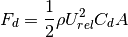
where  is the particle’s cross-sectional area,
  is the relative
velocity of particle and fluid,
is the relative
velocity of particle and fluid,  is the fluid density.
Depending on the drag_correlation
is the fluid density.
Depending on the drag_correlation  is calculated differently, see the definitions in enable_one_way_coupling/Dragmodel Specific Syntax
Optionally a rotational torque can be calculated:

where  is the particle rotation (neglecting fluid rotation),
  is the
kinematic fluid_viscosity of the fluid, is the fluid density and
is the
kinematic fluid_viscosity of the fluid, is the fluid density and  the radius of the volume equivalent sphere.
By default the rotational torque is neglected, unless the user specifies differently),
see section enable_one_way_coupling command.
the radius of the volume equivalent sphere.
By default the rotational torque is neglected, unless the user specifies differently),
see section enable_one_way_coupling command.
For some drag models the option use_point_cloud can be set. This options allows to calculate the drag / lift / torque not only for the centre of mass of a particle, but for a point cloud. Therefore a point_cloud_file is defined in the particle’s frame of reference. The points must be defined relative to the centre of mass of the clump, and that the clump must be defined so that the x,y,z are aligned with its eigenvectors. For each of the N points the drag F / lift L / torque T of point i is calculated separately using the local fluid velocity and then summed to the total particle force.
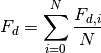


The torque therefore has three components: the pitch torque, the torque due to velocity gradients seen by a non-spherical particle and the rotational torque.
Depending on use_voidage_correction, which is true by default, the dragforce acting on each particle  is scaled to account for the presence of other particles.
This is known as voidage correction or swarm effect.
is scaled to account for the presence of other particles.
This is known as voidage correction or swarm effect.


All components of the force: drag, lift and pitch torque (if the drag model provides that) are scaled equally.


Other Syntax:
Please find other numerical settings in enable_one_way_coupling command.
Dependencies & Prerequisites:
All required fluid information (viscosity, density and velocity) are received from CFD. For communication between CFD and DEM, the command enable_cfd_coupling must be defined before this command. On CFD side, the force model DEMbasedDrag and the use of modelType B is required.
Examples
enable_cfd_coupling
enable_dem_drag mode dragforce model Schiller_Naumann region water
Restrictions
A particle_template must be defined before this command.