pair_style stokes_dynamics command
Warning
GPU support for this command has not been tested and may not work as expected.Syntax
pair_style stokes_dynamics keyword value
zero or more keywords/value pairs to be appended
keyword = cut_off_distance or update_every or clumps_only or visc or add_force or relative_tolerance or region or max_iter or algorithm
cut_off_distance value = cut_off_distance
  cut_off_distance = cut off distance at which particles can see each other
clumps_only value = yes or no
  particles can see particles only from the same clump (multi-sphere or bonded object)
update_every value = update_every
  update_every = frequency (in time steps) at which the stokesian forces are updated
visc value = muf
  muf = coefficient of fluid viscosity
region value = reg
  reg = region where the pair style is applied
add_force value = yes or no
  stokesian forces are integrated within the pair style
relative_tolerance value = relTol
  relTol = termination criterion for the iterative procedure
max_iter value = maxIter
  maxIter = maximum number of iterations
algorithm value = 1 or 2
  algorithm to use
Examples
pair_style stokes_dynamics cut_off_distance 1e-2 clumps_only yes update_every 10 visc 1e-2 add_force yes relative_tolerance 1e-3 max_iter 100 algorithm 1
pair_coeff * *
Description
Style stokes_dynamics computes the hydrodynamic force acting on each single sphere. The hydrodynamic force F_hydro acting on each single sphere i located in region reg is based on Stokes drag law. The hydrodynamic interaction is included via the velocity perturbation, v’_j, as per (1), from N−1 neighbour spheres located within the cut-off radius cut_off_distance in region reg. The perturbation velocity v’_j is given by (2), where F_j is the total force acting on particle j, excluding the hydrodynamic force.
![\mathbf{F}_i^\mathrm{Hydro} &= 6 \pi \eta a \left[ \left( \mathbf{V}_i^\infty + \sum_i^N \mathbf{v}_j' \right) - \mathbf{v}_i \right] \\
\mathbf{v}_j' &= \sum_j^N \mathbf{\Omega}_{ij} \cdot \mathbf{F}_j \\
\mathbf{\Omega}_{ij} &= \frac{1}{8 \pi \eta} \left( \frac{\delta}{\left|r_{ij}\right|} + \frac{r_{ij} r_{ij}}{\left|r_{ij}\right|^3} \right) + \frac{2 a^2}{8 \pi \eta} \left( \frac{\delta}{3 \left|r_{ij}\right|^3} + \frac{r_{ij} r_{ij}}{\left|r_{ij}\right|^5} \right)](_images/math/7396307a8160e1be9510b3858034df41bed93677.png)
In (Joung) it is assumed that the system is inertialess, i.e. hydrodynamic forces are in equilibrium with other non-hydrodynamic forces, for example contact forces, gravity, etc. Hence, in current implementation Eq. (2) is replaced by the following equivalent Eq. (4).
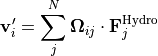
Eq. (1) and (3) are iterated together until convergence with relative tolerance relTol is achieved. The total number of iterations is limited by maxIter. The algorithm is called every update_every updating the perturbation velocities. However, the force F_hydro is updated every DEM time step using the actual particle velocity and the latest perturbation velocity.
If clumps_only is set to yes, then neighbour spheres from the same clump (multi-sphere or bonded object) are considered. Otherwise the algorithm makes no distinction whether two spheres belong to the same object or not.
Pair style stokes_dynamics can be used in both DEM and CFD-DEM cases. In case of DEM, the fluid velocity is considered to be constantly zero. It is also mandatory to specify the coefficient of viscosity. add_force should be set to yes in order to have F_hydro be summed explicitly with the total force inside pair style stokes_dynamics.
In case of a CFD-DEM simulation, the local fluid velocity and coefficient of viscosity are used. In this case, add_force should be set to no and appropriate force model should be enabled on CFD side in order to enable two way coupling. If custom coefficient of viscosity is defined by keyword visc, then the local coefficient of viscosity will be overwritten by constant value.
Restrictions
none
Default
update_every = 1 clumps_only = no max_iter = 100 add_force = no algorithm = 1
(Joung) Clinton G. Joung, Dynamic simulation of arbitrarily shaped particles in shear flow, Rheol Acta (2006) 46: 143–152. DOI 10.1007/s00397-006-0110-6