fix continuum/weighted command
Warning
GPU support for this command has not been tested and may not work as expected.Warning
This command is deprecated, please use calculate stress and/or the calculate strain commandsinstead
Syntax
fix ID group-ID continuum/weighted keyword value
ID, group-ID are documented in fix command
continuum/weighted = style name of this fix command
zero or one keyword/value pairs may be appended
keyword = {kernel_radius, kernel_type, compute}
  kernel_radius value = radius
    radius = Radius of the smoothing kernel
  kernel_type value = type
    type = Type of kernel {Top_Hat, Gaussian, Wendland}
  compute value = compute-type
    compute-type = Which tensor(s) to compute {stress, strain, stress_strain}
Examples
fix 1 all continuum/weighted kernel_radius 0.01 compute stress
fix 1 all continuum/weighted kernel_radius 0.2 kernel_type Wendland compute stress_strain
Description
If the compute keyword is set to either stress or stress_strain this fix calculates the complete stress tensor at each particle according to Goldhirsch. The formula is given by:

where
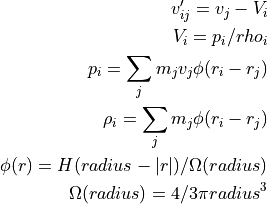
and
 is the velocity vector
 force acting from j onto i
 vector from center of j to center of i
 mass of particle i
 is the Heaviside function
In case solid boundaries are present the last term is given according to Weinhart et al. by

where

and  is the contact point of particle j with wall k and the sum runs over all particles j and walls k.
If the compute keyword is set to either strain or stress_strain this fix calculates the incremental strain tensor at each particle according to Zhang et al. The formula is given by

where most of the variables are given as above and additionally
 is the a-th component of the velocity difference between i and j
 is the a-th component of the gradient of phi with respect to
dt is the time-step size
The following three kernel types are implemented at the moment:
Top_Hat - Top hat kernel

Gaussian - Gaussian kernel

Wendland - Quinitic radial polynomial

Note that all kernels are equal to zero if r > kernel_radius (this implies a cut-off for the Gaussian). The constants a (different for each kernel) are chosen such that the integral of w over the ball of radius kernel_radius is equal to one. In case of the top hat kernel a_t is equal to the volume of this sphere.
Restart, fix_modify, output, run start/stop
No information about this fix is written to binary restart files. None of the fix_modify options are relevant to this fix.
The values can be dumped by using the f_stressTensor_[i] and/or f_strainTensor_[i] (0 <= i <= 8) values in dump commands
No parameter of this fix can be used with the start/stop keywords of the run command.
Restrictions
Strain computation does not work with the default TOP_HAT kernel as its derivative is zero.
In order to ensure that all particles in the kernel radius are considered make use of the neigh_modify command. In particular the contact_distance_factor which should be set such that
2*min(radius)*contact_distance_factor >= kernel_radius